We use Google Analytics to understand how visitors use this site. Analytics cookies are only activated with your consent. For details, read our Privacy Policy.
Profile lensThe same player, read from a different angle.
Athletic80
Acceleration
78
Pace
82
Agility
76
Strength
83
Balance
78
Jumping
80
Stamina
84
Fitness
80
Technical76
Dribbling
75
Short Passing
75
Long Passing
78
Finishing
63
Shot Accuracy
64
Shot Power
80
Shooting Technique
72
Heading
79
Tackling
79
Crossing
76
Free Kick
62
Penalties
64
First Touch
78
Mental76
Composure
76
Aggression
77
Consistency
77
Creativity
65
Leadership
73
Work Rate
80
Tactical77
Vision
74
Off the Ball
71
Defensive Positioning
76
Teamwork
85
Anticipation
80
Marking
78
Attacking71
Crossing
76
Finishing
63
Heading Accuracy
79
Shot Accuracy
64
Off the Ball
71
Technique73
Dribbling
75
Free Kick
62
Short Passing
75
Long Passing
78
First Touch
78
Shot Technique
72
Movement79
Acceleration
78
Pace
82
Agility
76
Balance
78
Physicality81
Shot Power
80
Jumping
80
Stamina
84
Strength
83
Fitness
80
Defending78
Marking
78
Tackling
79
Def. Positioning
76
Mentality & Game Reading75
Aggression
77
Composure
76
Penalties
64
Vision
74
Leadership
73
Work Rate
80
Teamwork
85
Anticipation
80
Consistency
77
Creativity
65
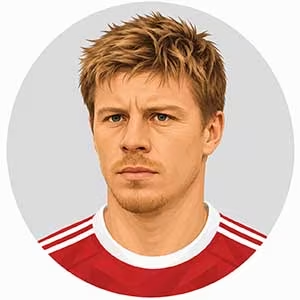
Denmark - Right BackHelveg, Thomas
Silvio Berlusconi had a habit of skewering his own players in public when a performance displeased him, and in January 2001, after Thomas Helveg came off the bench in a 2-2 derby draw, he reached for a fable: the deaf lion who ruins a jungle concert by mauling the violinist, oblivious to the harmony everyone else can hear. Helveg read the comparison in the papers and, by his own account decades later, was shaken by it for days — dark days, he called them — and never developed a real relationship with Berlusconi afterward beyond a passing hello at Milanello. Four months later, in the return derby, Milan beat Inter 6-0 with a defense that let nothing through, Helveg among the heroes, and the dressing room afterward was, in his words, seventh heaven. He still brings up the deaf lion jibe when asked about his career. He has never quite let it go.
Born in Odense in 1971, Helveg began and ended his career at his hometown club, winning the Danish title there as a teenager before Udinese signed him in 1993. Under Alberto Zaccheroni's evolving 3-4-3, he became the attacking full-back who made the system work, bombing forward from right-back with crosses and driving runs that earned him the nickname pure dynamite in Italy, while covering defensively with equal reliability — a genuinely two-way wing-back before the role had a settled name in Serie A. He followed Zaccheroni to Milan in 1998, winning the Scudetto in his first season, then a Coppa Italia and Champions League across five years at the club, before a final Italian season at Inter — reunited with Zaccheroni for a third time — produced little impact, and stints at Norwich City and Borussia Mönchengladbach were undercut by injuries, including a serious Achilles tear. For Denmark he won 108 caps, played five major tournaments across three different national coaches, and scored the goal that sealed a famous 4-1 win over Nigeria at the 1998 World Cup, Denmark's best-ever finish. He inherited the captaincy in 2004.
His limitations were tied closely to physical wear and to fit with a particular coaching setup. Helveg's attacking instincts occasionally left gaps behind him that his own defensive discipline usually, but not always, managed to cover, and younger, more technical Italian midfielders like Gennaro Gattuso and Massimo Ambrosini gradually squeezed his playing time at Milan as his early thirties arrived. Injuries accumulated in his final European seasons, robbing him of the running that had defined his entire game, and outside Zaccheroni's specific systems — first at Udinese, then Milan, then briefly Inter — his effectiveness noticeably dropped, suggesting a player whose value depended heavily on a tactical framework built partly around him rather than one he could impose on any team.
Temperamentally he comes across, across a wide range of interviews given long after retirement, as even-tempered, warm and slow to hold grudges — except for the one grudge he never resolved. He described his first day at Milanello with open, almost childlike wonder, and credited Paolo Maldini personally with teaching him, over a coffee, the professional standard the club expected. He built lasting friendships inside the dressing room — golf outings with Oliver Bierhoff, Mauro Tassotti, Roberto Donadoni and Andriy Shevchenko — and approached a coach he'd been warned to fear, Giovanni Galeone at Udinese, with an open mind that found instead a funny, slightly eccentric, deeply likeable man who insisted on joining training matches himself. He remained emotionally loyal to Odense throughout a career built elsewhere, calling it the club his heart actually belonged to even while representing two of Italian football's grandest names, and returned there after retiring to work in scouting and later with the Danish federation. Physical restlessness defined him as much off the pitch as on it — he chose Bruce Springsteen's "Born to Run" as the song that captured him best, and in his late forties was still constantly moving, cycling everywhere around Odense, competing in charity rides along Tour de France routes with former Denmark teammate Martin Jørgensen as advocates for multiple sclerosis research. Well-liked by supporters at every club he played for, defined by tireless physical effort and genuine warmth, Helveg carried one unhealed wound from a single cruel remark inside an otherwise contented and well-adjusted career.


 All Time DenmarkNT