We use Google Analytics to understand how visitors use this site. Analytics cookies are only activated with your consent. For details, read our Privacy Policy.
Profile lensThe same player, read from a different angle.
Athletic76
Acceleration
89
Pace
84
Agility
87
Strength
74
Balance
77
Jumping
66
Stamina
72
Fitness
60
Technical87
Dribbling
93
Short Passing
87
Long Passing
91
Finishing
83
Shot Accuracy
81
Shot Power
94
Shooting Technique
90
Heading
54
Tackling
33
Crossing
92
Free Kick
91
Penalties
84
First Touch
95
Mental72
Composure
85
Aggression
66
Consistency
64
Creativity
93
Leadership
68
Work Rate
64
Tactical76
Vision
85
Off the Ball
84
Defensive Positioning
30
Teamwork
61
Anticipation
74
Marking
30
Player Traits
Attacking79
Crossing
92
Finishing
83
Heading Accuracy
54
Shot Accuracy
81
Off the Ball
84
Technique91
Dribbling
93
Free Kick
91
Short Passing
87
Long Passing
91
First Touch
95
Shot Technique
90
Movement84
Acceleration
89
Pace
84
Agility
87
Balance
77
Physicality73
Shot Power
94
Jumping
66
Stamina
72
Strength
74
Fitness
60
Defending31
Marking
30
Tackling
33
Def. Positioning
30
Mentality & Game Reading74
Aggression
66
Composure
85
Penalties
84
Vision
85
Leadership
68
Work Rate
64
Teamwork
61
Anticipation
74
Consistency
64
Creativity
93
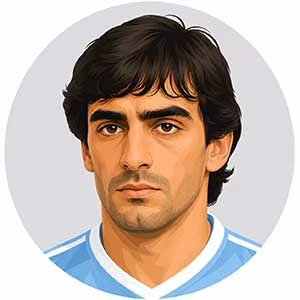
Uruguay - ForwardRecoba, Álvaro
August 31, 1997, at a sun-drenched San Siro, was supposed to be the coronation of Ronaldo Il Fenomeno on his Inter Milan debut, but an introverted 21-year-old Uruguayan off the bench stole the entire universe with two otherworldly left-footed strikes from another dimension. Álvaro Alexander Recoba Rivero, affectionately known worldwide as El Chino, possessed the most aesthetically sublime, devastating, and technically pure left foot modern football has ever seen. Operating as a free-roaming second striker, number ten, or wide playmaker, Recoba made the impossible look routine: generating curling trajectories that defied basic laws of physics from forty yards, curling direct free-kicks into top corners with zero backlift, and scoring directly from corner kicks (olímpicos) with casual arrogance. Over a decade at Inter under Massimo Moratti’s paternal adoration—alongside an explosive loan spell at Venezia where he single-handedly saved the club from relegation in 1999—Recoba won two Scudetti, two Copas Italia, two Supercoppas, and the 1997–98 UEFA Cup, later capturing titles in Uruguay with Nacional. Across 68 caps and 11 goals for La Celeste, he led Uruguay to the 2002 World Cup, famously scoring an iconic solo goal against Senegal.
The tragedy of Recoba’s career, however, lay in his total and unapologetic rejection of modern athletic discipline. His defensive tracking was non-existent, his tactical application was wildly inconsistent, and his match fitness was notoriously fragile; he could deliver thirty minutes of extraterrestrial genius that dismantled an entire Serie A backline, only to disappear into complete, lazy apathy for the next four weeks. Recurring hamstring strains, chronic calf problems, and an aversion to intense cardiovascular training prevented him from ever sustaining a full, dominant 34-match league campaign as an undisputed weekly starter.
Enigmatic, carefree, and playing football strictly for his own aesthetic amusement, Recoba was the quintessential romantic flawed genius. He did not care for tactical dogmatism, training ground micromanagement, or the relentless pressure of being the world’s highest-paid player in the early 2000s; he simply wanted the ball at his left foot so he could paint a masterpiece whenever the mood struck him. On the pitch, his body language was languid and unhurried: strolling between the lines with a sleepy expression before suddenly exploding into a sequence of dazzling stepovers and trajectory-bending strikes that left 80,000 fans breathless. Inside the Inter dressing room, he was an universally beloved, gentle figure whom teammates like Javier Zanetti and Christian Vieri forgave for his lack of defensive sacrifice because they knew his left boot could win any match out of nothing. Referees found him gentle and polite, while generations of goalkeepers were left traumatized by his dipping set-pieces, leaving an eternal legacy as the ultimate, unrepeatable cult icon of pure South American footballing wizardry.