We use Google Analytics to understand how visitors use this site. Analytics cookies are only activated with your consent. For details, read our Privacy Policy.
Profile lensThe same player, read from a different angle.
Athletic84
Acceleration
85
Pace
85
Agility
85
Strength
71
Balance
79
Jumping
77
Stamina
95
Fitness
93
Technical77
Dribbling
77
Short Passing
76
Long Passing
81
Finishing
68
Shot Accuracy
64
Shot Power
84
Shooting Technique
70
Heading
71
Tackling
75
Crossing
79
Free Kick
69
Penalties
72
First Touch
76
Mental80
Composure
74
Aggression
82
Consistency
90
Creativity
70
Leadership
70
Work Rate
88
Tactical77
Vision
74
Off the Ball
75
Defensive Positioning
71
Teamwork
90
Anticipation
77
Marking
73
Player Traits
Attacking71
Crossing
79
Finishing
68
Heading Accuracy
71
Shot Accuracy
64
Off the Ball
75
Technique75
Dribbling
77
Free Kick
69
Short Passing
76
Long Passing
81
First Touch
76
Shot Technique
70
Movement84
Acceleration
85
Pace
85
Agility
85
Balance
79
Physicality84
Shot Power
84
Jumping
77
Stamina
95
Strength
71
Fitness
93
Defending73
Marking
73
Tackling
75
Def. Positioning
71
Mentality & Game Reading79
Aggression
82
Composure
74
Penalties
72
Vision
74
Leadership
70
Work Rate
88
Teamwork
90
Anticipation
77
Consistency
90
Creativity
70
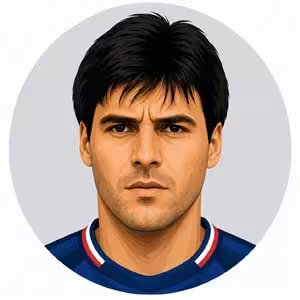
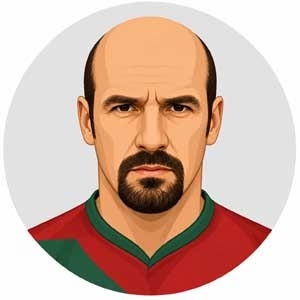
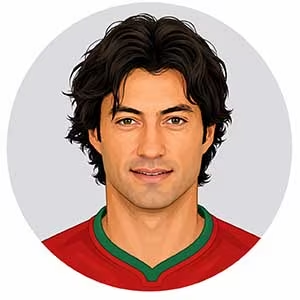
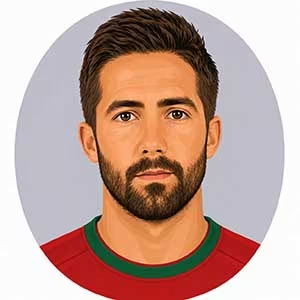
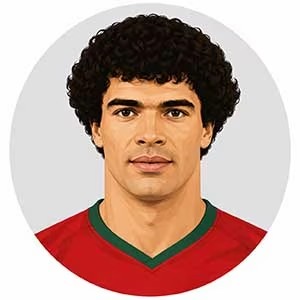
Portugal - Right BackJoão Pinto
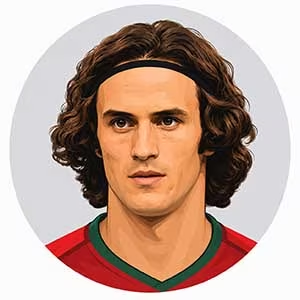
On 27 May 1987, João Pinto walked into the Praterstadion in Vienna wearing Porto’s captain’s armband for the European Cup final against Bayern Munich. Porto were missing Fernando Gomes and entered the final as outsiders. With thirteen minutes remaining they were still 1–0 down. Rabah Madjer equalised, Juary scored three minutes later, and João Pinto eventually lifted the European Cup above his head. The photograph captures him better than a spectacular individual action would have done. He had spent his entire senior career at Porto, survived changes of coaches and generations, and become captain not through theatrical authority but through permanence, competitive discipline and the repeated reliability of doing the same difficult job.
João Pinto was a right-back whose game combined defensive aggression, stamina and positional reliability with enough attacking ambition to support Porto’s right side continuously. Around 1.73 metres tall, he was compact and quick rather than physically imposing, defending through anticipation, acceleration and close engagement with opposing wingers. He tackled assertively, rarely gave wide attackers uncontested space to turn and recovered quickly when the defensive line was broken. In possession he was technically secure without being a creative organiser. He advanced when space appeared, overlapped to provide width and delivered from the flank, but generally understood when the more valuable contribution was to maintain defensive balance behind Porto’s attacking players. His extraordinary continuity became a tactical quality in itself. Developed entirely within Porto’s system, he made his senior debut in 1981 and never represented another professional club. Over sixteen first-team seasons he accumulated more than 500 official appearances and won nine Portuguese league titles, four Portuguese Cups and eight Super Cups. As captain he lifted the 1987 European Cup after the victory over Bayern, followed later that year by both the European Super Cup and Intercontinental Cup. He remained part of Porto’s transformation from a major Portuguese club into a persistent European presence and was still winning championships well into the 1990s. For Portugal he earned 70 caps between 1983 and 1996, appearing at Euro 1984, where Portugal reached the semi-finals, and the 1986 World Cup. His international longevity mirrored his club career: rather than experiencing a short athletic peak, João Pinto repeatedly adapted his defensive positioning as experience gradually replaced some of his early physical explosiveness.
That consistency should not disguise his limitations. João Pinto was not an expansive playmaker from full-back and could be less influential when a team required its wide defender to become a primary source of creativity against a deep block. His height also created an obvious disadvantage against opponents targeting the far post aerially, particularly when defensive rotations left him matched against larger forwards. His assertive preference for engaging wingers early could become dangerous when the first intervention failed, because space then opened behind him. As his pace declined, those situations required increasingly conservative positioning. He was also most naturally suited to organised teams in which his judgement about when to advance was supported by reliable midfield coverage. His discipline made him adaptable within structure, but he was less suited to tactical environments built around constant positional improvisation.
Psychologically, João Pinto’s career is defined most strongly by continuity without passivity. Remaining at one club for sixteen senior seasons could suggest comfort, but his behaviour occurred inside an increasingly competitive Porto environment in which places and trophies were repeatedly contested. He survived that competition by maintaining standards rather than using seniority as protection. His captaincy developed from the same pattern. Teammates and club accounts consistently present him as a reference point inside the group, but not as a player who needed public confrontation or elaborate gestures to establish authority. The 1987 European Cup final is revealing because Porto spent most of the match behind. There is no record of João Pinto abandoning his defensive responsibility in search of a heroic intervention; he continued performing his role while the attacking players changed the score. Once victory arrived, he accepted the symbolic responsibility of lifting the trophy without having needed to become the protagonist of the comeback. His competitive aggression was nevertheless real. He defended closely, challenged firmly and operated comfortably in matches of high physical intensity, but surviving evidence does not show a recurrent pattern of retaliation, referee confrontation or disciplinary collapse under provocation. Physical hostility appears to have increased the demands of his task rather than changed his emotional behaviour. His relationship with collective identity was considerably stronger. Porto was not simply his employer: his entire professional playing career became attached to the institution, and after retirement he continued working within the club structure. That attachment appears to have increased responsibility rather than entitlement. Internationally he experienced a very different test during the chaotic 1986 World Cup campaign, when disputes over conditions and organisation destabilised the Portuguese squad. João Pinto remained part of the collective protest surrounding the players but was not identified as one of its principal public agitators, fitting a broader pattern of solidarity without strong individual theatricality. Major occasions likewise did not appear to produce avoidance. He captained Porto through European finals and continued to accept defensive responsibility as the club’s expectations increased. His leadership was therefore normative and stabilising: repeat the standard, protect the structure, support the group and intervene when the role requires it. João Pinto was not emotionally detached; his identification with Porto was profound. What distinguished him was that belonging rarely needed to become spectacle before it became behaviour.


 All Time PortugalNT