We use Google Analytics to understand how visitors use this site. Analytics cookies are only activated with your consent. For details, read our Privacy Policy.
Profile lensThe same player, read from a different angle.
Athletic75
Acceleration
71
Pace
74
Agility
76
Strength
74
Balance
80
Jumping
72
Stamina
84
Fitness
68
Technical83
Dribbling
81
Short Passing
88
Long Passing
90
Finishing
65
Shot Accuracy
68
Shot Power
85
Shooting Technique
83
Heading
66
Tackling
79
Crossing
82
Free Kick
81
Penalties
71
First Touch
87
Mental80
Composure
89
Aggression
76
Consistency
72
Creativity
83
Leadership
79
Work Rate
77
Tactical81
Vision
87
Off the Ball
75
Defensive Positioning
78
Teamwork
85
Anticipation
77
Marking
74
Player Traits
Attacking71
Crossing
82
Finishing
65
Heading Accuracy
66
Shot Accuracy
68
Off the Ball
75
Technique85
Dribbling
81
Free Kick
81
Short Passing
88
Long Passing
90
First Touch
87
Shot Technique
83
Movement75
Acceleration
71
Pace
74
Agility
76
Balance
80
Physicality77
Shot Power
85
Jumping
72
Stamina
84
Strength
74
Fitness
68
Defending77
Marking
74
Tackling
79
Def. Positioning
78
Mentality & Game Reading80
Aggression
76
Composure
89
Penalties
71
Vision
87
Leadership
79
Work Rate
77
Teamwork
85
Anticipation
77
Consistency
72
Creativity
83
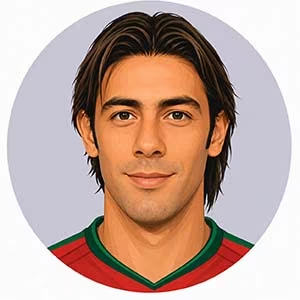
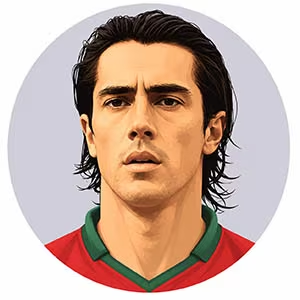
Portugal - Defensive MidfielderSousa, Paulo
Paulo Manuel Carvalho de Sousa was the quintessential deep-lying orchestrator of European football’s mid-1990s tactical peak: a cerebral regista who dictated the tempo of matches with immaculate spatial awareness, textbook passing range, and a pristine positional intelligence that made physical sprinting entirely unnecessary.
Operating at the base of the midfield, Sousa was the supreme architect of transitional play. He excelled at receiving the ball with his back to goal, escaping pressing traps with a single body feint, and instantly accelerating the team's build-up through piercing, progressive ground passes between the lines. After lifting the 1990–91 Primeira Liga with Benfica and crossing the Lisbon divide to win the 1995 Taça de Portugal with Sporting CP, he reached the global stratosphere in Marcello Lippi’s dominant Juventus. In Turin, he orchestrated the 1994–95 Scudetto and the 1995–96 UEFA Champions League triumph in Rome, before pulling off the historic feat of switching to Borussia Dortmund and winning a second consecutive Champions League title in 1996–97—defeating his former club Juventus in the Munich final. He later brought his cultured vision to Inter Milan, Parma, and Panathinaikos. For Portugal, across 52 caps, he was the intellectual midfield fulcrum of the legendary Geração de Ouro, starring at Euro '96 and Euro 2000 alongside Rui Costa and Luís Figo, after winning the 1989 FIFA World Youth Championship in Riyadh.
That sublime footballing intellect, however, was perpetually haunted by devastating physical fragility. Sousa lacked explosive linear sprint speed and possessed fragile knee joints; a brutal succession of chronic patellar tendinitis, cartilage wear, and recurring muscular breakdowns severely compromised his prime after 1997, robbing him of the lateral mobility required to survive high-intensity transition battles. Furthermore, his defensive contributions were strictly positional containment, requiring combative midfield destroyers like Didier Deschamps, Antonio Conte, or Paul Lambert around him to handle physical friction and ball recovery.
Aristocratic, deeply analytical, and carrying himself with the poised gravitas of a chess grandmaster, Sousa approached football as pure intellectual art. He was allergic to mindless long-ball tactics, expecting immaculate tactical synchronization from everyone around him and expressing visible frustration when teammates failed to read passing geometry. On the pitch, his body language was calm, upright, and authoritative: scanning the entire pitch before the ball arrived, directing passing lanes with subtle hand gestures, and striking passes off either boot with effortless grace. Inside the Juventus, Dortmund, and Portuguese national team dressing rooms, his tactical wisdom was revered by managers and peers alike, cementing an enduring legacy as one of the most aesthetically refined and tactically brilliant deep-lying playmakers in European history.


 All Time PortugalNT