We use Google Analytics to understand how visitors use this site. Analytics cookies are only activated with your consent. For details, read our Privacy Policy.
Profile lensThe same player, read from a different angle.
Athletic80
Acceleration
77
Pace
76
Agility
77
Strength
82
Balance
80
Jumping
83
Stamina
81
Fitness
85
Technical83
Dribbling
78
Short Passing
76
Long Passing
75
Finishing
91
Shot Accuracy
90
Shot Power
80
Shooting Technique
77
Heading
88
Tackling
38
Crossing
70
Free Kick
79
Penalties
87
First Touch
81
Mental79
Composure
84
Aggression
75
Consistency
82
Creativity
74
Leadership
74
Work Rate
73
Tactical81
Vision
71
Off the Ball
88
Defensive Positioning
33
Teamwork
72
Anticipation
92
Marking
35
Player Traits
Attacking85
Crossing
70
Finishing
91
Heading Accuracy
88
Shot Accuracy
90
Off the Ball
88
Technique78
Dribbling
78
Free Kick
79
Short Passing
76
Long Passing
75
First Touch
81
Shot Technique
77
Movement78
Acceleration
77
Pace
76
Agility
77
Balance
80
Physicality82
Shot Power
80
Jumping
83
Stamina
81
Strength
82
Fitness
85
Defending35
Marking
35
Tackling
38
Def. Positioning
33
Mentality & Game Reading78
Aggression
75
Composure
84
Penalties
87
Vision
71
Leadership
74
Work Rate
73
Teamwork
72
Anticipation
92
Consistency
82
Creativity
74
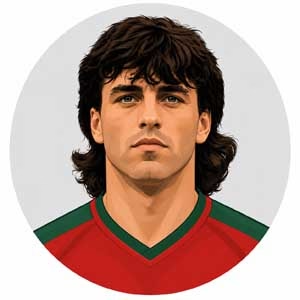
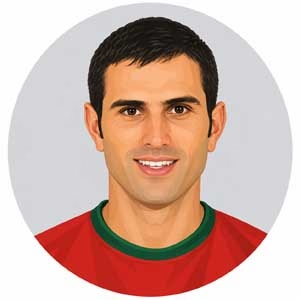
Portugal - StrikerPauleta
Pauleta was a centre-forward built primarily around movement, anticipation and economical finishing. Around 1.80 metres tall, he possessed neither overwhelming strength nor spectacular dribbling ability, but accelerated sharply over the distances that mattered inside the final third. He moved across centre-backs rather than remaining fixed between them, attacked the blind side and frequently finished with one or two touches. His heading was excellent for his size, while his finishing repertoire included first-time shots, chips and quick adjustments around goal. Pauleta developed unusually late for an elite striker. He played in the Azores and Portuguese lower divisions before moving to Salamanca in Spain, where prolific scoring brought a transfer to Deportivo La Coruña. He contributed to the 1999–2000 Liga title before joining Bordeaux, becoming Ligue 1’s leading scorer in 2001–02 and winning the Coupe de la Ligue. PSG signed him in 2003. Across five seasons he scored 109 goals in 211 official matches, twice finished as Ligue 1 top scorer and won two Coupes de France and the 2008 Coupe de la Ligue. He also became club captain. For Portugal he scored 47 goals in 88 appearances, becoming the national team’s record scorer at the time, and played at the 2002 and 2006 World Cups and Euro 2004. His international career ended after Portugal reached the 2006 World Cup semi-finals.
His efficiency depended heavily on receiving the ball in situations that allowed rapid decisions. When isolated as a lone striker against deep, compact defences, Pauleta could become disconnected from the game because he was not naturally a creator who dropped repeatedly into midfield or eliminated defenders through extended dribbling. Euro 2004 exposed a more unusual weakness. Portugal generated opportunities, but Pauleta went through the entire tournament without scoring. Jürgen Klinsmann, analysing the competition for UEFA, observed that he appeared to think too much when clear chances arrived, delaying actions that he would normally finish instinctively in league football. The final against Greece reinforced the problem: surrounded by enormous home expectation and facing a defence that denied space, his movements became increasingly frustrated before he was substituted. Tactical isolation and psychological pressure could therefore interact. When the instinctive striker was forced to wait, wrestle with crowded spaces and carry expectation from one missed chance into the next, his greatest strength — immediate decision-making — could deteriorate.
Psychologically, Pauleta appears to have been calm rather than emotionally detached. At PSG he explicitly acknowledged that being favourites created pressure and that matches against stronger opponents could sometimes feel psychologically easier because expectation transferred elsewhere. He also understood leadership as something earned gradually. After becoming vice-captain in 2004, he said he intended to speak more inside the group but would have disliked arriving at a club and immediately behaving as an authority; first he needed to understand the environment and earn his place within it. Once established, that restraint became much more forceful. During PSG’s disastrous 2006–07 season, captain Pauleta publicly said that some players did not deserve to wear the shirt after a humiliating European defeat. His leadership was therefore not merely supportive: when collective standards collapsed, he was capable of direct moral criticism. At the same time, his attachment to individual status remained relatively low. Years later he reacted positively when both his Portugal scoring record and his PSG record were surpassed, framing the achievement as good for the players and clubs involved rather than as a loss of personal standing. Big occasions normally raised his involvement: he repeatedly scored against Marseille and later said leaders had to “stand up and be counted” in such matches. Euro 2004 nevertheless prevents treating him as pressure-proof. Expectation could penetrate him deeply enough to interfere with finishing when misses accumulated. Importantly, that frustration did not translate into retaliation against defenders, referees or teammates; there is little evidence of habitual disciplinary escalation. Pauleta’s tension travelled inward toward execution rather than outward toward conflict. His strongest competitive state was therefore neither anger nor complete serenity. It was clarity: when responsibility could be reduced to movement, timing and one decisive touch, emotional noise almost disappeared.


 All Time PortugalNT