We use Google Analytics to understand how visitors use this site. Analytics cookies are only activated with your consent. For details, read our Privacy Policy.
Profile lensThe same player, read from a different angle.
Athletic80
Acceleration
77
Pace
77
Agility
76
Strength
83
Balance
82
Jumping
86
Stamina
81
Fitness
80
Technical84
Dribbling
85
Short Passing
78
Long Passing
74
Finishing
87
Shot Accuracy
85
Shot Power
85
Shooting Technique
78
Heading
87
Tackling
38
Crossing
66
Free Kick
65
Penalties
71
First Touch
85
Mental78
Composure
82
Aggression
77
Consistency
76
Creativity
78
Leadership
78
Work Rate
72
Tactical81
Vision
74
Off the Ball
87
Defensive Positioning
38
Teamwork
78
Anticipation
84
Marking
38
Player Traits
Attacking 82
Crossing
66
Finishing
87
Heading Accuracy
87
Shot Accuracy
85
Off the Ball
87
Technique 78
Dribbling
85
Free Kick
65
Short Passing
78
Long Passing
74
First Touch
85
Shot Technique
78
Movement 78
Acceleration
77
Pace
77
Agility
76
Balance
82
Physicality 83
Shot Power
85
Jumping
86
Stamina
81
Strength
83
Fitness
80
Defending 38
Marking
38
Tackling
38
Def. Positioning
38
Mentality & Game Reading 77
Aggression
77
Composure
82
Penalties
71
Vision
74
Leadership
78
Work Rate
72
Teamwork
78
Anticipation
84
Consistency
76
Creativity
78
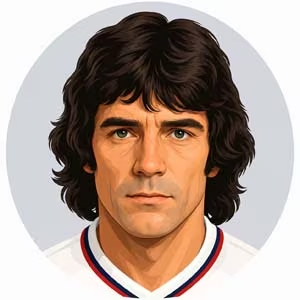
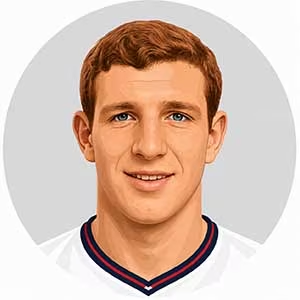
England - StrikerOsgood, Peter
Osgood joined Chelsea's academy as a teenager and became the club's first true homegrown superstar of the modern era. He was an unusually elegant centre-forward for his physical size — tall and strong in the air, but also technically gifted on the ground, capable of dribbling past defenders in tight spaces and finishing with either foot, a combination that earned him comparisons to continental forwards rarely applied to English strikers of the period. He recovered from a broken leg suffered as a nineteen-year-old to become the focal point of a talented, stylish Chelsea side under Tommy Docherty and then Dave Sexton, scoring 150 goals in 380 appearances across two spells at the club and winning the 1970 FA Cup and the 1971 European Cup Winners' Cup, scoring in the final against Real Madrid. He later played for Southampton, helping them win the 1976 FA Cup as a veteran, and closed his career with a brief return to Chelsea and a spell in the United States. For England he won only four caps despite his club form, a gap widely attributed to Alf Ramsey's preference for a more disciplined, less individualistic style of centre-forward than Osgood offered.
His limitations were connected as much to lifestyle and application as to football itself. Osgood's physical condition fluctuated across his career, and his commitment to training discipline was inconsistent by the standards even of a permissive era, a pattern that became more pronounced from his late twenties onward and shortened a career that had promised considerably more silverware than it delivered. He clashed with Dave Sexton over tactical discipline and personal conduct, a conflict that contributed to his eventual departure from Chelsea in 1974 at a point when his ability still exceeded what he was producing. His decline was earlier and steeper than his talent alone would explain, and England's reluctance to select him regularly compounded a sense, which he carried for the rest of his life, of unfulfilled potential at the highest level.
Temperamentally he was charismatic, generous and drawn to attention in a way that suited Chelsea's fashionable identity perfectly and served his own professional longevity less well. Osgood was popular and gregarious inside the dressing room, a natural entertainer rather than a vocal organizer, and he led by flair and personality rather than by tactical instruction or defensive example. He argued periodically with coaches over discipline rather than tactics, resented Sexton's stricter regime specifically, and reacted to being dropped or criticized with open frustration rather than quiet acceptance. He was not aggressive toward opponents or officials on the pitch, fouling infrequently and rarely retaliating against physical treatment, his conflicts were with authority off the pitch rather than with adversaries on it. He embraced London's celebrity culture of the era fully, comfortable with photographers and journalists in a way most footballers of his generation avoided, and that visibility became inseparable from his identity as a player. Chelsea supporters never stopped adoring him, voting him the club's greatest ever player decades after his retirement, and he remained connected to Stamford Bridge as a match-day host until his death, evidence that whatever conflicts had shortened his career never touched the bond with the people who had watched it. Gifted, magnetic and never quite disciplined enough to become what his talent promised, Osgood was the player who taught an entire fanbase what glamour looked like on a football pitch.


 All Time Chelsea Club