We use Google Analytics to understand how visitors use this site. Analytics cookies are only activated with your consent. For details, read our Privacy Policy.
Profile lensThe same player, read from a different angle.
Athletic82
Acceleration
86
Pace
82
Agility
85
Strength
71
Balance
75
Jumping
81
Stamina
91
Fitness
85
Technical75
Dribbling
77
Short Passing
73
Long Passing
77
Finishing
64
Shot Accuracy
65
Shot Power
77
Shooting Technique
71
Heading
74
Tackling
71
Crossing
75
Free Kick
61
Penalties
60
First Touch
77
Mental76
Composure
77
Aggression
85
Consistency
78
Creativity
69
Leadership
70
Work Rate
82
Tactical73
Vision
72
Off the Ball
74
Defensive Positioning
68
Teamwork
78
Anticipation
76
Marking
68
Player Traits
Attacking70
Crossing
75
Finishing
64
Heading Accuracy
74
Shot Accuracy
65
Off the Ball
74
Technique73
Dribbling
77
Free Kick
61
Short Passing
73
Long Passing
77
First Touch
77
Shot Technique
71
Movement82
Acceleration
86
Pace
82
Agility
85
Balance
75
Physicality81
Shot Power
77
Jumping
81
Stamina
91
Strength
71
Fitness
85
Defending69
Marking
68
Tackling
71
Def. Positioning
68
Mentality & Game Reading75
Aggression
85
Composure
77
Penalties
60
Vision
72
Leadership
70
Work Rate
82
Teamwork
78
Anticipation
76
Consistency
78
Creativity
69
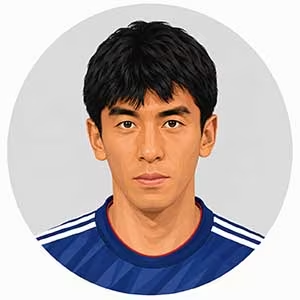
Japan - Left BackNagatomo, Yūto
An astonishing VO2 max engine that allowed him to sprint up and down the left flank for ninety minutes without registering a drop in linear speed turned an undersized native of Saijō into the tireless defensive workhorse of modern Japanese and Italian football. Yuto Nagatomo was the definitive archetype of the high-octane modern wing-back: a pocket dynamo standing five-foot-seven who combined relentless cardiovascular stamina, exceptional recovery acceleration, and two-footed crossing balance to lock down the touchline across Europe.
Operating on either flank—though primarily deployed as an aggressive left-back—Nagatomo was an absolute pest for opposing wingers in one-on-one isolations. He utilized rapid deceleration, a low center of gravity, and clean standing tackles to neutralize faster opponents, before immediately springing forward on overlapping sprints to deliver crisp cutbacks off either foot. Rising through Meiji University and FC Tokyo, his brilliant displays at the 2011 AFC Asian Cup—where his extra-time cross delivered the winning goal in the final against Australia—earned him an immediate move to Cesena and then Inter Milan. Across eight seasons in Milan spanning 210 appearances and 11 goals, he became a reliable mainstay during a turbulent transitional era, captaining the Nerazzurri and lifting the 2010–11 Coppa Italia. He later swept back-to-back Süper Lig titles with Galatasaray before returning to FC Tokyo. For Japan, across a staggering 142 caps and four goals, he is the second-most capped player in national history, starting across four consecutive World Cups (2010, 2014, 2018, 2022) and capturing the 2011 Asian Cup.
His specialized, running-heavy profile, however, came with clear physical and technical ceilings. Nagatomo lacked the towering physical frame or vertical elevation to win aerial duels inside his own box, leaving him vulnerable to back-post cross-field diagonal balls targeted at physically dominant wingers. Furthermore, while his crossing was reliable on the overlap, he was not an intricate playmaker who could cut inside and pick out intricate through-balls against deep, hyper-compact low blocks.
Exuberant, deeply disciplined, and radiating boundless positive energy, Nagatomo was an adored cultural glue guy whose infectious work ethic earned universal dressing-room respect. He approached training with monastic devotion—popularizing core-stability and yoga regimens across the sport—and embraced high-pressure Italian football with an enthusiastic, respectful bow that endeared him to the San Siro terraces. On the pitch, his presence was all kinetic motion and grit: chasing down lost causes, diving into tackles with total physical commitment, and immediately driving back into defensive shape. Inside the Inter, Galatasaray, and Samurai Blue dressing rooms, he was an indispensable, unifying leader whose relentless humility, vocal encouragement, and tireless physical output made him an immortal modern symbol of Japanese sporting spirit.



 All-Time AsiaAsia