We use Google Analytics to understand how visitors use this site. Analytics cookies are only activated with your consent. For details, read our Privacy Policy.
Profile lensThe same player, read from a different angle.
Athletic79
Acceleration
74
Pace
74
Agility
72
Strength
83
Balance
79
Jumping
83
Stamina
82
Fitness
85
Technical75
Dribbling
69
Short Passing
71
Long Passing
71
Finishing
64
Shot Accuracy
66
Shot Power
83
Shooting Technique
64
Heading
85
Tackling
86
Crossing
64
Free Kick
60
Penalties
60
First Touch
73
Mental78
Composure
82
Aggression
88
Consistency
80
Creativity
66
Leadership
70
Work Rate
82
Tactical80
Vision
70
Off the Ball
60
Defensive Positioning
86
Teamwork
82
Anticipation
83
Marking
84
Player Traits
Attacking68
Crossing
64
Finishing
64
Heading Accuracy
85
Shot Accuracy
66
Off the Ball
60
Technique68
Dribbling
69
Free Kick
60
Short Passing
71
Long Passing
71
First Touch
73
Shot Technique
64
Movement75
Acceleration
74
Pace
74
Agility
72
Balance
79
Physicality83
Shot Power
83
Jumping
83
Stamina
82
Strength
83
Fitness
85
Defending85
Marking
84
Tackling
86
Def. Positioning
86
Mentality & Game Reading76
Aggression
88
Composure
82
Penalties
60
Vision
70
Leadership
70
Work Rate
82
Teamwork
82
Anticipation
83
Consistency
80
Creativity
66
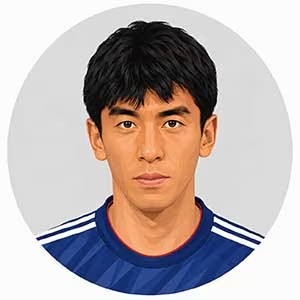
Japan - Centre-backIhara, Masami
In Doha on 28 October 1993, Japan were seconds from qualifying for their first World Cup when Iraq equalised from a late corner. Masami Ihara remained in the defensive line as the final whistle confirmed elimination, an episode that would become known in Japan simply as the “Agony of Doha.” Four years later he entered another qualification campaign carrying both the memory of that failure and a different responsibility: by then he was the national-team captain, and qualification for France 1998 was widely treated not merely as an ambition but as an obligation. Ihara later described that campaign as the most difficult period of his playing career. After poor results, supporters directed open anger at the team; following one draw, objects were thrown towards the players’ bus. His recollection is important because he did not describe himself as insulated from the pressure. He explicitly said he felt the responsibility and weight of public expectation. What changed after Doha was not sensitivity but interpretation: he came to regard the earlier failure as evidence that a match remained unstable until its final moment, and during the 1997 campaign he consciously used that memory to reinforce persistence rather than protect himself from the possibility of another collapse.
Ihara was a central defender and sweeper whose game depended on reading the attack before physical emergency became necessary. Originally a forward in high school, he converted to defence at the University of Tsukuba and entered the senior national team while still a student. His defensive strengths were anticipation, positioning and controlled intervention; the Japan Football Association specifically remembers the combination of strong defending with calm decision-making that earned him the nickname “Asian Wall.” At Yokohama Marinos he became the stabilising centre of the defence, winning the 1995 J.League championship and appearing in the league’s Best Eleven for five consecutive seasons from 1993 to 1997; that same year he was named AFC Asian Player of the Year. With Japan he accumulated 122 official senior internationals and became the country’s first player to reach 100, eventually captaining the side in 47 matches. His defensive intelligence made him particularly effective when play developed in front of him and he could coordinate distance, cover and the timing of intervention. He could also distribute accurately after recovery rather than merely clear danger. At France 1998 he started and completed all three matches as captain, functioning as the organisational reference of a team experiencing the World Cup for the first time.
The same structure created limitations. Ihara was not an explosive recovery defender and did not possess unusual acceleration once an attacker had escaped the area he could control through anticipation. His comparative advantage therefore declined when a defensive line became stretched, when repeated transitions forced him into long recovery runs or when attackers could isolate him before he had established positional superiority. Nor was his calm distribution equivalent to the creative range of a true libero who could dominate midfield possession for extended periods. His value was primarily preventative and organisational. The 1998 World Cup also exposes a collective limitation that Ihara himself later articulated without attempting to rewrite the tournament: Japan were prepared intensely to qualify but insufficiently prepared to win once they arrived. Looking back, he argued that the team had not understood where to place its performance peak or how to structure the preceding camp and warm-up matches. That admission matters because three defeats in France should not automatically be interpreted as Ihara degrading under major-event pressure. Japan lost each match narrowly, and he remained an uninterrupted starter. The more defensible degradation condition is tactical: remove the time and structure required for anticipation, expand the space behind him and force repeated reactive athletic contests, and the qualities that made him authoritative become less protective.
Psychologically, Ihara’s clearest distinguishing feature is **non-possessive authority**. He accepted responsibility for leading the team without treating captaincy as ownership of rank. When Hidetoshi Nakata entered the national side as a much younger player, he addressed Ihara simply by surname on the pitch—an unusually direct behaviour inside the strongly seniority-conscious Japanese environment of the period. Ihara later recalled neither reprimanding him nor interpreting it as disrespect; instead, he recognised that Nakata’s generation had already experienced international youth tournaments that his own generation had not and interpreted the younger player’s confidence as evidence of higher standards. That is not passive leadership. Ihara said that after becoming captain he consciously felt that he had to pull the team forward, but also acknowledged that he had several “captains behind the captain”: teammates who exercised leadership alongside him. He developed his own method rather than simply reproducing what coaches demanded, while Takeshi Okada explicitly entrusted him with making decisions on the pitch when the coach’s instructions could not be heard. His response to pressure followed the same pattern. He admitted the 1997 qualification campaign was oppressive rather than pretending immunity, yet later described Doha as something whose pressure could be converted into energy. Public hostility therefore produced acknowledged emotional load without documented collapse or retaliation. Evidence for habitual referee confrontation, revenge fouling, teammate-directed blame or provocation-driven aggression is insufficient and should remain unknown. Ihara’s profile is consequently narrower than “calm leader”: **he accepted central responsibility while allowing status, information and authority to circulate around him**. Leadership increased his burden without requiring him to defend the symbolic privileges of being the leader.


 All-Time AsiaAsia