We use Google Analytics to understand how visitors use this site. Analytics cookies are only activated with your consent. For details, read our Privacy Policy.
Profile lensThe same player, read from a different angle.
Athletic81
Acceleration
83
Pace
79
Agility
82
Strength
82
Balance
77
Jumping
82
Stamina
81
Fitness
83
Technical86
Dribbling
84
Short Passing
80
Long Passing
75
Finishing
91
Shot Accuracy
94
Shot Power
81
Shooting Technique
78
Heading
83
Tackling
48
Crossing
71
Free Kick
67
Penalties
86
First Touch
85
Mental83
Composure
88
Aggression
77
Consistency
84
Creativity
82
Leadership
77
Work Rate
80
Tactical87
Vision
84
Off the Ball
93
Defensive Positioning
42
Teamwork
83
Anticipation
91
Marking
39
Player Traits
Attacking86
Crossing
71
Finishing
91
Heading Accuracy
83
Shot Accuracy
94
Off the Ball
93
Technique78
Dribbling
84
Free Kick
67
Short Passing
80
Long Passing
75
First Touch
85
Shot Technique
78
Movement80
Acceleration
83
Pace
79
Agility
82
Balance
77
Physicality82
Shot Power
81
Jumping
82
Stamina
81
Strength
82
Fitness
83
Defending43
Marking
39
Tackling
48
Def. Positioning
42
Mentality & Game Reading83
Aggression
77
Composure
88
Penalties
86
Vision
84
Leadership
77
Work Rate
80
Teamwork
83
Anticipation
91
Consistency
84
Creativity
82
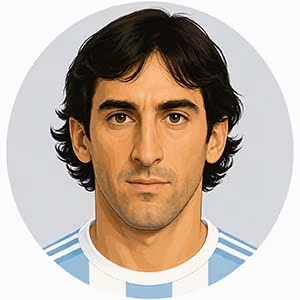
Argentina - StrikerMilito, Diego
Diego Milito
Late bloomers in European football rarely arrive with the devastating, season-defining completeness that marked the peak of the Argentine center-forward known across the globe as El Príncipe. Rising through Racing Club before proving his surgical finishing instincts in Europe with Real Zaragoza and Genoa, Diego Alberto Milito reached the absolute summit of world football during the historic 2009–10 campaign under José Mourinho at Inter Milan. Standing with a lean, deceptively agile frame and a low center of gravity, Milito dismantled defensive structures through an exquisite economy of movement: sharp diagonal feints to unbalance center-backs, sudden bursts into the half-spaces, and his iconic, sweeping body-faint (la finta) that sent world-class defenders like Daniel Van Buyten sliding off the frame before he slid the ball into the net. His technical execution in the penalty box was pure, unadulterated efficiency—possessing pristine first-touch control on the turn, soft-footed chipped finishes, and an unselfish capacity to hold up play with his back to goal to bring Wesley Sneijder and Samuel Eto'o into the attack. In the span of a single month in May 2010, Milito scored every single decisive goal to seal the legendary Treble: the sole winner against Roma in the Coppa Italia final, the title-clinching strike against Siena on the final day of Serie A, and a breathtaking brace against Bayern Munich in the UEFA Champions League final at the Santiago Bernabéu.
Psychologically, Milito was the absolute antithesis of the modern, self-promoting superstar, navigating the cutthroat pressures of elite football with an understated, monastic humility. On the pitch, his leadership was purely functional and selfless; he did not engage in theatrical posturing or aggressive gesturing, but instead drove his team forward through tireless pressing, intelligent off-the-ball runs that created space for others, and an ice-cold calm in the game's most pressurized moments. Inside the dressing room, he was a universally beloved, deeply modest teammate whose dedication to tactical discipline and daily training routines made him a natural reference point for both South American veterans and Italian stalwarts. Under the suffocating pressure of knockout football, his emotional state reached a state of meditative, razor-sharp focus; he welcomed the heaviest responsibilities with stoic composure, displaying zero panic when chances were scarce. Toward match officials and opposition stoppers, Milito maintained a spotless, gentlemanly demeanor: absorbing heavy physical punishment without diving or retaliating, avoiding referee disputes, and letting his lethal penalty-box intelligence deliver the ultimate competitive answer on the scoreboard.


 All Time InternazionaleClub