We use Google Analytics to understand how visitors use this site. Analytics cookies are only activated with your consent. For details, read our Privacy Policy.
Profile lensThe same player, read from a different angle.
Athletic82
Acceleration
85
Pace
84
Agility
81
Strength
77
Balance
79
Jumping
79
Stamina
85
Fitness
84
Technical81
Dribbling
80
Short Passing
80
Long Passing
81
Finishing
84
Shot Accuracy
79
Shot Power
83
Shooting Technique
76
Heading
85
Tackling
52
Crossing
73
Free Kick
71
Penalties
77
First Touch
80
Mental80
Composure
83
Aggression
80
Consistency
78
Creativity
71
Leadership
80
Work Rate
82
Tactical80
Vision
78
Off the Ball
81
Defensive Positioning
55
Teamwork
80
Anticipation
85
Marking
49
Attacking80
Crossing
73
Finishing
84
Heading Accuracy
85
Shot Accuracy
79
Off the Ball
81
Technique78
Dribbling
80
Free Kick
71
Short Passing
80
Long Passing
81
First Touch
80
Shot Technique
76
Movement82
Acceleration
85
Pace
84
Agility
81
Balance
79
Physicality82
Shot Power
83
Jumping
79
Stamina
85
Strength
77
Fitness
84
Defending52
Marking
49
Tackling
52
Def. Positioning
55
Mentality & Game Reading79
Aggression
80
Composure
83
Penalties
77
Vision
78
Leadership
80
Work Rate
82
Teamwork
80
Anticipation
85
Consistency
78
Creativity
71
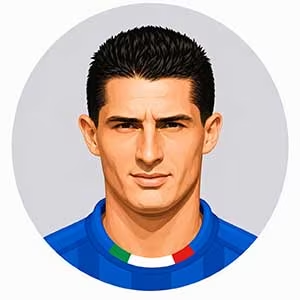
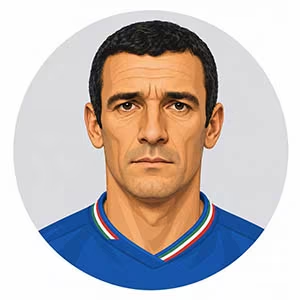
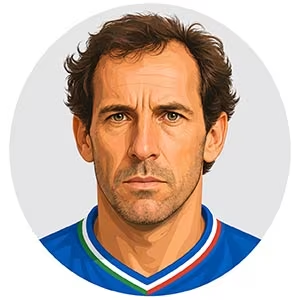
Italy - StrikerMassaro, Daniele
Ask most people what they remember about Daniele Massaro and they will mention the missed penalty — the one right before Roberto Baggio's, the one that gets forgotten because the more famous miss came ninety seconds later. Ask anyone who actually played with him and a different story emerges: a forward who accepted being benched after scoring, played out of position whenever the team needed a body there, and wore ten of Milan's eleven available shirt numbers across his career because he was never precious about which one he had. He explained the whole approach himself, years later, in a single sentence: he had done everything for Milan, even played as a defender, accepted being left out even after scoring, always put the group first.
Born in Monza in 1961, Massaro started as a box-to-box midfielder in Serie B with his hometown club before establishing himself at Fiorentina, where a near-miss title race in 1982 was the best individual season of his career to that point. Adriano Galliani signed him for Milan in 1986, discovering him as a young player at a parish youth club, and the fit was awkward at first: Arrigo Sacchi did not initially trust him, disagreed with him over his best position, and sent him on loan to Roma for a season. Massaro returned, adapted himself to whatever role Sacchi needed — left wing under Sacchi's pressing system, emergency full-back once when the team was short a defender, second striker once Marco van Basten's body began to fail him — and eventually became first choice up front under Fabio Capello, top-scoring for the club in 1993–94 with a string of goals so often decisive late in matches that supporters nicknamed him Provvidenza. He won four Serie A titles, two European Cups with Milan (1990, 1994, having missed the 1989 final through the loan spell), and scored twice in the 4–0 demolition of Cruyff's Barcelona in the 1994 Champions League final. For Italy he was part of the 1982 World Cup-winning squad without playing a minute, and twelve years later started at the 1994 final, where his penalty was saved by Cláudio Taffarel moments before Baggio's more famous miss ended the tournament.
His limitations followed directly from a career built on adaptability rather than a fixed, maximized skill set. Massaro was rarely the most technically gifted attacker on any pitch he occupied, and his individual goal output, while genuinely useful, depended heavily on being deployed correctly by a coach willing to use his work rate and positioning rather than isolated brilliance. For years at Milan he was a squad player rather than an automatic starter, competing against a rotating cast of far more celebrated attacking talents — Van Basten, Gullit, later Papin and Savićević — and his path to regular first-team football came almost entirely through other players' injuries rather than through directly winning a position in open competition.
Temperamentally he described himself, in his own words, as stubborn, and it was the specific, useful kind of stubbornness that expressed itself as adaptability rather than resistance — the willingness to keep changing what was asked of him rather than insisting on one preferred role. He accepted demotions, loan spells and being substituted after scoring without recorded complaint, and Sacchi later credited him with learning to place collective function above individual ambition, a lesson Massaro repeated in interviews for the rest of his life as the defining influence on his career. He formed a close, enduring friendship with Franco Baresi that outlasted both their playing careers, and remained visibly attached to Milan long after retirement, returning as the club's brand ambassador and dedicating a sporting director qualification, earned in his sixties, to Galliani, the man who had first believed in him. Away from football he pursued rally driving competitively into his late thirties, including a run against Valentino Rossi, played golf on informal courses cut into the woods around Milan's training ground with teammates including Van Basten himself, and later captained Italy's national beach soccer team. His public profile after football included an unsuccessful, low-vote run for local office in Milan in 2016, a brief and modest venture into politics that generated no lasting controversy. Adaptable to the point of self-effacement, quietly proud rather than aggrieved about a career built on other people's misfortune, Massaro turned an unusually literal willingness to do whatever the team needed into one of the most decorated squad careers in Italian football.