We use Google Analytics to understand how visitors use this site. Analytics cookies are only activated with your consent. For details, read our Privacy Policy.
Profile lensThe same player, read from a different angle.
Athletic79
Acceleration
85
Pace
77
Agility
77
Strength
84
Balance
76
Jumping
83
Stamina
77
Fitness
76
Technical86
Dribbling
82
Short Passing
76
Long Passing
78
Finishing
94
Shot Accuracy
95
Shot Power
90
Shooting Technique
89
Heading
87
Tackling
33
Crossing
70
Free Kick
77
Penalties
90
First Touch
79
Mental80
Composure
83
Aggression
76
Consistency
75
Creativity
72
Leadership
82
Work Rate
85
Tactical83
Vision
72
Off the Ball
94
Defensive Positioning
32
Teamwork
70
Anticipation
91
Marking
38
Player Traits
Attacking88
Crossing
70
Finishing
94
Heading Accuracy
87
Shot Accuracy
95
Off the Ball
94
Technique80
Dribbling
82
Free Kick
77
Short Passing
76
Long Passing
78
First Touch
79
Shot Technique
89
Movement79
Acceleration
85
Pace
77
Agility
77
Balance
76
Physicality82
Shot Power
90
Jumping
83
Stamina
77
Strength
84
Fitness
76
Defending34
Marking
38
Tackling
33
Def. Positioning
32
Mentality & Game Reading80
Aggression
76
Composure
83
Penalties
90
Vision
72
Leadership
82
Work Rate
85
Teamwork
70
Anticipation
91
Consistency
75
Creativity
72
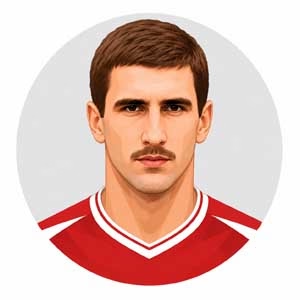
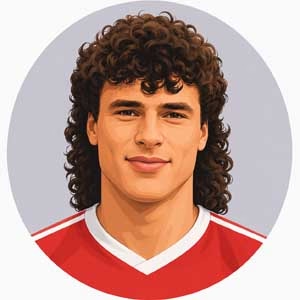
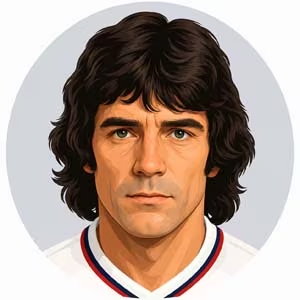
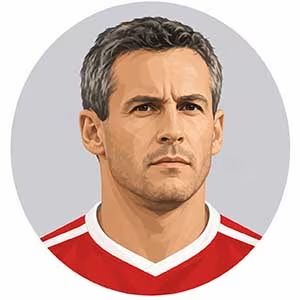
Austria - StrikerKrankl, Hans
Forty-one league goals in a single Austrian season earned him the European Golden Shoe in 1978, but it was his ruthless, left-footed hammer that made Johann Krankl the most feared penalty-box executioner in central Europe throughout the 1970s and 1980s. Der Goleador was an old-school predator who turned half-chances into pure panic for opposing goalkeepers, combining sharp short-burst acceleration with exceptional back-to-goal hold-up play and a devastating first-time strike.
Krankl forged his domestic legend across two iconic spells at Rapid Wien, netting an astonishing 336 goals in 449 matches, capturing two Austrian Bundesliga titles, four Austrian Cups, and reaching the 1985 European Cup Winners' Cup final. His sensational 1978 move to FC Barcelona yielded immediate folklore: he won the Pichichi Trophy with 29 goals in his debut season and scored the extra-time winner against Fortuna Düsseldorf in Basel to lift the 1978–79 European Cup Winners' Cup, finishing as the 1978 Ballon d'Or runner-up behind Kevin Keegan. For Austria, across 69 caps and 34 goals, his international apex is etched in national mythology: scoring twice to defeat reigning champions West Germany 3–2 at the 1978 World Cup in Córdoba (Das Wunder von Córdoba), sparking radio commentator Edi Finger’s immortal on-air meltdown: "I werd narrisch!"
His lethal efficiency, however, existed almost entirely within the final thirty yards. Krankl was an unapologetic, traditional center-forward who offered virtually no defensive pressing, tracking back, or wide-channel running; if his midfield was overrun or failed to deliver crosses and vertical balls into the eighteen-yard box, he was easily cut adrift from the game. Furthermore, his fiery, uncompromising temperament led to explosive clashes with coaches—most notably Joaquim Rifé at Barcelona—that prematurely brought an end to his time in Catalonia.
Boisterous, fiercely proud, and carrying the rock-and-roll swagger of a Vienna street idol—even releasing chart-topping pop singles during his playing career—Krankl lived for the roar of the terraces. He never doubted his own finishing ability, demanding the ball from teammates and punishing defenders the moment they gave him half a yard on his left side. On the pitch, his presence was imposing and volatile: wrestling center-backs for position, demanding service with angry gestures, and celebrating goals with wild, roaring sprints toward the fans. Inside the Rapid, Barça, and Austrian national team locker rooms, he was an undisputed alpha leader whose ferocious will to win and clutch finishing under pressure cemented his standing as Austria's greatest modern goalscorer.