We use Google Analytics to understand how visitors use this site. Analytics cookies are only activated with your consent. For details, read our Privacy Policy.
Profile lensThe same player, read from a different angle.
Athletic76
Acceleration
66
Pace
72
Agility
64
Strength
98
Balance
77
Jumping
76
Stamina
82
Fitness
76
Technical83
Dribbling
81
Short Passing
78
Long Passing
71
Finishing
89
Shot Accuracy
82
Shot Power
87
Shooting Technique
77
Heading
92
Tackling
42
Crossing
67
Free Kick
72
Penalties
70
First Touch
83
Mental79
Composure
82
Aggression
75
Consistency
76
Creativity
74
Leadership
81
Work Rate
80
Tactical82
Vision
76
Off the Ball
88
Defensive Positioning
47
Teamwork
82
Anticipation
85
Marking
38
Player Traits
Attacking84
Crossing
67
Finishing
89
Heading Accuracy
92
Shot Accuracy
82
Off the Ball
88
Technique77
Dribbling
81
Free Kick
72
Short Passing
78
Long Passing
71
First Touch
83
Shot Technique
77
Movement70
Acceleration
66
Pace
72
Agility
64
Balance
77
Physicality84
Shot Power
87
Jumping
76
Stamina
82
Strength
98
Fitness
76
Defending42
Marking
38
Tackling
42
Def. Positioning
47
Mentality & Game Reading78
Aggression
75
Composure
82
Penalties
70
Vision
76
Leadership
81
Work Rate
80
Teamwork
82
Anticipation
85
Consistency
76
Creativity
74
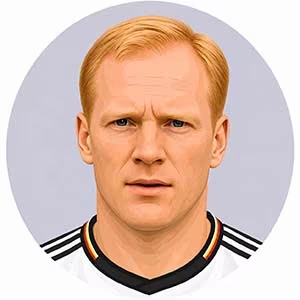
Czech Republic - StrikerKoller, Jan
On 12 June 2006, five minutes into the Czech Republic’s first World Cup match, Zdeněk Grygera crossed from the right and Jan Koller rose above Oguchi Onyewu to head the ball powerfully past Kasey Keller. Ten months earlier, Koller had suffered a major knee-ligament injury and had spent months working almost in isolation to reach the tournament at all. His World Cup had begun with the action that defined him best: establish position, attack the cross, finish decisively. Before half-time, however, he left the field with another muscular injury. The goal and the exit compressed the two forces that shaped much of his career — extraordinary functional durability and a body eventually asked to carry too much.
At 2.02 metres, Koller was an obvious target man, but treating him as merely an aerial specialist misses much of his usefulness. His size allowed him to pin centre-backs, receive direct passes with his back to goal and create space for runners, yet he also developed surprisingly secure feet for a player of his frame. He could lay the ball off cleanly, combine around the box and finish with either foot, while his heading became a major weapon through training rather than simple height. Koller later said that as a young professional his coordination and technique were weaknesses and that specific heading practice gradually increased both his ability and confidence. Sparta Prague did not initially value him highly, and after leaving for Lokeren he developed dramatically, scoring 46 league goals in three seasons. Anderlecht then signed him for a Belgian-record fee; paired with Tomasz Radzinski, he won two league titles and became Belgian Footballer of the Year. Borussia Dortmund brought him to Germany in 2001. He scored 11 Bundesliga goals as Dortmund won the 2001–02 title and also scored in that season’s UEFA Cup final defeat to Feyenoord. Across five years he became a central reference point for Dortmund’s attack before later spells with Monaco, Nürnberg, Krylia Sovetov Samara and Cannes. Internationally he was even more productive: 55 goals in 91 appearances made him the Czech Republic’s record scorer. He played at Euro 2000, Euro 2004, the 2006 World Cup and Euro 2008, with Euro 2004 providing the strongest tournament expression of his partnership play and finishing.
Koller’s size created its own tactical limitations. He was not quick over long distances, could not repeatedly separate from defenders through acceleration and was less dangerous when forced to attack from wide or receive facing his own goal far from support. Teams that prevented crosses and denied clean direct service could leave him isolated, while aggressive centre-backs who challenged his first contact before support arrived could reduce his linking influence. His technical improvement was substantial, but tight-space dribbling remained functional rather than creative. The Czech attack worked best when mobile players moved around him; without those runners, possession into Koller could become predictable. His enormous frame also accumulated physical cost. The serious knee injury of 2005 required surgery and months of rehabilitation, and the subsequent hamstring problem at the 2006 World Cup illustrated how compensating for one physical weakness could overload another area.
Psychologically, Koller’s strongest trait was learned persistence rather than effortless confidence. He has repeatedly rejected the idea that his career emerged from exceptional natural talent, describing himself as a late developer who had to improve technique, coordination and heading through work. That history matters because early rejection did not produce visible resentment. Sparta allowed him to leave, yet Koller later discussed the episode primarily as evidence that he had not been technically ready, not as an institutional betrayal. The clearest behavioural test came before the 2006 World Cup. After knee surgery, he spent roughly four months in a rehabilitation centre in Regensburg, training daily around the single objective of reaching the tournament. He admitted that pessimistic thoughts occurred when recovery progressed slowly and even said there were moments when he doubted he would make it, but he repeatedly returned to the World Cup as motivation and ultimately recovered ahead of the original timetable. When another injury ended his tournament after only 43 minutes, his public response was strikingly proportionate: he said worse tragedies happened, expressed gratitude for having reached the World Cup at all and refused to risk returning unless he could genuinely help the team. That distinction suggests high frustration internally but strong behavioural regulation. Physical confrontation itself rarely appears to have provoked retaliation. Koller’s game required constant contact, yet his disciplinary profile was modest for a striker engaged in so many aerial duels. Pressure also did not appear to narrow his behaviour. In November 2002, when Jens Lehmann was sent off against Bayern after Dortmund had used all substitutions, Koller immediately volunteered to go in goal. He had played as a goalkeeper as a teenager and occasionally practised in training; he kept Bayern scoreless for the remaining minutes and was named kicker’s man of the match despite Dortmund losing. Years later he described the incident without self-mythologising, just as he rejected being called a Dortmund hero because others had served the club longer. That low need for personal status coexisted with substantial competitive ambition. He wanted new challenges, worked obsessively to recover from injury and remained emotionally invested in representing his country, but recognition itself was not the fuel. His confidence came from usefulness: if fit and capable of helping, he wanted responsibility; if not, he preferred not to occupy the place.