We use Google Analytics to understand how visitors use this site. Analytics cookies are only activated with your consent. For details, read our Privacy Policy.
Profile lensThe same player, read from a different angle.
Athletic82
Acceleration
76
Pace
80
Agility
76
Strength
91
Balance
80
Jumping
88
Stamina
83
Fitness
84
Technical84
Dribbling
82
Short Passing
76
Long Passing
68
Finishing
91
Shot Accuracy
85
Shot Power
82
Shooting Technique
77
Heading
95
Tackling
41
Crossing
62
Free Kick
66
Penalties
80
First Touch
83
Mental76
Composure
85
Aggression
76
Consistency
74
Creativity
64
Leadership
70
Work Rate
74
Tactical83
Vision
72
Off the Ball
91
Defensive Positioning
38
Teamwork
76
Anticipation
90
Marking
33
Player Traits
Attacking85
Crossing
62
Finishing
91
Heading Accuracy
95
Shot Accuracy
85
Off the Ball
91
Technique75
Dribbling
82
Free Kick
66
Short Passing
76
Long Passing
68
First Touch
83
Shot Technique
77
Movement78
Acceleration
76
Pace
80
Agility
76
Balance
80
Physicality86
Shot Power
82
Jumping
88
Stamina
83
Strength
91
Fitness
84
Defending37
Marking
33
Tackling
41
Def. Positioning
38
Mentality & Game Reading76
Aggression
76
Composure
85
Penalties
80
Vision
72
Leadership
70
Work Rate
74
Teamwork
76
Anticipation
90
Consistency
74
Creativity
64
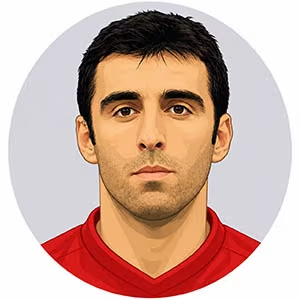
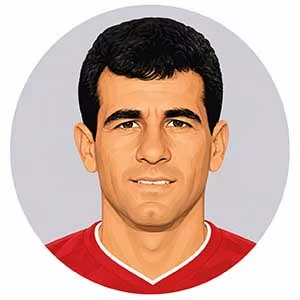
Turkey - StrikerŞükür, Hakan
Rising into the evening sky with an astonishing vertical leap, hanging motionless for an impossible split-second above two center-backs, and driving a thumping header into the top corner defined the overwhelming physical presence of Turkish football’s undisputed goalscoring sovereign. Hakan Şükür—revered worldwide as the Kral (King) or the Bull of the Bosphorus—was a towering, powerhouse target-man who combined colossal aerial dominance with selfless hold-up play, relentless defensive pressing from the front, and a lethal penalty-box scoring record.
Standing six-foot-three with a broad, athletic frame, Şükür was the ultimate focal point: dominating long direct balls, pinning center-halves with his back to goal, and flicking subtle knockdowns into the paths of advancing attacking midfielders like Gheorghe Hagi and Emre Belözoğlu. Over three storied spells at Galatasaray totaling 549 matches and 295 goals, he served as the undisputed talisman of the club’s greatest era, sweeping eight Turkish Süper Lig championships, five Turkish Cups, and captaining the side through their historic, undefeated 1999–2000 UEFA Cup triumph over Arsenal in Copenhagen. His European travels included spells at Torino, Inter Milan, Parma (winning the 2001–02 Coppa Italia), and Blackburn Rovers. For Turkey, across 112 caps, he remains the all-time top scorer in national history with 51 goals, captaining the Milli Takım to a historic third-place finish at the 2002 World Cup, where he scored the fastest goal in World Cup history—just 10.8 seconds into the third-place playoff against South Korea.
His heavy, target-man profile, however, came with distinct technical limitations. Şükür was far from a nimble, tight-space dribbler who could dance past defenders in phone booths or create goals out of nothing through individual solo runs; his scoring output was fundamentally dependent on continuous delivery from wide areas and dynamic runners feeding him vertical passes into his chest. When confronted by elite, mobile European sweepers who denied him physical contact and cut off crossing supply lines from the flanks, his match impact could be reduced to an isolated, attritional battle.
Fiercely proud, deeply spiritual, and carrying the immense emotional weight of a nation’s sporting expectations, Şükür approached professional football as a sacred duty. He never shirked a single aerial duel, throwing his body into flying boots and tracking back fifty yards to defend corners without complaint. On the pitch, his presence was imposing, vocal, and demanding: battling stoppers with unyielding physical strength, organizing pressing triggers with sweeping arm gestures, and celebrating goals with roar-filled sprints to the terraces. Inside the Galatasaray and Turkish national team dressing rooms, he was an untouchable, patriarchal figure whose courage, work rate, and iconic goals made him a living legend of Eurasian football history.