We use Google Analytics to understand how visitors use this site. Analytics cookies are only activated with your consent. For details, read our Privacy Policy.
Profile lensThe same player, read from a different angle.
Athletic81
Acceleration
82
Pace
85
Agility
84
Strength
77
Balance
73
Jumping
78
Stamina
88
Fitness
80
Technical83
Dribbling
86
Short Passing
85
Long Passing
85
Finishing
76
Shot Accuracy
74
Shot Power
84
Shooting Technique
82
Heading
76
Tackling
58
Crossing
80
Free Kick
75
Penalties
74
First Touch
86
Mental76
Composure
76
Aggression
82
Consistency
78
Creativity
79
Leadership
70
Work Rate
82
Tactical77
Vision
80
Off the Ball
80
Defensive Positioning
54
Teamwork
77
Anticipation
76
Marking
49
Attacking77
Crossing
80
Finishing
76
Heading Accuracy
76
Shot Accuracy
74
Off the Ball
80
Technique83
Dribbling
86
Free Kick
75
Short Passing
85
Long Passing
85
First Touch
86
Shot Technique
82
Movement81
Acceleration
82
Pace
85
Agility
84
Balance
73
Physicality81
Shot Power
84
Jumping
78
Stamina
88
Strength
77
Fitness
80
Defending54
Marking
49
Tackling
58
Def. Positioning
54
Mentality & Game Reading77
Aggression
82
Composure
76
Penalties
74
Vision
80
Leadership
70
Work Rate
82
Teamwork
77
Anticipation
76
Consistency
78
Creativity
79
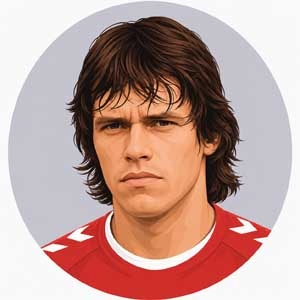
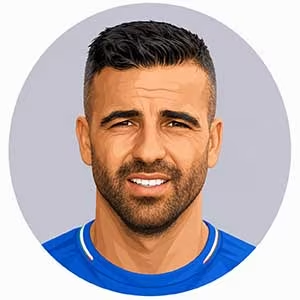
Denmark - Right MidfielderJørgensen, Martin
When Udinese and Fiorentina had to settle their joint ownership of Martin Jørgensen through sealed bids in 2005, neither club thought he was worth paying for. Udinese's envelope contained the number zero. Fiorentina's contained five hundred euros — for a player with eight years of Serie A experience already behind him. It was, in the words of one Italian retrospective, the best money the club never actually spent, because Jørgensen responded to being valued at essentially nothing by playing more than 150 matches over the following six seasons and becoming, quietly, one of the most reliable players in the squad.
Born in Ryomgård, Denmark, in 1975, Jørgensen began his career as a full-back at his hometown club AGF before a release clause allowed him to move to Italy in 1997, joining Udinese specifically to play alongside fellow Dane Thomas Helveg. Across seven seasons at Udinese he settled into central midfield, developing into a genuinely versatile, two-way player who could be deployed across several positions without any evident loss of effectiveness, contributing to the club's surprising third-place finish in 1997–98. His move to Fiorentina in 2004 began poorly — a difficult first season that led directly to his clubs undervaluing him almost to the point of insult — before he became a Viola stalwart, scoring a decisive goal that secured Champions League qualification and, in his final season at the club, a fine strike at Anfield that helped Fiorentina defeat Liverpool in the Champions League group stage. He closed his playing career back at AGF, retiring in 2014 after a twenty-year professional journey. For Denmark he won 102 caps and 12 goals across more than a decade, playing at the 2010 World Cup and multiple European Championships as part of the country's consistent international generation.
His limitations were mostly cosmetic rather than substantive, and appear to have cost him more in reputation than in actual results. Jørgensen's running style was genuinely unusual — awkward enough that observers occasionally mistook it for a lack of top-level ability, a misreading that directly contributed to the humiliatingly low sealed bids both his clubs submitted in 2005. He was not a player who produced dazzling individual highlights, and his value depended on consistency and adaptability across roles rather than any single standout quality, which made him easy for outsiders to undervalue and considerably harder for teammates and coaches, who saw him weekly, to do without.
Temperamentally he responded to that specific institutional insult — being priced at zero and then at a token five hundred euros by the two clubs who knew him best — not with public complaint but with a long, steady run of exactly the reliable performances that made the valuation look absurd in hindsight. He was, by every account, an adaptable, dependable presence rather than a demonstrative one, the kind of player coaches trusted with multiple positions precisely because his application never wavered regardless of the role. His final season at Fiorentina, in which he delivered one of his most memorable European performances at Anfield before choosing to return home to Aarhus rather than chase a more lucrative late-career move elsewhere, suggested a player for whom loyalty to his origins outweighed further accumulation. After retiring he moved into scouting and coaching roles with AGF and briefly the Danish national team, and, according to at least one account, into work connected to the bus and transport industry — a strikingly unglamorous second act for a player who had once been the subject of a genuine Serie A transfer standoff, and one entirely consistent with a career built on substance over visibility. Undervalued by the very clubs who knew him best, quietly vindicated over years rather than moments, and apparently indifferent to the kind of recognition that eluded him, Jørgensen built a two-decade career on proving, repeatedly and without ever raising his voice about it, that the sealed-bid envelopes had been wrong.