We use Google Analytics to understand how visitors use this site. Analytics cookies are only activated with your consent. For details, read our Privacy Policy.
Profile lensThe same player, read from a different angle.
Athletic82
Acceleration
85
Pace
82
Agility
82
Strength
72
Balance
80
Jumping
84
Stamina
85
Fitness
84
Technical74
Dribbling
73
Short Passing
75
Long Passing
75
Finishing
52
Shot Accuracy
59
Shot Power
78
Shooting Technique
68
Heading
74
Tackling
79
Crossing
74
Free Kick
58
Penalties
55
First Touch
74
Mental79
Composure
82
Aggression
76
Consistency
80
Creativity
68
Leadership
70
Work Rate
84
Tactical76
Vision
74
Off the Ball
63
Defensive Positioning
80
Teamwork
78
Anticipation
81
Marking
82
Attacking64
Crossing
74
Finishing
52
Heading Accuracy
74
Shot Accuracy
59
Off the Ball
63
Technique71
Dribbling
73
Free Kick
58
Short Passing
75
Long Passing
75
First Touch
74
Shot Technique
68
Movement82
Acceleration
85
Pace
82
Agility
82
Balance
80
Physicality81
Shot Power
78
Jumping
84
Stamina
85
Strength
72
Fitness
84
Defending80
Marking
82
Tackling
79
Def. Positioning
80
Mentality & Game Reading75
Aggression
76
Composure
82
Penalties
55
Vision
74
Leadership
70
Work Rate
84
Teamwork
78
Anticipation
81
Consistency
80
Creativity
68
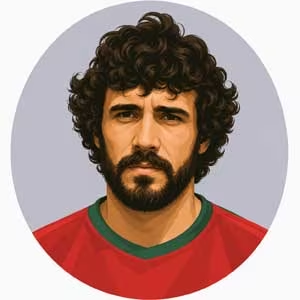
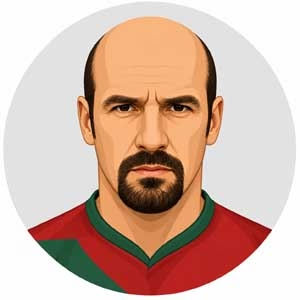
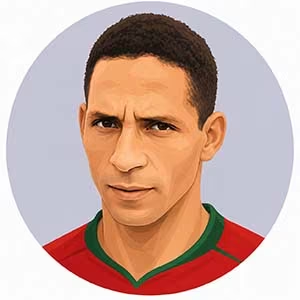
Portugal - Left BackHilário
Four days before Sporting were due to play MTK Budapest in the 1964 European Cup Winners’ Cup final, Hilário da Conceição fractured his tibia against Vitória de Setúbal. He had played virtually the entire European campaign and had spent years as an automatic starter, yet the defining match would take place without him. Hilário later remembered being devastated. From hospital, however, his message to the team was not about the injustice of his absence: he sent a telegram urging them to fight until the end and telling them they were in his heart. Sporting won the replay in Antwerp. When the squad returned to Lisbon, Fernando Mendes and the players went directly from the airport to Hilário’s home carrying the trophy; he kissed it and cried. ([sporting.pt](https://www.sporting.pt/pt/noticias/clube/2013-02-24/um-monstro-sagrado-do-sporting?utm_source=chatgpt.com)) The scene is psychologically useful because forced exclusion from the greatest match in his club’s history produced obvious personal pain without documented detachment from the group’s objective.
Hilário was an exceptionally fast and technically refined left-back whose defending was based more on reading, footwork and controlled confrontation than on intimidation. His own description of facing Garrincha is especially revealing tactically. The first time, as a nineteen-year-old, he was badly beaten. On later meetings he changed the problem rather than simply increasing aggression: he concluded that attempting to stop a creative winger through fouls made the defender’s situation worse and instead concentrated on the ball. Garrincha himself reportedly stopped calling him by the generic nickname he used for full-backs and addressed him by name. ([dn.pt](https://www.dn.pt/arquivo/diario-de-noticias/a-melhor-seleccao-da-historia---hilario%3A-o-heroi-esquecido.html?utm_source=chatgpt.com)) Years later Hilário gave the same tactical principle when discussing Luís Figo: quick creative wingers should be defended through total concentration on the ball, not through fouling the man. ([record.pt](https://www.record.pt/internacional/competicoes-de-selecoes/detalhe/hilario-falta-a-esta-seleccao-alguem-como-o-eusebio?utm_source=chatgpt.com)) He combined that defensive intelligence with speed, technique and a powerful shot, became an undisputed Sporting starter for almost his entire fifteen-season senior career and played every match for Portugal at the 1966 World Cup. Contemporary and retrospective Portuguese accounts consistently identify him among the tournament’s outstanding left-backs. ([ccpm.pt](https://ccpm.pt/pt/hilario-da-conceicao-122?utm_source=chatgpt.com))
His limitations were clearest when the duel became less readable and more purely physical. Hilário’s speed and timing allowed him to control elite wingers, but he was not a large defender and could not derive the same advantage when play was reduced to repeated aerial contests or static physical collisions. His forward contribution was technically strong for the era but should not be projected into the role of a later possession-dominant full-back: he could advance and strike the ball, but his primary responsibility remained direct control of the opposing flank. The career also demonstrates physical vulnerability despite extraordinary durability. The fractured tibia in 1964 removed him from the most important final Sporting ever played, and the injury was severe enough to become one of the defining memories of his career. Yet he returned and continued as first choice for years. Only in his final season, 1972–73, did he definitively lose the regular left-back position before being given a late appearance in the Portuguese Cup final as part of his farewell. ([ccpm.pt](https://ccpm.pt/pt/hilario-da-conceicao-122?utm_source=chatgpt.com)) His degradation therefore came primarily through physical limitation and eventual ageing, not through inability to manage elite attackers psychologically.
Psychologically, Hilário is best defined by **de-escalatory competitiveness**. His football contained strong direct duelling, but his documented response to tension was repeatedly to reduce unnecessary conflict rather than amplify it. He later recalled that Sporting–Benfica matches could become heated and that he and Mário Coluna would sometimes speak in Ronga, the language they shared from Mozambique, specifically to calm disputes without other players understanding the exchange. ([dn.pt](https://www.dn.pt/arquivo/diario-de-noticias/a-melhor-seleccao-da-historia---hilario%3A-o-heroi-esquecido.html?utm_source=chatgpt.com)) This is concrete conflict behaviour, not an inference from temperament. The same distinction appears tactically in his approach to Garrincha: physical aggression was not rejected morally but judged ineffective, so he disciplined himself to watch the ball rather than retaliate against deception. His reaction to the 1964 injury adds another dimension. He openly remembered being shattered by missing the final, yet the immediate behaviour available to teammates was encouragement rather than resentment; when they brought the trophy to him, he accepted the victory as shared rather than treating participation as the condition for belonging. ([sporting.pt](https://www.sporting.pt/pt/noticias/clube/2013-02-24/um-monstro-sagrado-do-sporting?utm_source=chatgpt.com)) Later in life he remained inside Sporting as coach, assistant and youth-development figure, reinforcing—but not retroactively proving—a long pattern of institutional attachment. Evidence concerning referee confrontation, response to teammates’ individual mistakes or hostile crowds is insufficient and should remain unknown. What is defensible is unusually specific: **Hilário competed intensely without requiring emotional escalation, and when conflict threatened the collective task he could actively work to lower its temperature**.


 All Time PortugalNT