We use Google Analytics to understand how visitors use this site. Analytics cookies are only activated with your consent. For details, read our Privacy Policy.
Profile lensThe same player, read from a different angle.
Athletic79
Acceleration
74
Pace
73
Agility
76
Strength
86
Balance
77
Jumping
84
Stamina
84
Fitness
77
Technical80
Dribbling
77
Short Passing
78
Long Passing
78
Finishing
68
Shot Accuracy
72
Shot Power
86
Shooting Technique
70
Heading
88
Tackling
87
Crossing
74
Free Kick
72
Penalties
66
First Touch
77
Mental77
Composure
78
Aggression
82
Consistency
76
Creativity
68
Leadership
70
Work Rate
86
Tactical83
Vision
75
Off the Ball
66
Defensive Positioning
87
Teamwork
86
Anticipation
84
Marking
87
Player Traits
Attacking74
Crossing
74
Finishing
68
Heading Accuracy
88
Shot Accuracy
72
Off the Ball
66
Technique75
Dribbling
77
Free Kick
72
Short Passing
78
Long Passing
78
First Touch
77
Shot Technique
70
Movement75
Acceleration
74
Pace
73
Agility
76
Balance
77
Physicality83
Shot Power
86
Jumping
84
Stamina
84
Strength
86
Fitness
77
Defending87
Marking
87
Tackling
87
Def. Positioning
87
Mentality & Game Reading77
Aggression
82
Composure
78
Penalties
66
Vision
75
Leadership
70
Work Rate
86
Teamwork
86
Anticipation
84
Consistency
76
Creativity
68
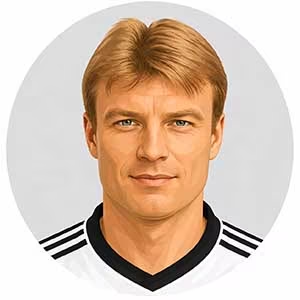
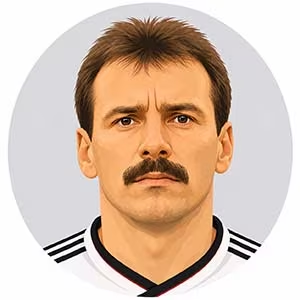
Germany - Centre-backHelmer, Thomas
A ghost goal against 1. FC Nürnberg in April 1994 briefly made him the center of Bundesliga controversy, but reducing the Herford native to a refereeing quirk overlooks one of the most reliable and tactically adaptable German defenders of the 1990s. Thomas Helmer was a commanding, clean-tackling center-half and sweeping libero who combined imposing physical strength with surprising technical composure and sharp aerial timing.
Forged at Arminia Bielefeld and Borussia Dortmund—where he lifted the 1989 DFB-Pokal—Helmer made a then-record domestic switch to Bayern Munich in 1992 for 7.5 million Deutsche Mark. In Bavaria, he became an indispensable defensive pillar across 244 matches, captaining the side to three Bundesliga championships (1994, 1997, 1999), the 1998 DFB-Pokal, and the 1995–96 UEFA Cup against Bordeaux. For Germany, across 68 caps and five goals, his international pinnacle arrived at Euro '96 in England, where he played every minute of the knockout rounds to anchor Die Mannschaft to the continental trophy, having previously been a runner-up at Euro '92.
Helmer’s defensive style, however, relied on spatial reading and structural compactness rather than blistering recovery speed. When dragged into isolated 40-yard footraces against dynamic, agile forwards on wide-open counter-attacks, his large frame and deliberate turning circle could be exposed. Furthermore, recurring hamstring strains and knee wear took a heavy toll toward his thirties, accelerating a brief, unsuccessful transition to the Premier League with Sunderland.
Calm, articulate, and carrying an unshakeable professional gravitas, Helmer led by tactical organization rather than theatrical screaming. He read the game two phases ahead, stepping out of the backline with his head up to distribute crisp ground passes or dispossess strikers with clean standing challenges. Inside the volatile FC Hollywood locker rooms of the 1990s, he was a respected, level-headed figure whose diplomatic composure kept disparate egos aligned, cementing an enduring legacy as one of the most dependable and decorated German central defenders of his generation.