We use Google Analytics to understand how visitors use this site. Analytics cookies are only activated with your consent. For details, read our Privacy Policy.
Profile lensThe same player, read from a different angle.
Athletic81
Acceleration
79
Pace
82
Agility
75
Strength
82
Balance
76
Jumping
83
Stamina
85
Fitness
84
Technical75
Dribbling
76
Short Passing
72
Long Passing
74
Finishing
65
Shot Accuracy
66
Shot Power
84
Shooting Technique
68
Heading
80
Tackling
78
Crossing
77
Free Kick
66
Penalties
65
First Touch
75
Mental79
Composure
77
Aggression
78
Consistency
80
Creativity
65
Leadership
80
Work Rate
80
Tactical77
Vision
74
Off the Ball
70
Defensive Positioning
76
Teamwork
82
Anticipation
80
Marking
82
Attacking72
Crossing
77
Finishing
65
Heading Accuracy
80
Shot Accuracy
66
Off the Ball
70
Technique72
Dribbling
76
Free Kick
66
Short Passing
72
Long Passing
74
First Touch
75
Shot Technique
68
Movement78
Acceleration
79
Pace
82
Agility
75
Balance
76
Physicality84
Shot Power
84
Jumping
83
Stamina
85
Strength
82
Fitness
84
Defending79
Marking
82
Tackling
78
Def. Positioning
76
Mentality & Game Reading76
Aggression
78
Composure
77
Penalties
65
Vision
74
Leadership
80
Work Rate
80
Teamwork
82
Anticipation
80
Consistency
80
Creativity
65
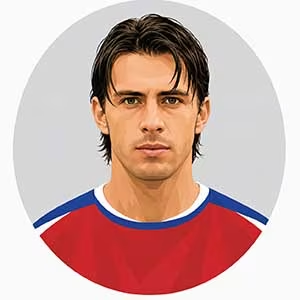
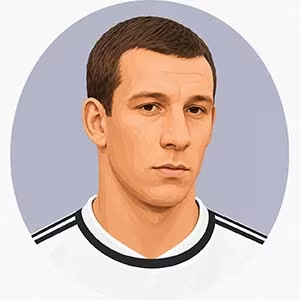
Czech Republic - Right BackGrygera, Zdeněk
Pragmatic positional reliability, clean fundamental tackling, and physical durability across the backline made Zdeněk Grygera a trusted tactical anchor during a turbulent transitional era for both club and country. Developing at Petra Drnovice and Sparta Prague—where he secured two Czech First League titles—the Moravian defender established his European reputation at AFC Ajax under Ronald Koeman and Danny Blind. Standing six feet tall with a sturdy, upright frame, Grygera was primarily a defensive right-back who could seamlessly slide across to center-back or left-back in a flat back four. He was not a modern, explosive wing-back who lived to overlap and beat defenders one-on-one; his game was built around conservative positioning, solid aerial leverage on diagonal cross-field balls, and a firm, low-risk side-foot distribution. Moving to Juventus on a free transfer in 2007 during their post-Calciopoli rebuild, he became an undisputed regular across four seasons, making over 110 appearances and scoring a famous stoppage-time equalizer against Inter Milan in the 2009 Derby d'Italia. On the international stage, he accumulated 65 caps and two goals for the Czech Republic, functioning as the starting right-back for Karel Brückner’s electrifying Euro 2004 semi-final squad, the 2006 World Cup, and Euro 2008. Structurally, however, his physical limitations were evident against world-class pace: he lacked high-end recovery speed when caught upfield, had a stiff turning circle against nimble wingers, and offered minimal crossing variation into the final third. A severe anterior cruciate ligament tear sustained during a brief Premier League stint at Fulham in 2011 ultimately brought a sudden end to his top-flight career.
Disciplined, stoic, and unbothered by external criticism, Grygera was the consummate low-maintenance professional who executed managerial instructions to the letter without demanding tactical concessions. He possessed zero interest in self-promotion or stylistic flair, approaching demanding defensive assignments against elite wingers with methodical, blue-collar focus. On the pitch, his emotional baseline remained steady even when isolated in high-risk one-on-one situations; he relied on strict positional containment rather than desperate, sliding challenges that might lead to cards or penalties. Inside the dressing rooms of Amsterdam, Turin, and the Czech national team, he was an understated, reliable figure who blended effortlessly into squad hierarchies, respected by veteran leaders like Pavel Nedvěd and Gianluigi Buffon for his spotless training habits and willingness to play through physical knocks. When targeted by opposing attacks as the perceived weak link in possession, Grygera rarely panicked, keeping his clearances simple and avoiding costly unforced turnovers in his own third. Toward match officials and physical opponents, he was sober, polite, and completely devoid of gamesmanship, leaving behind a legacy as a dedicated, selfless, and disciplined defensive workhorse who stabilized every backline he represented.