We use Google Analytics to understand how visitors use this site. Analytics cookies are only activated with your consent. For details, read our Privacy Policy.
Profile lensThe same player, read from a different angle.
Athletic80
Acceleration
87
Pace
82
Agility
87
Strength
71
Balance
80
Jumping
79
Stamina
77
Fitness
76
Technical84
Dribbling
92
Short Passing
79
Long Passing
85
Finishing
86
Shot Accuracy
82
Shot Power
80
Shooting Technique
80
Heading
66
Tackling
38
Crossing
83
Free Kick
74
Penalties
74
First Touch
87
Mental81
Composure
82
Aggression
76
Consistency
77
Creativity
84
Leadership
85
Work Rate
79
Tactical77
Vision
79
Off the Ball
85
Defensive Positioning
40
Teamwork
77
Anticipation
76
Marking
33
Player Traits
Attacking80
Crossing
83
Finishing
86
Heading Accuracy
66
Shot Accuracy
82
Off the Ball
85
Technique83
Dribbling
92
Free Kick
74
Short Passing
79
Long Passing
85
First Touch
87
Shot Technique
80
Movement84
Acceleration
87
Pace
82
Agility
87
Balance
80
Physicality77
Shot Power
80
Jumping
79
Stamina
77
Strength
71
Fitness
76
Defending37
Marking
33
Tackling
38
Def. Positioning
40
Mentality & Game Reading79
Aggression
76
Composure
82
Penalties
74
Vision
79
Leadership
85
Work Rate
79
Teamwork
77
Anticipation
76
Consistency
77
Creativity
84
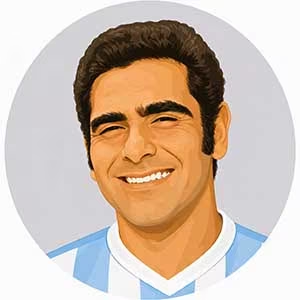
Uruguay - Right WingerCubilla, Luis
Montevideo, 1970s: an aging winger explains to a young reporter that the most important thing on a football pitch is not speed or strength but knowing what the opponent is about to do before he does. Luis Cubilla spent twenty years proving it. He was not the quickest winger of his generation, not the most technically dazzling, and not the biggest name in any of the great teams he played for — and he won two Copas Libertadores with two different clubs in two different countries, played in three World Cups, and finished with a collection of medals that few South Americans of any era can match.
Born in Paysandú in 1940, Cubilla emerged at Peñarol, where he became part of the finest side in the club's history under Roberto Scarone. He was a right-winger of the classical South American type: 1.72m, low centre of gravity, comfortable hugging the touchline, and dangerous cutting inside onto his left. His dribbling relied on changes of rhythm rather than pure acceleration, and his crossing was accurate and varied. What distinguished him was game intelligence — reading defensive shape, drifting into the spaces full-backs vacated, and choosing the moment rather than forcing it. With Peñarol he won the Copa Libertadores in 1960 and 1961 and the Intercontinental Cup in 1961, beating Benfica. He then moved to Barcelona, where he spent three seasons without ever fully settling, then to River Plate in Argentina, before returning to Uruguay and finally joining Nacional — Peñarol's fiercest rival — where at thirty-one he won a second Libertadores and Intercontinental Cup in 1971, an act of cross-divide success almost nobody in Montevideo has replicated. For Uruguay he won 38 caps and played at the World Cups of 1962, 1970 and 1974, reaching the semi-finals in Mexico.
His limitations were of scale rather than of ability. Cubilla was never a prolific scorer, contributing crosses and openings rather than finishing, and against disciplined full-backs who refused to be drawn out of position he could be contained without great difficulty. His European spell exposed a dependence on rhythm-based football: in a Spanish league that pressed harder and gave less time, his effectiveness dropped noticeably, and he returned to South America without having made the impact his reputation promised.
Temperamentally he was shrewd rather than combustible. Cubilla played with the viveza that Río de la Plata football has always prized — provoking defenders into rash challenges, winning free kicks in advantageous positions, managing the referee with small courtesies, and slowing a game his team was winning through a hundred imperceptible delays. It was calculated rather than aggressive: he rarely retaliated physically, was seldom booked for violence, and treated gamesmanship as a professional skill on the same shelf as crossing. Off the ball he was constantly talking — to teammates, to opponents, to officials — and teammates described a player who understood matches strategically and communicated that understanding continuously. His move from Peñarol to Nacional required considerable nerve in a city that regards the divide as absolute, and he made it without apparent anxiety. Away from football he was thoughtful, articulate and ambitious in a way that pointed clearly towards the long and distinguished coaching career that followed across Uruguay, Paraguay and beyond. Cunning, durable and quietly relentless, Cubilla won trophies on both sides of a rivalry that most players never cross once.


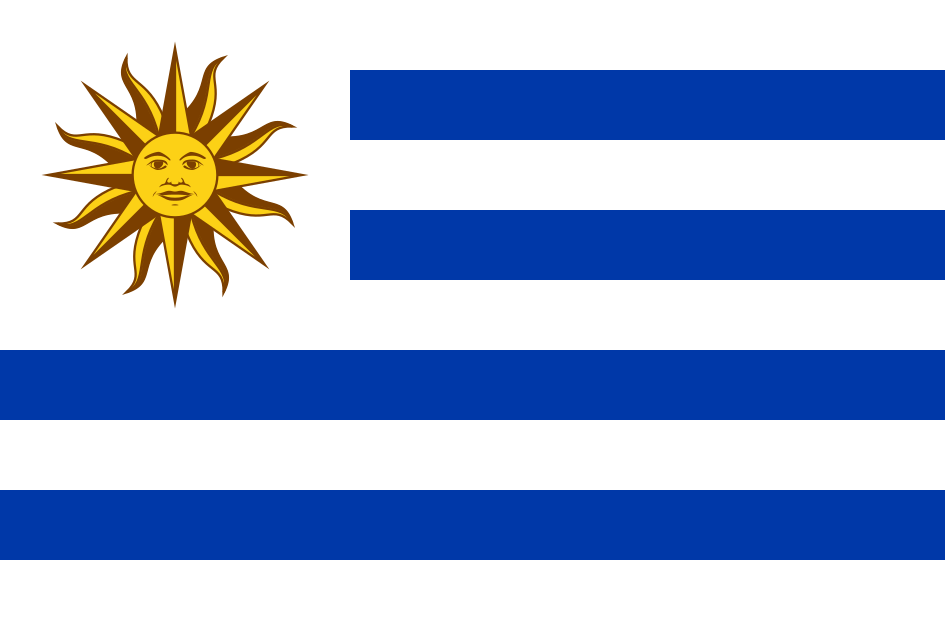 All Time UruguayNT