We use Google Analytics to understand how visitors use this site. Analytics cookies are only activated with your consent. For details, read our Privacy Policy.
Profile lensThe same player, read from a different angle.
Athletic82
Acceleration
85
Pace
83
Agility
82
Strength
82
Balance
80
Jumping
85
Stamina
79
Fitness
77
Technical83
Dribbling
82
Short Passing
77
Long Passing
78
Finishing
86
Shot Accuracy
85
Shot Power
85
Shooting Technique
79
Heading
86
Tackling
44
Crossing
70
Free Kick
72
Penalties
88
First Touch
84
Mental81
Composure
87
Aggression
76
Consistency
80
Creativity
76
Leadership
75
Work Rate
78
Tactical82
Vision
74
Off the Ball
87
Defensive Positioning
44
Teamwork
84
Anticipation
85
Marking
38
Player Traits
Attacking83
Crossing
70
Finishing
86
Heading Accuracy
86
Shot Accuracy
85
Off the Ball
87
Technique79
Dribbling
82
Free Kick
72
Short Passing
77
Long Passing
78
First Touch
84
Shot Technique
79
Movement83
Acceleration
85
Pace
83
Agility
82
Balance
80
Physicality82
Shot Power
85
Jumping
85
Stamina
79
Strength
82
Fitness
77
Defending42
Marking
38
Tackling
44
Def. Positioning
44
Mentality & Game Reading80
Aggression
76
Composure
87
Penalties
88
Vision
74
Leadership
75
Work Rate
78
Teamwork
84
Anticipation
85
Consistency
80
Creativity
76
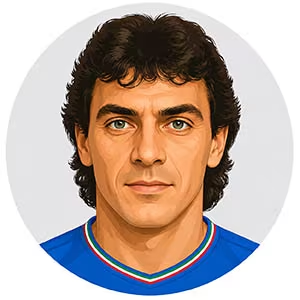
Italy - StrikerVirdis, Pietro Paolo
At San Siro on 19 April 1989, Milan entered the second leg of their European Cup semi-final against Real Madrid with the tie level after a 1–1 draw in Spain. Pietro Paolo Virdis was thirty-one and no longer the automatic attacking reference he had been when he became Serie A’s leading scorer two seasons earlier. Yet Arrigo Sacchi selected him alongside Marco van Basten. Milan overwhelmed Madrid 5–0. Virdis did not score, but his movement across the front contributed to a collective performance built on pressure, interchange and the willingness of attackers to work without possession. Weeks later Milan became European champions. The situation represented a long distance from the early trajectory of Virdis’s career. He had been a prolific young striker at Cagliari, moved to Juventus with enormous expectations, struggled for continuity, returned to Sardinia, went back to Turin and was subsequently sold to Udinese before reconstructing himself at Milan. His career did not progress through uninterrupted confirmation. It repeatedly removed the status he had appeared to earn and required him to establish usefulness again.
Virdis was a centre-forward whose intelligence inside the penalty area mattered more than imposing physical dimensions. Strong in the air despite being around 1.82 metres, he timed movements well, attacked crosses aggressively and possessed the technical cleanliness to finish quickly with either foot. He was not a static penalty-box striker: he could move laterally, combine outside the area and create space for another forward, qualities that became increasingly important once Sacchi transformed Milan’s attacking structure. His peak individual season came in 1986–87, when 17 league goals made him Serie A’s Capocannoniere. The following year his goals against Napoli in the decisive 3–2 victory at the San Paolo helped Milan overtake Diego Maradona’s side and win the championship. At Juventus he had already collected major trophies, but his contribution there had been irregular; at Milan he became both more prolific and tactically mature. Sacchi later retained him within a system demanding coordinated pressing and movement rather than allowing the centre-forward to wait exclusively for service. Virdis therefore evolved from promising scorer into a forward capable of contributing to a much more collective attacking mechanism.
His limitations were visible precisely when that mechanism was absent. Virdis was not physically overwhelming enough to dominate elite centre-backs through contact alone, nor explosive enough to manufacture repeated chances by separating over long distances. He depended on reading service, combination and movement around him. When confidence and continuity disappeared, his scoring could fall sharply. His first Juventus spell demonstrated that vulnerability: arriving as an expensive young forward, he struggled to reproduce his Cagliari output and was eventually loaned back. Even after returning to Juventus, he never became an undisputed attacking reference. This should not be reduced to psychological weakness. Competition, tactical context and the quality of teammates all affected his minutes, while his later Milan success proves that early difficulty did not establish a permanent ceiling. Age eventually removed some mobility, and the arrival of Van Basten increasingly reduced his centrality. Virdis could remain useful inside Sacchi’s collective system, but once his physical and scoring advantages declined he did not possess a separate elite creative function capable of guaranteeing selection.
Psychologically, Virdis’s most defensible distinguishing feature is **persistence after repeated status displacement without corresponding public externalisation**. His career repeatedly delivered signals that could have been interpreted as rejection. Juventus bought him as one of Italy’s major young forwards, then returned him to Cagliari on loan after an unsuccessful first season. He subsequently re-entered Juventus, left again for Udinese and only in his late twenties established the period that ultimately defined his reputation. The important evidence lies in behaviour rather than assumptions about how those moves felt: Virdis repeatedly resumed competitive work rather than constructing a public grievance around selection or hierarchy. At Milan the pattern became sharper. After winning the scoring title, he progressively surrendered attacking centrality as the Dutch forwards arrived, yet continued adapting to Sacchi’s collective requirements and remained part of the European Cup-winning squad. This does not prove low sensitivity to status; surviving evidence is too weak to establish what he privately felt about each demotion. It demonstrates **status-loss functionality**: reduced hierarchy did not automatically remove his capacity to contribute. The same distinction applies to pressure. His two goals at Napoli in 1988 came in one of the most consequential matches of his club career, indicating that high stakes themselves did not suppress execution. Evidence concerning referees, individual provocation, teammate mistakes, hostile crowds or confrontation with coaches is insufficient and should remain unknown. Virdis therefore resists the generic “professional striker” label. His stronger pattern is that repeated institutional and competitive displacement altered his position without permanently convincing him that his usefulness had expired.