We use Google Analytics to understand how visitors use this site. Analytics cookies are only activated with your consent. For details, read our Privacy Policy.
Profile lensThe same player, read from a different angle.
Athletic80
Acceleration
82
Pace
86
Agility
83
Strength
82
Balance
78
Jumping
73
Stamina
81
Fitness
75
Technical81
Dribbling
86
Short Passing
77
Long Passing
81
Finishing
82
Shot Accuracy
74
Shot Power
83
Shooting Technique
78
Heading
66
Tackling
48
Crossing
84
Free Kick
77
Penalties
75
First Touch
84
Mental78
Composure
78
Aggression
76
Consistency
74
Creativity
82
Leadership
78
Work Rate
81
Tactical76
Vision
80
Off the Ball
82
Defensive Positioning
42
Teamwork
78
Anticipation
75
Marking
41
Player Traits
Attacking78
Crossing
84
Finishing
82
Heading Accuracy
66
Shot Accuracy
74
Off the Ball
82
Technique81
Dribbling
86
Free Kick
77
Short Passing
77
Long Passing
81
First Touch
84
Shot Technique
78
Movement82
Acceleration
82
Pace
86
Agility
83
Balance
78
Physicality79
Shot Power
83
Jumping
73
Stamina
81
Strength
82
Fitness
75
Defending44
Marking
41
Tackling
48
Def. Positioning
42
Mentality & Game Reading78
Aggression
76
Composure
78
Penalties
75
Vision
80
Leadership
78
Work Rate
81
Teamwork
78
Anticipation
75
Consistency
74
Creativity
82
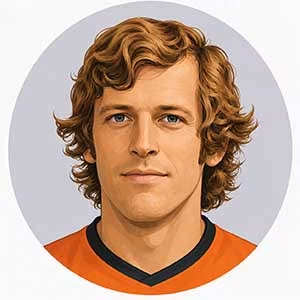
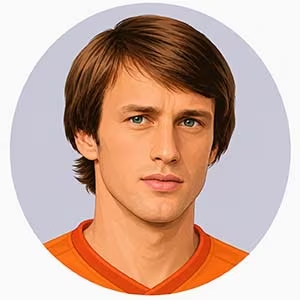
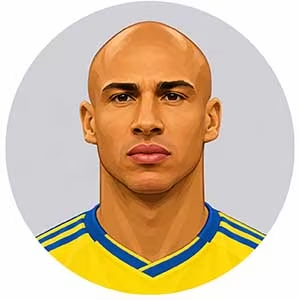
Sweden - Left WingerPersson, Örjan
When Scottish football was at its absolute competitive zenith in the mid-1960s, it was an unorthodox, dynamic Swedish outside-left who broke through traditional insular barriers to become a pioneering continental idol for Dundee United and Rangers. Emerging from the technical hotbed of Örgryte IS alongside the virtuoso Agne Simonsson, Per Örjan Persson possessed a blistering change of pace, an unyielding physical balance over heavy mud, and a lethal, swerving left-foot cross delivered at maximum sprint speed. Tactically direct and unburdened by over-elaboration, Persson excelled at isolating full-backs on the outer chalk: he would drop his shoulder, knock the ball past his marker into open grass, and whip vicious, low-trajectory deliveries across the six-yard corridor or cut inside to unleash ferocious long-range drives. As a key protagonist in Jerry Kerr’s historic Dundee United side—famously scoring in their back-to-back 1966–67 Inter-Cities Fairs Cup triumphs over defending champions Barcelona—and later reaching the 1969 Scottish Cup final with Rangers, he earned 48 caps for Sweden, serving as a vital wide outlet across both the 1970 World Cup in Mexico and the 1974 World Cup in West Germany. Mentally and emotionally, Persson was a quiet trailblazer driven by an understated, iron-willed adaptability and an innate love for the raw physical contest. Relocating to the uncompromising, tackle-heavy landscape of Scottish football in 1964—an era when Scandinavian imports were rare and viewed with deep skepticism—he conquered the terraces not with flamboyant posturing, but with sheer grit, physical bravery, and a refusal to back down from bone-jarring challenges. On the pitch, his demeanor was remarkably grounded; he played with an unpretentious, workmanlike focus, treating every high-stakes European tie with the same quiet concentration as a domestic league clash. Inside the dressing room, he was a deeply respected, low-maintenance teammate whose quiet professionalism and rapid assimilation into Scottish sporting culture earned him unconditional reverence in Dundee and Glasgow. Under high-friction World Cup tournament conditions, his emotional pulse remained remarkably flat; he never let hostile cauldrons or tight marking disrupt his rhythm, executing his wide duties with mechanical consistency. Toward match officials and physical defenders who routinely targeted him with brutal challenges, Persson maintained an immaculate, old-school stoicism: never rolling on the ground, feigning injury, or retaliating, simply bouncing back up to his feet to run at his marker again on the very next sequence.