We use Google Analytics to understand how visitors use this site. Analytics cookies are only activated with your consent. For details, read our Privacy Policy.
Profile lensThe same player, read from a different angle.
Athletic87
Acceleration
95
Pace
92
Agility
92
Strength
78
Balance
84
Jumping
82
Stamina
86
Fitness
86
Technical80
Dribbling
83
Short Passing
75
Long Passing
76
Finishing
87
Shot Accuracy
79
Shot Power
85
Shooting Technique
77
Heading
77
Tackling
45
Crossing
75
Free Kick
72
Penalties
75
First Touch
83
Mental81
Composure
82
Aggression
85
Consistency
82
Creativity
76
Leadership
78
Work Rate
80
Tactical80
Vision
78
Off the Ball
88
Defensive Positioning
48
Teamwork
78
Anticipation
85
Marking
42
Player Traits
Attacking81
Crossing
75
Finishing
87
Heading Accuracy
77
Shot Accuracy
79
Off the Ball
88
Technique78
Dribbling
83
Free Kick
72
Short Passing
75
Long Passing
76
First Touch
83
Shot Technique
77
Movement91
Acceleration
95
Pace
92
Agility
92
Balance
84
Physicality83
Shot Power
85
Jumping
82
Stamina
86
Strength
78
Fitness
86
Defending45
Marking
42
Tackling
45
Def. Positioning
48
Mentality & Game Reading80
Aggression
85
Composure
82
Penalties
75
Vision
78
Leadership
78
Work Rate
80
Teamwork
78
Anticipation
85
Consistency
82
Creativity
76
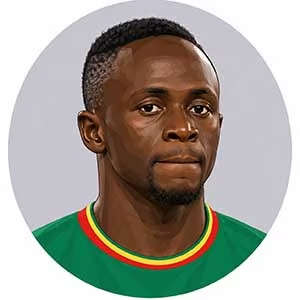
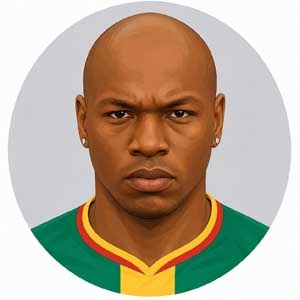
Senegal - Right WingerMané, Sadio
Sadio Mané’s most destructive movement often began before he touched the ball. From the left he would wait until the defender’s attention shifted inside, then accelerate diagonally through the gap between full-back and centre-back, arriving at a speed that turned an ordinary forward pass into an immediate scoring opportunity. His first steps were exceptionally violent, but the movement was not simply sprinting: Mané continuously adjusted the angle according to where teammates and defenders moved, allowing him to attack centrally without permanently occupying the striker’s position. At Liverpool this became part of a front line whose members repeatedly exchanged territory. Mané could begin as the widest attacker, become the first presser, recover towards midfield and still arrive inside the six-yard box. The amount of work preceding the finish helps explain why his scoring should not be separated from his collective function.
Mané was a wide forward capable of playing from either flank or centrally. His acceleration, balance and close control made him dangerous attacking open space, while rapid changes of direction allowed him to continue dribbling after the initial burst. He was a strong finisher with either foot and exceptionally effective in the air relative to his height because of explosive elevation and aggressive timing. Under Jürgen Klopp his off-ball contribution became equally important: pressing from the front, recovering towards the full-back and immediately transitioning back into attack. He scored 120 goals in 269 Liverpool appearances while winning the Premier League and Champions League, yet his role was never reduced to finishing. With Senegal, responsibility became still broader. Mané was the principal attacking reference of the side that won the 2021 Africa Cup of Nations, scoring the decisive penalty in the final shoot-out against Egypt and later another decisive shoot-out penalty against the same opponent to qualify for the 2022 World Cup.
There were nevertheless clear limits. Mané was technically secure but not a primary possession organiser; teams defending extremely deep could reduce the space available for the acceleration that made his carrying most destructive. His first touch at maximal speed could occasionally become loose, and his creativity was more dangerous through movement, combinations and penetration than through sustained orchestration against a static block. His intense physical game also depended heavily on repeat acceleration. As those margins narrowed, particularly after leaving Liverpool, he could no longer create separation with the same frequency. His aggression had another boundary. Most of Mané’s physical intensity was tactical—pressing, duelling and attacking loose balls—but isolated interpersonal conflicts could become genuinely emotional. At Bayern Munich in 2023, an argument with Leroy Sané after defeat to Manchester City continued into the dressing room and Mané struck his teammate, leading to a club suspension and fine. That episode produced an actual availability cost and cannot be absorbed into generic competitiveness.
Psychologically, Mané is best defined by **reciprocity-sensitive collectivism**. His Liverpool behaviour supplies both sides of the mechanism. He accepted enormous defensive and off-ball work inside Klopp’s structure without requiring every attack to finish through him, demonstrating genuine capacity for tactical subordination. Yet at Burnley in 2019 he reacted furiously after being substituted, with television footage showing his anger directed towards a previous attacking situation in which Mohamed Salah had chosen to shoot rather than pass to him. Klopp subsequently described the incident as an emotional reaction that the group could resolve rather than a lasting rupture. The distinction is useful: Mané’s frustration was not simply caused by failing to score or being substituted; it followed a perceived failure of attacking reciprocity after he had made himself available. The Sané incident demonstrates that this sensitivity could, in a different environment, cross into unacceptable escalation. Conversely, major collective responsibility generally increased rather than reduced his willingness to expose himself. After Senegal had lost the 2019 Africa Cup of Nations final, Mané remained the central figure in the next campaign and took the decisive final penalty in 2022. Evidence for chronic referee conflict or systematic blame after teammates’ mistakes is insufficient. The stronger contradiction is that **Mané could subordinate an extraordinary amount of individual effort to the collective, but precisely because he invested so heavily in that exchange, moments he perceived as failures of reciprocity could provoke reactions far stronger than his generally cooperative role suggested**.