We use Google Analytics to understand how visitors use this site. Analytics cookies are only activated with your consent. For details, read our Privacy Policy.
Profile lensThe same player, read from a different angle.
Athletic82
Acceleration
83
Pace
85
Agility
82
Strength
81
Balance
77
Jumping
77
Stamina
85
Fitness
86
Technical81
Dribbling
86
Short Passing
78
Long Passing
86
Finishing
78
Shot Accuracy
77
Shot Power
80
Shooting Technique
78
Heading
69
Tackling
51
Crossing
86
Free Kick
67
Penalties
71
First Touch
85
Mental78
Composure
76
Aggression
79
Consistency
83
Creativity
84
Leadership
75
Work Rate
77
Tactical80
Vision
80
Off the Ball
83
Defensive Positioning
51
Teamwork
85
Anticipation
78
Marking
41
Attacking79
Crossing
86
Finishing
78
Heading Accuracy
69
Shot Accuracy
77
Off the Ball
83
Technique80
Dribbling
86
Free Kick
67
Short Passing
78
Long Passing
86
First Touch
85
Shot Technique
78
Movement82
Acceleration
83
Pace
85
Agility
82
Balance
77
Physicality82
Shot Power
80
Jumping
77
Stamina
85
Strength
81
Fitness
86
Defending48
Marking
41
Tackling
51
Def. Positioning
51
Mentality & Game Reading79
Aggression
79
Composure
76
Penalties
71
Vision
80
Leadership
75
Work Rate
77
Teamwork
85
Anticipation
78
Consistency
83
Creativity
84
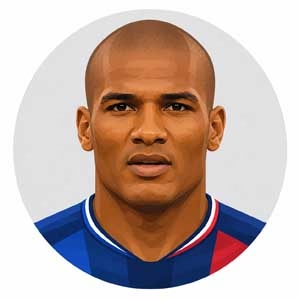
France - Left MidfielderMalouda, Florent
Florent Malouda arrived at Chelsea with the reputation of a genuinely gifted, occasionally luxurious wide player from Lyon's most dominant era, and spent most of his English career being quietly reshaped into something more defensively accountable and considerably less indulgent — a transformation he generally accepted, though not always without visible frustration along the way.
Born in Cayenne, French Guiana, in 1980, Malouda developed through French football at Châteauroux and Guingamp before establishing himself at Lyon, where he became a key attacking presence in the side that dominated Ligue 1 for most of the 2000s. He was a versatile, technically accomplished wide player, comfortable on either flank, capable of beating defenders in one-on-one situations and delivering a dangerous, well-weighted cross, with an end product that improved steadily as he matured. At Lyon he won four consecutive Ligue 1 titles between 2004 and 2007 and was named French Player of the Year in 2007, form that persuaded Chelsea to sign him that summer. Under José Mourinho's successors, and particularly under Carlo Ancelotti, he adapted into a more disciplined, two-way wide player, contributing to the 2010 Premier League and FA Cup double and later the 2012 Champions League and Europa League successes, though by the latter he was featuring considerably less as younger options were preferred. He made over 200 appearances for Chelsea across six seasons. For France he won 80 caps, was a regular in the squad that reached the 2006 World Cup final, and played at the 2010 World Cup during the deeply dysfunctional campaign that ended in a player revolt and early elimination.
His limitations shifted over the course of his career in ways that reflected the demands placed on him rather than any fixed technical ceiling. At Lyon, in a more expansive system, his end product could be inconsistent relative to his evident quality, prone to matches of genuine brilliance followed by stretches of anonymity. In England, asked increasingly to track back and defend his flank as Premier League football demanded, his attacking output and his sense of creative freedom both declined, and he occasionally appeared visibly restricted by a defensive workload he had not been asked to carry earlier in his career. Age and accumulated injuries further reduced his effectiveness in his final Chelsea seasons, and he never fully recovered the influence he had carried in his best Lyon years.
Temperamentally he showed more variability than many players in comparable wide, service-based roles. Malouda accepted the tactical reshaping Chelsea's coaching staff imposed on his game, but not always in silence — he was reported at various points to be unhappy with a reduced attacking role, and his relationship with André Villas-Boas deteriorated sharply during the manager's short tenure, resulting in him being frozen out of the squad entirely for a period despite being under contract, a dispute that became public and was resolved only once Villas-Boas was replaced. He was not a disciplinary problem on the pitch in any conventional sense, maintaining a reasonable card record for a wide player subjected to persistent physical attention, but his frustration when marginalized was less contained than that of several other technically gifted players who accepted diminished roles with more visible equanimity. Within the France squad he was present for one of international football's most publicly dysfunctional episodes, the 2010 training ground strike, without emerging as either its instigator or its most prominent figure, suggesting a player who participated in collective discontent without personally driving it. Away from the pitch his profile remained relatively modest, and after his playing career he moved into ambassadorial and coaching-adjacent roles connected to his former clubs. Technically gifted, adaptable under normal circumstances but capable of open frustration when sidelined, Malouda's career illustrates how differently a talented wide player can respond to positional demotion depending on how it is communicated and how permanent it appears.


 All Time ChelseaClub