We use Google Analytics to understand how visitors use this site. Analytics cookies are only activated with your consent. For details, read our Privacy Policy.
Profile lensThe same player, read from a different angle.
Athletic79
Acceleration
79
Pace
84
Agility
77
Strength
84
Balance
73
Jumping
77
Stamina
77
Fitness
77
Technical85
Dribbling
78
Short Passing
75
Long Passing
75
Finishing
92
Shot Accuracy
94
Shot Power
85
Shooting Technique
80
Heading
85
Tackling
38
Crossing
70
Free Kick
74
Penalties
81
First Touch
84
Mental81
Composure
84
Aggression
76
Consistency
79
Creativity
80
Leadership
80
Work Rate
78
Tactical84
Vision
75
Off the Ball
93
Defensive Positioning
33
Teamwork
74
Anticipation
91
Marking
33
Player Traits
Attacking87
Crossing
70
Finishing
92
Heading Accuracy
85
Shot Accuracy
94
Off the Ball
93
Technique78
Dribbling
78
Free Kick
74
Short Passing
75
Long Passing
75
First Touch
84
Shot Technique
80
Movement78
Acceleration
79
Pace
84
Agility
77
Balance
73
Physicality80
Shot Power
85
Jumping
77
Stamina
77
Strength
84
Fitness
77
Defending35
Marking
33
Tackling
38
Def. Positioning
33
Mentality & Game Reading80
Aggression
76
Composure
84
Penalties
81
Vision
75
Leadership
80
Work Rate
78
Teamwork
74
Anticipation
91
Consistency
79
Creativity
80
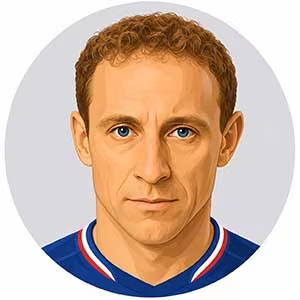
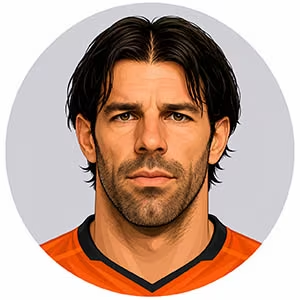
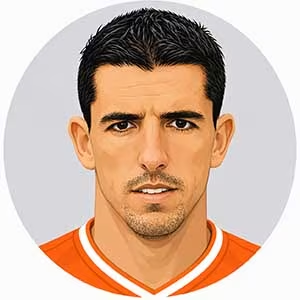
Netherlands - StrikerMakaay, Roy
On 7 March 2007, Real Madrid had barely completed the first pass of their Champions League second leg in Munich when Roberto Carlos miscontrolled the ball under pressure. Hasan Salihamidžić stole possession and immediately found Roy Makaay. Ten seconds after kick-off, Makaay drove a low shot past Iker Casillas. It became the fastest goal in Champions League history at the time. The finish was typical of him: no extra touch, no visible hesitation, no need to improve the angle. The chance appeared and the decision was already made. Bayern eventually won 2–1 and advanced. Makaay’s game was built around exactly that economy — minimal movement, minimal delay, maximum consequence.
Makaay was a centre-forward whose defining qualities were timing, composure and efficiency rather than spectacular athleticism. He was tall enough to compete physically, quick enough to attack space behind a defensive line and technically clean with either foot, but his greatest strength was how early he recognised the final action. He did not need many touches to finish and was particularly dangerous when receiving diagonally across goal or when a defender had been forced to turn. His off-ball movement was subtle rather than incessant: instead of roaming constantly, he conserved position and then accelerated into the channel most likely to produce a shooting opportunity. He could also drop short to combine, but he was not primarily a playmaking forward. At Vitesse and Tenerife he developed steadily before exploding at Deportivo La Coruña, where he scored 79 league goals in four seasons and won the 2002 Copa del Rey. In 2002–03 he scored 29 league goals, won the Pichichi Trophy and received the European Golden Shoe. Bayern Munich signed him that summer for a club-record fee. He scored prolifically across four seasons, winning Bundesliga and DFB-Pokal doubles in 2005 and 2006. His first season in Munich brought 23 league goals, and he remained one of the most consistent scorers in Germany before leaving for Feyenoord in 2007. He finished his playing career there in 2010. For the Netherlands he won 43 caps and scored six goals, but his international role was more modest than his club scoring record suggested, partly because competition for attacking places was unusually strong.
The same economy that made Makaay efficient also limited the ways in which he could influence difficult matches. If opponents denied the space behind them, prevented early service into the box and forced him to receive with his back to goal under pressure, he could become peripheral. He was not a forward who naturally solved congestion through dribbling or created a large volume of chances for himself from static positions. His game worked best when teammates could feed him early and accurately. When that supply disappeared, his low-touch style could look like inactivity rather than restraint. He was also less suited to systems requiring constant pressing or extensive defensive work from the striker. At international level, where his role was often less central and combinations were less tailored around his movement, he never reproduced his club numbers. Later in his Bayern spell, tactical changes and competition reduced his prominence, and once the team no longer treated him as the automatic focal point, his influence became less stable.
Psychologically, Makaay appears to have possessed unusually low emotional noise around the act of finishing. Teammates and coaches repeatedly described him as calm, understated and efficient, and his own public behaviour fit that image. He rarely celebrated goals theatrically, rarely sought confrontation and showed little evidence of using anger or provocation as fuel. The 2007 goal against Real Madrid is a useful example because the occasion was enormous and the action arrived almost immediately: there was no time to settle into the match emotionally. Makaay simply executed the chance. That suggests a striker whose activation threshold was already high enough without needing external stimulation. His career also shows substantial tolerance for pressure generated by expectations. Deportivo paid heavily for him, Bayern broke their transfer record to sign him, and he responded in both contexts with immediate scoring rather than visible anxiety. The more difficult psychological question concerns status. At Bayern, once competition increased and his role became less secure, Makaay did not respond with public confrontation or open rebellion, but he did become increasingly ready to leave for a team where he could remain central. That distinction matters. He was not indifferent to hierarchy; he simply processed dissatisfaction quietly. His behaviour therefore suggests high internal confidence combined with low performative ego. Criticism rarely produced public escalation, and there is little evidence of repeated feuds with coaches, referees or teammates. Physical provocation similarly appears to have affected the difficulty of his work more than his emotional state. Makaay’s leadership was not vocal or corrective. He led through reliability: occupying the right space, repeating the same runs and converting chances without requiring the group to revolve emotionally around him. When matches became chaotic, this could be both strength and weakness. He did not usually become less composed, but neither did he naturally seize the game by force of personality. His best psychological environment was one in which responsibility was clear, service was reliable and he could reduce pressure to one repeated task: arrive, decide, finish.


 All Time Bayern MunichClub