We use Google Analytics to understand how visitors use this site. Analytics cookies are only activated with your consent. For details, read our Privacy Policy.
Profile lensThe same player, read from a different angle.
Athletic79
Acceleration
80
Pace
77
Agility
79
Strength
78
Balance
77
Jumping
92
Stamina
65
Fitness
87
Technical46
Dribbling
63
Short Passing
65
Long Passing
67
Shot Accuracy
44
Shot Power
83
Shooting Technique
43
Heading
45
Free Kick
44
Penalties
44
First Touch
55
Mental80
Composure
83
Consistency
73
Leadership
83
Goalkeeping88
Reflexes
95
Positioning
85
Handling
85
Kicking
85
Goalkeeping88
Reflexes
95
Positioning
85
Handling
85
Kicking
85
Attacking45
Heading Accuracy
45
Shot Accuracy
44
Technique56
Dribbling
63
Free Kick
44
Short Passing
65
Long Passing
67
First Touch
55
Shot Technique
43
Physicality81
Shot Power
83
Jumping
92
Stamina
65
Strength
78
Fitness
87
Movement78
Acceleration
80
Pace
77
Agility
79
Balance
77
Mentality & Game Reading71
Composure
83
Penalties
44
Leadership
83
Consistency
73
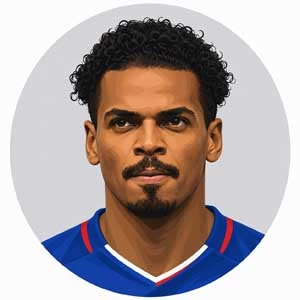
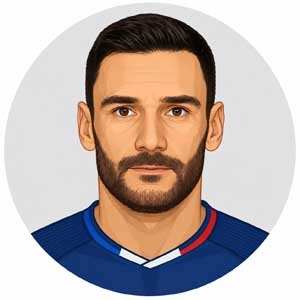
France - GoalkeeperLama, Bernard
Elastic leaps that seemed to suspend him in mid-air, distinctive tracksuit bottoms, and the acrobatic swagger of a Guyanese trapeze artist turned Bernard Pascal Maurice Lama into the defining cult icon of Paris Saint-Germain’s glorious 1990s era. Arriving from Lille, Metz, and Lens to replace the beloved Joël Bats in 1992, Lama transformed goalkeeping into an exhibition of explosive athleticism: flying horizontally across the face of goal to claw out top-corner strikes, launching 60-yard counter-attacking throws with one arm, and sweeping aggressively outside his eighteen-yard box with clean sliding tackles. Across 318 matches for PSG, he captained the side through their golden continental peak, winning the 1993–94 Division 1 championship, two Coupes de France (1993, 1995), and the historic 1995–96 European Cup Winners' Cup in Brussels against Rapid Wien. For France, across 44 caps, he was the undisputed number one at Euro '96—earning a place in the Team of the Tournament—and served as the senior deputy in the legendary 1998 World Cup-winning squad and Euro 2000 triumph.
Lama’s hyper-athletic, high-risk style, however, carried stark disciplinary and technical vulnerabilities. His sweeping adventures outside the box occasionally produced disastrous misjudgments on bouncing turf, and his handling on routine, ground-level wet shots could be surprisingly erratic compared to his miraculous aerial acrobatics. Furthermore, his career was severely derailed in early 1997 by a two-month suspension following a positive test for cannabis, which cost him his starting spot for Les Bleus to Fabien Barthez just ahead of the 1998 World Cup.
Independent, outspoken, and governed by a fierce personal dignity, Lama walked through French football on his own terms. He had zero interest in media posturing or playing the political game, taking pride in his Afro-Caribbean roots and openly expressing his opinions on society and football governance. On the pitch, his presence was explosive and magnetic: dominating his penalty area with feline grace, bantering with opposing forwards, and celebrating spectacular saves with casual nonchalance. Inside the Parc des Princes and Clairefontaine dressing rooms, he was an immensely respected, charismatic figure whose supreme physical standard and clutch bravery inspired a generation of French goalkeepers, leaving behind an immortal legacy as one of the most spectacular, athletic, and memorable shot-stoppers in European football history.