We use Google Analytics to understand how visitors use this site. Analytics cookies are only activated with your consent. For details, read our Privacy Policy.
Profile lensThe same player, read from a different angle.
Athletic79
Acceleration
83
Pace
86
Agility
78
Strength
74
Balance
80
Jumping
73
Stamina
82
Fitness
73
Technical83
Dribbling
84
Short Passing
83
Long Passing
83
Finishing
87
Shot Accuracy
86
Shot Power
79
Shooting Technique
82
Heading
68
Tackling
33
Crossing
79
Free Kick
78
Penalties
71
First Touch
86
Mental79
Composure
79
Aggression
84
Consistency
77
Creativity
82
Leadership
81
Work Rate
76
Tactical81
Vision
84
Off the Ball
87
Defensive Positioning
38
Teamwork
80
Anticipation
78
Marking
33
Player Traits
Attacking81
Crossing
79
Finishing
87
Heading Accuracy
68
Shot Accuracy
86
Off the Ball
87
Technique83
Dribbling
84
Free Kick
78
Short Passing
83
Long Passing
83
First Touch
86
Shot Technique
82
Movement82
Acceleration
83
Pace
86
Agility
78
Balance
80
Physicality76
Shot Power
79
Jumping
73
Stamina
82
Strength
74
Fitness
73
Defending35
Marking
33
Tackling
33
Def. Positioning
38
Mentality & Game Reading79
Aggression
84
Composure
79
Penalties
71
Vision
84
Leadership
81
Work Rate
76
Teamwork
80
Anticipation
78
Consistency
77
Creativity
82
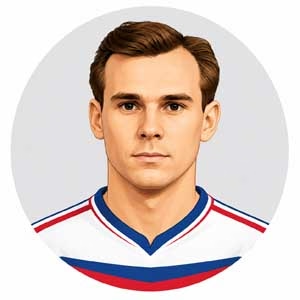
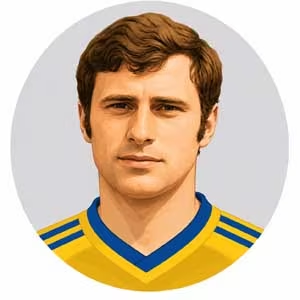
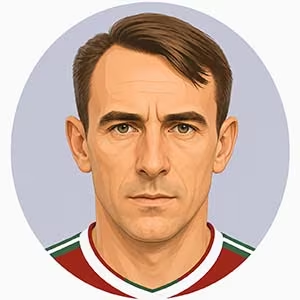
Russia - ForwardIvanov, Valentin
In Santiago on 10 June 1962, the Soviet Union were level with Chile in a World Cup quarter-final when Valentin Ivanov lost the ball in central midfield. The mistake was punished immediately: Chile counterattacked and Eladio Rojas scored what became the winning goal. Ivanov later remembered turning and chasing the move himself but being unable to recover the ground. It is a useful scene because almost everything normally associated with him had worked before it. He had already scored four times in the tournament and would finish as joint top scorer; Soviet attacks repeatedly passed through a player capable of receiving behind the forwards, accelerating with the ball and choosing between combination and direct penetration. Yet this time his freedom became exposure. Ivanov did not stand watching his error—he tried to repair it—but the recovery arrived too late. Soviet criticism subsequently concentrated heavily on goalkeeper Lev Yashin, obscuring Ivanov’s responsibility for the initial turnover. The episode provides something rarer than another description of his talent: a documented personal error under maximum competitive pressure, an immediate corrective reaction, and a failure that did not require either emotional collapse or scapegoating of someone else to explain it.
Ivanov was not primarily a conventional centre-forward despite his scoring record. Nikita Simonyan described him as the inside forward operating beneath Eduard Streltsov, with responsibility for directing attacks rather than leading the line permanently. His game combined pace, close control, dribbling and unusually rapid football perception; accounts of the Ivanov–Streltsov partnership emphasise how quickly the pair recognised each other’s movements and exchanged positions or passes before defenders could reset. Ivanov could therefore become both constructor and finisher. He scored 124 league goals for Torpedo Moscow, the club he represented throughout his senior playing career, and 26 for the Soviet Union, including two in the 1960 European Championship semi-final against Czechoslovakia and four at the 1962 World Cup. His danger came especially from advancing into attacking space rather than waiting inside it: he could carry through midfield, combine centrally and then arrive near goal himself. That elasticity helped make Torpedo’s attack difficult to assign man-for-man. He later captained both club and country, and his continuity at Torpedo survived opportunities to move elsewhere—including an attempted post-Olympic recruitment by CSKA that Ivanov and Streltsov reportedly rejected together.
There was, however, a clear asymmetry in his game. Ivanov himself admitted that he disliked defensive work, and Simonyan similarly recalled that Torpedo largely spared him those duties while the national team demanded considerably more. That matters because his attacking intelligence should not be retrofitted into modern all-phase tactical completeness. He could respond to an error by chasing—as the Chile episode shows—without being naturally committed to sustained defensive labour. Those are different propositions. His effectiveness was greatest when allowed to receive facing forward, improvise around another technically intelligent attacker and preserve energy for construction and penetration. Requiring prolonged recovery running or repeatedly positioning him as part of a rigid defensive block removed part of what made him exceptional and imposed work he did not naturally seek. Nor was possession security absolute: his willingness to manipulate the ball centrally necessarily carried turnover risk, and at the highest level one such error could decide elimination. The correct limitation is therefore not “poor under pressure”; he produced extensively in major tournaments. It is that increased defensive obligation and reduced attacking discretion could lower his value, while his creative boldness occasionally exposed the team when possession was lost in dangerous central zones.
Psychologically, Ivanov is best understood through a striking separation between **competitive audacity and personal modesty**. Former Torpedo goalkeeper Valery Sarychev summarised the contradiction sharply: Ivanov had been “нахальный на поле”—brazen or impudent on the pitch—while extraordinarily modest away from it. His wife Lidiya supplied behaviour behind that description. She recalled that he hated losing not only football matches but even informal contests such as chess or billiards, arguing until the end and needing to win; she regarded leadership as intrinsic to his character. Yet she also described his response to public admiration as neither self-exalting nor submissive: he accepted status without visibly building an identity around deference or celebrity. Authority was similarly selective rather than generically rebellious. Ivanov revered Torpedo coach Viktor Maslov as a teacher and consciously learned from him, but when powerful CSKA attempted to pull him and Streltsov away after the 1956 Olympics, the two initially refused rather than treating institutional prestige as irresistible. On the field, his appetite for risk and dominance did not translate into documented referee obsession, retaliatory violence or repeated loss of emotional control; those areas should remain unknown rather than artificially low. What is documented is stronger and more specific: error triggered immediate attempted repair; losing was personally difficult to accept; competitive environments brought out assertiveness considerably greater than his everyday manner; and respect for authority depended on legitimacy rather than automatic submission. Ivanov therefore resists both “calm leader” and “warrior”. His distinctive pattern is **context-split assertiveness**: modest social presentation, high competitive self-assertion, and a powerful aversion to defeat without good evidence that frustration regularly degraded the next action.