We use Google Analytics to understand how visitors use this site. Analytics cookies are only activated with your consent. For details, read our Privacy Policy.
Profile lensThe same player, read from a different angle.
Athletic82
Acceleration
88
Pace
83
Agility
85
Strength
76
Balance
77
Jumping
87
Stamina
84
Fitness
79
Technical80
Dribbling
75
Short Passing
70
Long Passing
64
Finishing
93
Shot Accuracy
88
Shot Power
74
Shooting Technique
92
Heading
92
Tackling
37
Crossing
60
Free Kick
65
Penalties
74
First Touch
78
Mental81
Composure
93
Aggression
84
Consistency
77
Creativity
60
Leadership
73
Work Rate
84
Tactical84
Vision
66
Off the Ball
96
Defensive Positioning
30
Teamwork
68
Anticipation
98
Marking
30
Player Traits
Attacking86
Crossing
60
Finishing
93
Heading Accuracy
92
Shot Accuracy
88
Off the Ball
96
Technique74
Dribbling
75
Free Kick
65
Short Passing
70
Long Passing
64
First Touch
78
Shot Technique
92
Movement83
Acceleration
88
Pace
83
Agility
85
Balance
77
Physicality80
Shot Power
74
Jumping
87
Stamina
84
Strength
76
Fitness
79
Defending32
Marking
30
Tackling
37
Def. Positioning
30
Mentality & Game Reading78
Aggression
84
Composure
93
Penalties
74
Vision
66
Leadership
73
Work Rate
84
Teamwork
68
Anticipation
98
Consistency
77
Creativity
60
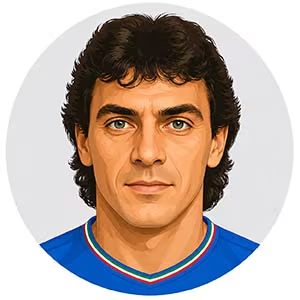
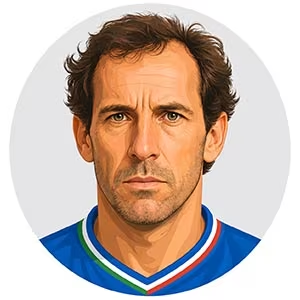
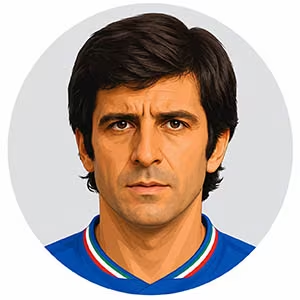
Italy - StrikerInzaghi, Filippo
He was not born with supernatural dribbling skill, he did not possess a booming long-range shot, and he could barely beat a defender over twenty meters in a footrace, yet Filippo Inzaghi stood as one of the most lethal, obsessive penalty-box predators in the history of world football. Starring for Atalanta, Juventus, AC Milan, and Italy, Superpippo operated permanently on the razor's edge of the opposition offside line—a spatial obsession famously summarized by Sir Alex Ferguson’s remark that Inzaghi was "born offside." His technical profile was stripped of all aesthetic fluff, streamlined for absolute clinical efficiency: lightning-fast short-burst movement inside the six-yard box, an uncanny ability to read deflection trajectories off defenders, and a two-touch finishing technique that used whatever body part was necessary—knee, chest, shoulder, or boot—to turn the ball into the back of the net. Anchoring the frontline of Carlo Ancelotti's Milan, he decided the 2007 UEFA Champions League final against Liverpool with a classic brace, adding to two Serie A titles, two Champions League trophies, and the 2006 World Cup.
On the pitch, Inzaghi was a hyperactive, electric bundle of pure nervous energy, leading his attack not through physical dominance, but through an obsessive, manic intensity that wore defenders down psychologically. Within the dressing room, he was an endearing, intensely focused teammate whose child-like passion for goalscoring was matched by a legendary, highly detailed study of opposition defenders' weaknesses and goalkeeper habits. Under peak matchday pressure, his emotional response was explosive and utterly unfiltered; every goal—whether a Champions League final decider or an early-round tap-in—was met with the same wild, wide-eyed sprint toward the corner flag, screaming in unadulterated joy. Towards match officials and assistant referees, he maintained a constant, highly animated dialogue, perpetually arguing offside calls with arms raised before immediately resetting his line for the next attack. Obsessive in his daily physical preparation, diet, and recovery protocols to extend his career past the age of 38, Inzaghi poured his entire life into the art of the goal, taking absolute, personal responsibility for his team's offensive output.



 All Time MilanClub