We use Google Analytics to understand how visitors use this site. Analytics cookies are only activated with your consent. For details, read our Privacy Policy.
Profile lensThe same player, read from a different angle.
Athletic81
Acceleration
86
Pace
82
Agility
83
Strength
72
Balance
78
Jumping
74
Stamina
89
Fitness
87
Technical77
Dribbling
82
Short Passing
74
Long Passing
81
Finishing
72
Shot Accuracy
63
Shot Power
75
Shooting Technique
72
Heading
66
Tackling
75
Crossing
79
Free Kick
68
Penalties
66
First Touch
80
Mental81
Composure
76
Aggression
85
Consistency
86
Creativity
69
Leadership
84
Work Rate
81
Tactical76
Vision
76
Off the Ball
74
Defensive Positioning
73
Teamwork
85
Anticipation
77
Marking
69
Attacking71
Crossing
79
Finishing
72
Heading Accuracy
66
Shot Accuracy
63
Off the Ball
74
Technique76
Dribbling
82
Free Kick
68
Short Passing
74
Long Passing
81
First Touch
80
Shot Technique
72
Movement82
Acceleration
86
Pace
82
Agility
83
Balance
78
Physicality79
Shot Power
75
Jumping
74
Stamina
89
Strength
72
Fitness
87
Defending72
Marking
69
Tackling
75
Def. Positioning
73
Mentality & Game Reading79
Aggression
85
Composure
76
Penalties
66
Vision
76
Leadership
84
Work Rate
81
Teamwork
85
Anticipation
77
Consistency
86
Creativity
69
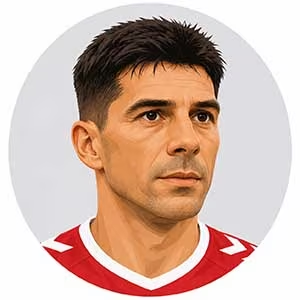
Denmark - Left BackHeintze, Jan
In Eindhoven during the first months of the 1982–83 season, Jan Heintze arrived at PSV as a teenage left winger and immediately discovered that the role he had known in Denmark would not survive unchanged. Foreign-player restrictions limited his opportunities, the environment was new, and coach Thijs Libregts was openly unconvinced by him. Heintze later recalled deciding that, whatever happened, he would remain for the full eighteen months of his contract rather than retreat early. The following season, under Jan Reker, his career changed direction: the small attacking player was converted into a left-back and eventually made the position his own. That adaptation became the foundation of more than two decades at elite level. It also established a pattern that would recur throughout his career. Heintze could accept substantial alteration to his footballing function when he believed the process still offered him a legitimate route forward. What he found much harder to accept was not change itself, but being treated as though his value had already been decided against him.
As a left-back, Heintze was defined by mobility, stamina and constant participation along the flank. At only around 1.70 metres he lacked aerial dominance, but compensated through acceleration, aggression in the duel and an extraordinary capacity to repeat runs. His background as a winger remained visible: he could overlap naturally, support possession higher up the pitch and attack space without looking like a defender venturing outside his comfort zone. PSV used that energy through one of the club’s most successful eras, including the 1988 European Cup triumph and a long sequence of domestic titles. After twelve seasons in Eindhoven he moved to Germany, first with Uerdingen and then Bayer Leverkusen, where he later described the period as the best football of his career. He returned to PSV in 1999 and remained productive almost until forty. He attributed that longevity partly to luck with injuries but also to an unusually professional lifestyle: extra physical work after training and careful attention to diet. Internationally he eventually reached 86 caps for Denmark, although those appearances were interrupted by a remarkable five-year gap before his return under Bo Johansson in 1996.
His limitations were partly structural and partly physical. Heintze’s lack of height made him vulnerable when isolated against much larger opponents, particularly if a coach used him in roles that exposed rather than concealed that weakness. Aad de Mos once deployed him centrally against an opponent Heintze remembered as roughly two heads taller; after conceding twice in the air, he was substituted at half-time and publicly criticised by the coach. That episode is useful because it separates tactical mismatch from generic defensive weakness. Heintze could defend aggressively and reliably on the flank, but asking him to solve repeated central aerial duels removed the qualities that made him valuable. His attacking contribution also depended heavily on physical sharpness: reduced stamina or acceleration would inevitably diminish both recovery and overlap. At the 2002 World Cup, aged thirty-eight, he struggled with the heat and was substituted during the group stage before losing his place. That was late-career physical degradation, not evidence that major-event pressure itself destabilised him.
Psychologically, Heintze is best defined by **high functional adaptability combined with strong sensitivity to delegitimisation**. The clearest contrast comes from his relationships with coaches. He could accept a major positional conversion at PSV, tolerate early foreign-player restrictions and later return to the Danish national team after years of exclusion without requiring restoration of old status before performing. Under Bo Johansson he immediately re-established himself and then played more than fifty internationals consecutively. Yet his relationships with Richard Møller Nielsen and Aad de Mos deteriorated sharply when Heintze believed the treatment had crossed from selection into disrespect. In 1991, after travelling for Denmark only to discover he would not start, he returned to PSV without the coach’s permission; the decision led to a one-year suspension and effectively a multi-year rupture with the national team. At PSV under De Mos, Heintze later said he had become so tired of the coach’s methods and public criticism that he explicitly asked to train with the reserves instead. These were not reactions to simple competition: Heintze had repeatedly survived competition throughout his career. The trigger was perceived invalidation of role and worth. At the same time, his professional behaviour outside such breakdowns was extremely disciplined; he trained beyond formal sessions and treated physical preparation as a personal responsibility. Evidence for habitual referee confrontation, retaliation after provocation or teammate-directed blame is insufficient and should remain unknown. The defensible contradiction is sharper: **Heintze could adapt almost indefinitely when he still felt functionally respected, but once criticism became humiliation in his eyes, compliance could turn into direct refusal**.


 All Time DenmarkNT