We use Google Analytics to understand how visitors use this site. Analytics cookies are only activated with your consent. For details, read our Privacy Policy.
Profile lensThe same player, read from a different angle.
Athletic79
Acceleration
78
Pace
81
Agility
82
Strength
79
Balance
79
Jumping
74
Stamina
81
Fitness
81
Technical86
Dribbling
86
Short Passing
91
Long Passing
89
Finishing
84
Shot Accuracy
83
Shot Power
80
Shooting Technique
80
Heading
73
Tackling
48
Crossing
85
Free Kick
73
Penalties
77
First Touch
86
Mental84
Composure
91
Aggression
75
Consistency
78
Creativity
76
Leadership
82
Work Rate
83
Tactical85
Vision
90
Off the Ball
85
Defensive Positioning
41
Teamwork
88
Anticipation
76
Marking
48
Player Traits
Attacking82
Crossing
85
Finishing
84
Heading Accuracy
73
Shot Accuracy
83
Off the Ball
85
Technique84
Dribbling
86
Free Kick
73
Short Passing
91
Long Passing
89
First Touch
86
Shot Technique
80
Movement80
Acceleration
78
Pace
81
Agility
82
Balance
79
Physicality79
Shot Power
80
Jumping
74
Stamina
81
Strength
79
Fitness
81
Defending46
Marking
48
Tackling
48
Def. Positioning
41
Mentality & Game Reading82
Aggression
75
Composure
91
Penalties
77
Vision
90
Leadership
82
Work Rate
83
Teamwork
88
Anticipation
76
Consistency
78
Creativity
76
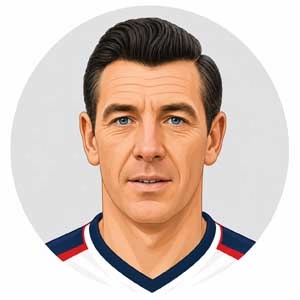
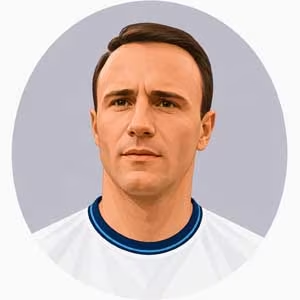
England - Attacking MidfielderHaynes, Johnny
The muddy pitches of post-war English football had no greater geometric architect than John Norman Haynes, universally christened The Maestro and immortalized as the very first footballer to earn £100 a week following the abolition of the maximum wage. A pure, one-club visionary who devoted his entire eighteen-year professional career to Fulham, Haynes operated as the undisputed aristocratic conductor from the inside-left berth. Standing five-foot-nine with a broad chest, upright carriage, and extraordinary peripheral vision, he turned the progressive pass into a lethal weapon: possessing an exquisite touch off either foot, an uncanny ability to curve low through-balls with millimeter spin into the path of galloping wingers, and a sudden drop of the shoulder that created passing lanes out of congested midfield corridors. Across 658 appearances and 158 goals for Fulham, he dragged a modest West London club to the FA Cup semi-finals twice (1958, 1962) and into the top flight. For England, across 56 caps and 18 goals, he captained his country 22 times—including at the 1958 and 1962 World Cups—earning iconic acclaim from Pelé as the best passer of the ball the Brazilian had ever seen, alongside a third-place finish in the 1961 Ballon d'Or.
Tactically, however, Haynes’s game belonged to an era of unhurried orchestrators: his work rate without the ball was low, his defensive contribution was negligible, and his linear sprint speed over distance was modest. A devastating car crash in 1962 shattered his knee, stripping him of his sharp turning elasticity and effectively ending his international career at just 27, leaving his final years as a static distributor.
Perfectionist, autocratic, and notoriously demanding of those around him, Haynes played with the sharp, intolerant temperament of a genius forced to work alongside ordinary mortals. He possessed zero patience for substandard play; when a teammate misread his visionary passes or missed a simple opportunity, Haynes would openly berate them on the pitch with fierce, caustic verbal lashings—a trait that occasionally caused friction with more sensitive teammates. On the pitch, his body language was imperious: he directed traffic with sharp hand gestures, commanded every set-piece, and demanded every transition flow through his boots. Inside the Craven Cottage dressing room, he was an untouchable monarch whose tactical insight held sway over managers, setting an uncompromising standard for technical preparation. When marked by aggressive, bone-crunching wing-halves who sought to kick him out of matches, Haynes used his lightning-fast first-time distribution to release the ball before contact, letting his passing range serve as his primary defense. Match officials found him an articulate, highly vocal presence who contested refereeing interpretations, leaving an immortal legacy as the purest, most refined, and historically pivotal playmaker in English football history.