We use Google Analytics to understand how visitors use this site. Analytics cookies are only activated with your consent. For details, read our Privacy Policy.
Profile lensThe same player, read from a different angle.
Athletic78
Acceleration
85
Pace
77
Agility
83
Strength
74
Balance
74
Jumping
80
Stamina
78
Fitness
74
Technical84
Dribbling
84
Short Passing
77
Long Passing
68
Finishing
89
Shot Accuracy
89
Shot Power
84
Shooting Technique
79
Heading
82
Tackling
40
Crossing
61
Free Kick
74
Penalties
77
First Touch
86
Mental76
Composure
85
Aggression
76
Consistency
72
Creativity
86
Leadership
70
Work Rate
70
Tactical83
Vision
77
Off the Ball
89
Defensive Positioning
40
Teamwork
72
Anticipation
92
Marking
33
Player Traits
Attacking82
Crossing
61
Finishing
89
Heading Accuracy
82
Shot Accuracy
89
Off the Ball
89
Technique78
Dribbling
84
Free Kick
74
Short Passing
77
Long Passing
68
First Touch
86
Shot Technique
79
Movement80
Acceleration
85
Pace
77
Agility
83
Balance
74
Physicality78
Shot Power
84
Jumping
80
Stamina
78
Strength
74
Fitness
74
Defending38
Marking
33
Tackling
40
Def. Positioning
40
Mentality & Game Reading78
Aggression
76
Composure
85
Penalties
77
Vision
77
Leadership
70
Work Rate
70
Teamwork
72
Anticipation
92
Consistency
72
Creativity
86
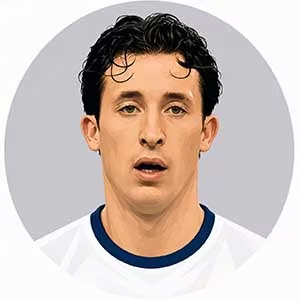
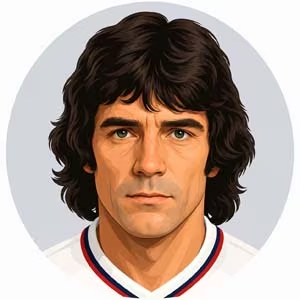
England - StrikerFowler, Robbie
He was seventeen when Liverpool put him in the first team and eighteen when he scored five in a match. He was twenty when he had already scored more than a hundred goals for the club, and the Kop had stopped calling him by his name and started calling him God. Robbie Fowler was, for roughly four seasons in the mid-nineties, the most natural finisher English football had produced in a generation — and then a cruciate ligament and a series of injuries removed the sharpness before he was twenty-five, and the rest of his career was spent as a very good striker who had once been something else entirely.
Born in Toxteth, Liverpool, in 1975, Fowler came through the club's academy and made his debut in 1993. At 1.76m he was neither quick nor strong, and his gift was almost purely technical: an ability to finish first-time, from any angle, with either foot, with an economy of movement that made difficult chances look procedural. He scored 183 goals in 369 appearances across two spells, remains the club's sixth-highest scorer, and holds the record for the fastest hat-trick in Premier League history at four minutes and thirty-three seconds. He won the League Cup in 1995 and, in the extraordinary 2000–01 treble season, the FA Cup, League Cup and UEFA Cup, though by then Gérard Houllier was selecting him behind Michael Owen and Emile Heskey. He moved to Leeds United and then Manchester City before returning to Liverpool in 2006, and won 26 caps for England, a total far below what his early years had promised, in a period crowded with Shearer, Sheringham and Owen.
His decline was primarily physical but not exclusively. The knee injury sustained in 1998 removed his acceleration permanently, and his conditioning and off-field discipline in that period were a persistent source of friction with Houllier, whose relationship with him deteriorated to the point of a sale. He offered little pressing or link play, was ineffective in the air, and depended heavily on service and on being the focal point rather than a component. Once the sharpness went, his goal output fell disproportionately, because so little of his game had ever been about anything else.
Temperamentally he was cool, ironic and slightly detached from his own status. Fowler was famously unimpressed by the reverence he received, joking about the nickname, uninterested in the celebrity that surrounded Liverpool footballers, and low-key in interviews to the point of appearing bored. He was not a vocal leader and never sought to be, and teammates described a dry, funny Scouser who did his job and went home. He was also capable of remarkable independence: in 1997 he lifted his shirt to reveal a message supporting the sacked Liverpool dockers during a European tie, accepting a UEFA fine without complaint, and he made a habit of correcting referees who had awarded him decisions he had not earned — including a penalty against Arsenal that he tried to have overturned before taking it. Alongside that ran a genuine capacity for provocation: the celebrations aimed at opposing supporters, the running feuds, the incidents that produced bans and headlines. He responded to hostility with amusement rather than anger, and his performances were largely unaffected by crowd or occasion. Away from football he was private, family-oriented, and built one of the largest property portfolios in British sport, a business seriousness entirely at odds with his public image. Gifted, unbothered and prematurely diminished, Fowler was the most natural finisher of his era and the least interested in what that meant.