We use Google Analytics to understand how visitors use this site. Analytics cookies are only activated with your consent. For details, read our Privacy Policy.
Profile lensThe same player, read from a different angle.
Athletic77
Acceleration
69
Pace
74
Agility
66
Strength
86
Balance
81
Jumping
82
Stamina
82
Fitness
77
Technical79
Dribbling
77
Short Passing
78
Long Passing
78
Finishing
62
Shot Accuracy
63
Shot Power
77
Shooting Technique
67
Heading
84
Tackling
85
Crossing
70
Free Kick
65
Penalties
60
First Touch
77
Mental77
Composure
73
Aggression
83
Consistency
81
Creativity
66
Leadership
84
Work Rate
71
Tactical77
Vision
74
Off the Ball
65
Defensive Positioning
82
Teamwork
75
Anticipation
75
Marking
82
Player Traits
Attacking69
Crossing
70
Finishing
62
Heading Accuracy
84
Shot Accuracy
63
Off the Ball
65
Technique74
Dribbling
77
Free Kick
65
Short Passing
78
Long Passing
78
First Touch
77
Shot Technique
67
Movement73
Acceleration
69
Pace
74
Agility
66
Balance
81
Physicality81
Shot Power
77
Jumping
82
Stamina
82
Strength
86
Fitness
77
Defending83
Marking
82
Tackling
85
Def. Positioning
82
Mentality & Game Reading74
Aggression
83
Composure
73
Penalties
60
Vision
74
Leadership
84
Work Rate
71
Teamwork
75
Anticipation
75
Consistency
81
Creativity
66
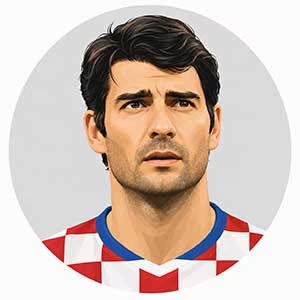
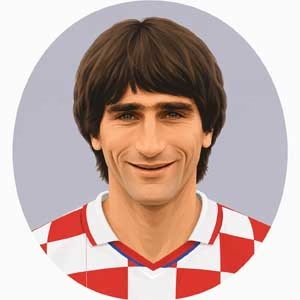
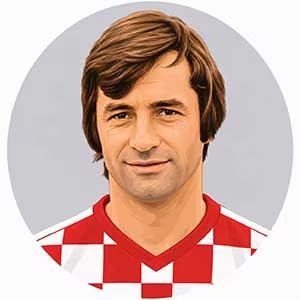
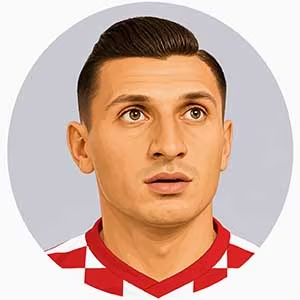
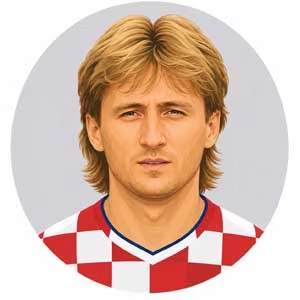
Croatia - Centre-backĆorluka, Vedran
Vedran Ćorluka spent nearly two decades as one of the more tactically dependable defenders in his generation of Croatian football without ever quite generating the kind of individual moments that make a defender a household name outside his own country — solid, versatile and largely without controversy across four major European leagues, in a career built almost entirely on doing the difficult parts of defending correctly and rarely being discussed for much else.
Born in Vukovar in 1986, in a city whose name carries considerable weight in Croatian national memory from the war of the early 1990s, Ćorluka was a versatile defender comfortable at centre-back and right-back, physically composed, strong in the air relative to his frame, and generally reliable in reading danger before it fully developed rather than relying on recovery pace to correct mistakes. He came through Dinamo Zagreb before a move to Manchester City in 2007, then Tottenham Hotspur in 2008, where he spent four seasons as a regular in the Premier League, before a move to Bayer Leverkusen and finally Lokomotiv Moscow, where he closed the European portion of his career with several productive seasons in Russian football. He won domestic honors with Dinamo Zagreb early in his career and remained a first-choice international defender for well over a decade. For Croatia he won 103 caps, was a starting centre-back in the side that reached the 2018 World Cup final — the country's greatest result — and remained involved with the national team into his mid-thirties, a rare longevity at the highest level of international defensive selection.
His limitations were largely those of a solid, dependable defender operating just below the very highest technical tier of his position. Ćorluka was not an exceptional passer capable of progressing play through sophisticated buildup structures, and his effectiveness depended considerably on organizational discipline and partnership with more dominant central defenders around him rather than on individual defensive brilliance. Against genuinely elite, technically superior forwards in isolated one-on-one situations, he could be more troubled than his overall reliability suggested, and his versatility across multiple defensive positions, while valuable, occasionally meant he settled less completely into the specific demands of either role compared to a specialist.
Temperamentally he was calm, professional and notably free of the kind of institutional or disciplinary friction that has periodically appeared elsewhere in the corpus among players of similarly long, well-traveled careers. Ćorluka maintained a low public profile relative to his sustained international significance, rarely generating controversy across four different football cultures and multiple national team cycles spanning some of Croatia's most significant tournament performances. He was respected within Croatia's national team setup as a reliable, experienced presence during the 2018 World Cup run, playing alongside a squad containing considerably more individually celebrated figures like Modrić and Rakitić without any evident friction about his own more modest public recognition. He accepted positional flexibility between centre-back and right-back across his career without documented resistance, adapting to different tactical systems and different countries — England, Germany, Russia — with what appears to have been considerable ease. Away from the pitch his profile remained modest, and he has continued a public association with Croatian football since retiring without becoming the kind of contested administrative figure some of his more prominent compatriots did. Steady, adaptable and quietly effective across an unusually long international career, Ćorluka represents the kind of defensive consistency that a golden generation depends on structurally without ever placing at its emotional or narrative center.