We use Google Analytics to understand how visitors use this site. Analytics cookies are only activated with your consent. For details, read our Privacy Policy.
Profile lensThe same player, read from a different angle.
Athletic79
Acceleration
71
Pace
77
Agility
72
Strength
91
Balance
88
Jumping
82
Stamina
80
Fitness
73
Technical78
Dribbling
75
Short Passing
73
Long Passing
78
Finishing
60
Shot Accuracy
63
Shot Power
84
Shooting Technique
67
Heading
85
Tackling
86
Crossing
74
Free Kick
62
Penalties
63
First Touch
76
Mental72
Composure
75
Aggression
90
Consistency
73
Creativity
64
Leadership
66
Work Rate
72
Tactical79
Vision
71
Off the Ball
60
Defensive Positioning
82
Teamwork
76
Anticipation
82
Marking
85
Player Traits
Attacking68
Crossing
74
Finishing
60
Heading Accuracy
85
Shot Accuracy
63
Off the Ball
60
Technique72
Dribbling
75
Free Kick
62
Short Passing
73
Long Passing
78
First Touch
76
Shot Technique
67
Movement77
Acceleration
71
Pace
77
Agility
72
Balance
88
Physicality82
Shot Power
84
Jumping
82
Stamina
80
Strength
91
Fitness
73
Defending84
Marking
85
Tackling
86
Def. Positioning
82
Mentality & Game Reading73
Aggression
90
Composure
75
Penalties
63
Vision
71
Leadership
66
Work Rate
72
Teamwork
76
Anticipation
82
Consistency
73
Creativity
64
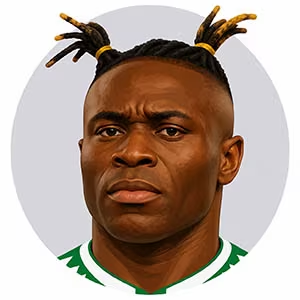
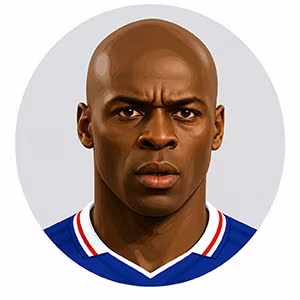
Nigeria - Centre-backWest, Taribo
Bright green and purple braided antenna horns sprouting from his scalp formed the iconic silhouette of a defensive enforcer who turned the penalty area into a territory of physical intimidation. Taribo West was the combative cornerstone of the historic Nigerian Dream Team that captured the 1996 Olympic Gold Medal in Atlanta before establishing himself as a formidable defensive powerhouse across Europe. Operating as an aggressive, front-foot center-back or an emergency left-back, West combined crushing physical power with exceptional sliding recovery tackles, suffocating opposing strikers through sheer friction and close-contact marking. After rising to prominence under Guy Roux at Auxerre—winning the 1995–96 Ligue 1 and Coupe de France double—he joined Inter Milan in 1997, anchoring Luigi Simoni’s backline alongside Giuseppe Bergomi to claim the 1997–98 UEFA Cup in Paris. He later achieved the rare feat of crossing the Milan divide to AC Milan, alongside spells at Derby County, 1. FC Kaiserslautern, and Partizan Belgrade. Across 42 caps for Nigeria, he was an irreplaceable defensive pillar across two World Cups (1998, 2002) and two AFCON campaigns.
Underneath the intimidating exterior, however, West’s game lived permanently on a knife-edge of disciplinary and positional risk. His distribution from the back was rudimentary and prone to dangerous unforced errors under aggressive pressing swarms. His high-risk tackling style—characterized by flying, studs-extended lunges—led to frequent bookings, dismissals, and conceded penalties, while his lack of positional discipline could leave expansive voids behind him if an agile forward drew him out of the defensive line with a clever decoy run.
Flamboyant in appearance, fiercely spiritual, and entirely fearless on the pitch, West approached defending as an act of sacred warfare. He used his eccentric look and menacing stare to wage psychological warfare on strikers long before the opening whistle, relishing the physical collisions and aerial battles of Serie A and the Premier League. On the pitch, his presence was explosive and unapologetic: lunging into 50-50 challenges with ferocious intensity and celebrating crucial stops with chest-thumping passion. Inside the locker room, he was a complex, colorful character—known for holding team prayer sessions and maintaining strong personal convictions—whose fierce loyalty on the pitch earned him the deep affection of teammates like Ronaldo and Javier Zanetti. Match officials found him an exhausting, formidable presence to manage, cementing his standing as one of the most memorable, physically dominant, and iconic African defenders in football history.