We use Google Analytics to understand how visitors use this site. Analytics cookies are only activated with your consent. For details, read our Privacy Policy.
Profile lensThe same player, read from a different angle.
Athletic83
Acceleration
87
Pace
92
Agility
88
Strength
74
Balance
77
Jumping
84
Stamina
83
Fitness
78
Technical83
Dribbling
87
Short Passing
77
Long Passing
78
Finishing
84
Shot Accuracy
83
Shot Power
87
Shooting Technique
79
Heading
78
Tackling
48
Crossing
70
Free Kick
77
Penalties
87
First Touch
85
Mental79
Composure
84
Aggression
80
Consistency
77
Creativity
82
Leadership
78
Work Rate
75
Tactical80
Vision
75
Off the Ball
86
Defensive Positioning
45
Teamwork
74
Anticipation
83
Marking
38
Attacking80
Crossing
70
Finishing
84
Heading Accuracy
78
Shot Accuracy
83
Off the Ball
86
Technique81
Dribbling
87
Free Kick
77
Short Passing
77
Long Passing
78
First Touch
85
Shot Technique
79
Movement86
Acceleration
87
Pace
92
Agility
88
Balance
77
Physicality81
Shot Power
87
Jumping
84
Stamina
83
Strength
74
Fitness
78
Defending44
Marking
38
Tackling
48
Def. Positioning
45
Mentality & Game Reading80
Aggression
80
Composure
84
Penalties
87
Vision
75
Leadership
78
Work Rate
75
Teamwork
74
Anticipation
83
Consistency
77
Creativity
82
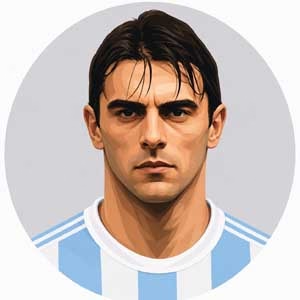
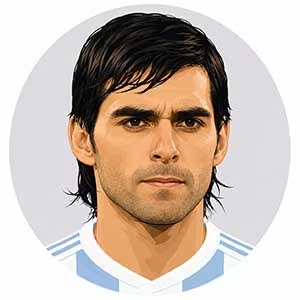
Argentina - StrikerLópez, Claudio
A sudden drop of the shoulder on the left channel followed by a lightning-fast sprint that left Real Madrid’s defensive line grasping at thin air turned a wiry forward from Río Tercero into the most feared transitional assassin in European football around the turn of the millennium. Claudio Javier López—immortalized globally as El Piojo (The Flea)—was a lethal, counter-attacking weapon whose blistering top-end sprint speed and direct running completely tore open backlines across Spain, Italy, and international football.
Operating as a second striker, inverted winger, or fluid wide forward, López relied on exceptional acceleration over thirty yards, an uncanny ability to strike volleys on the dead run, and a venomous, laser-guided left boot that punished any team foolish enough to deploy a high defensive line. Rising through Racing Club, he moved to Valencia CF in 1996, becoming the undisputed icon of Claudio Ranieri and Héctor Cúper’s high-octane setup: netting 74 goals across four seasons, lifting the 1998–99 Copa del Rey, the 1999 Supercopa de España, and scoring five goals on the way to the 2000 UEFA Champions League final. His sensational, high-profile switch to SS Lazio in 2000 yielded the 2000 Supercoppa Italiana and the 2003–04 Coppa Italia, before later winning titles in Mexico with Club América and concluding his career in Major League Soccer with the Kansas City Wizards and Colorado Rapids. For Argentina, across 55 caps and ten goals, he was a regular starter across two World Cups (1998 and 2002), famously scoring a brilliant breakaway goal against the Netherlands in the 1998 quarter-final in Marseille.
His specialized, hyper-direct skill set, however, was heavily reliant on open space ahead of him. López struggled when tasked with breaking down deep, compact low blocks where defenders refused to push up and denied him running lanes; his passing in tight central pockets was functional rather than intricate, and his right foot was largely ornamental. If an opponent sat deep inside their own eighteen-yard box and cut off long diagonal balls over the top, his scoring impact could be heavily reduced.
Spitfire, irreverent, and carrying an unshakeable confidence in his physical speed, López played with frantic, fearless urgency. He relished big-game hostility, taking immense personal pleasure in terrorizing heavyweights—most famously tormenting Real Madrid, against whom he scored twelve goals during his Valencia peak. On the pitch, his body language was all coiled kinetic energy: sprinting onto loose balls, challenging stoppers with direct runs, and celebrating goals with manic fist pumps. Inside the Valencia, Lazio, and Argentine dressing rooms, he was an energetic, sharp-witted figure whose devastating counter-attacking output made him an indispensable asset for pragmatic tacticians, cementing an immortal legacy as one of the fastest and most clinical transitional forwards of the modern era.