We use Google Analytics to understand how visitors use this site. Analytics cookies are only activated with your consent. For details, read our Privacy Policy.
Profile lensThe same player, read from a different angle.
Athletic80
Acceleration
72
Pace
74
Agility
77
Strength
86
Balance
82
Jumping
85
Stamina
80
Fitness
80
Technical77
Dribbling
77
Short Passing
75
Long Passing
76
Finishing
64
Shot Accuracy
64
Shot Power
80
Shooting Technique
65
Heading
86
Tackling
87
Crossing
71
Free Kick
62
Penalties
60
First Touch
74
Mental77
Composure
82
Aggression
87
Consistency
74
Creativity
71
Leadership
70
Work Rate
86
Tactical78
Vision
73
Off the Ball
63
Defensive Positioning
85
Teamwork
76
Anticipation
85
Marking
84
Player Traits
Attacking70
Crossing
71
Finishing
64
Heading Accuracy
86
Shot Accuracy
64
Off the Ball
63
Technique72
Dribbling
77
Free Kick
62
Short Passing
75
Long Passing
76
First Touch
74
Shot Technique
65
Movement76
Acceleration
72
Pace
74
Agility
77
Balance
82
Physicality82
Shot Power
80
Jumping
85
Stamina
80
Strength
86
Fitness
80
Defending85
Marking
84
Tackling
87
Def. Positioning
85
Mentality & Game Reading76
Aggression
87
Composure
82
Penalties
60
Vision
73
Leadership
70
Work Rate
86
Teamwork
76
Anticipation
85
Consistency
74
Creativity
71
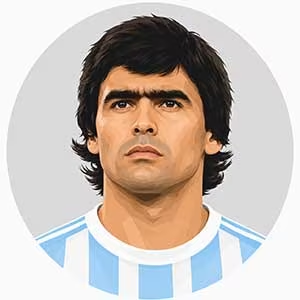
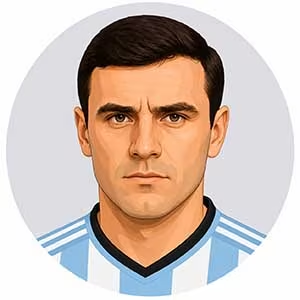
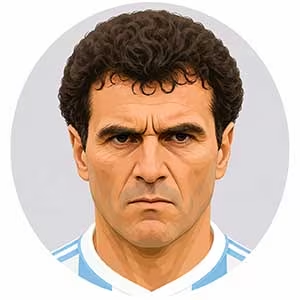
Argentina - SweeperBrown, José Luis
Playing the final forty-five minutes of a World Cup final with a dislocated shoulder, biting a hole into his jersey to secure his thumb and keep his dangling right arm pinned against his chest, turned an unheralded defender into the ultimate symbol of Argentine sporting heroism. José Luis Brown—immortalized forever as Tata—was the emotional heartbeat and sweeping foundation of Carlos Bilardo’s 1986 world champions. Arriving in Mexico without a club after severe knee operations, Brown was thrust into the starting lineup following Daniel Passarella’s sudden illness, anchoring the back three as a classic, commanding líbero. He read the game two moves ahead, stepping out to snuff out ground attacks and dominating the aerial corridor inside his box—a trait immortalized in the 23rd minute of the final against West Germany when he soared above Harald Schumacher to head home Argentina's opening goal. Over a grueling career spanning Estudiantes de La Plata (where he won back-to-back Metropolitano and Nacional titles in 1982 and 1983 as Bilardo's trusted captain), Boca Juniors, Deportivo Español, Racing Club, and spells in France with Brest and Spain with Real Murcia, he proved himself an indestructible defensive rock. For Argentina, across 36 caps and one historic goal, his international apex was absolute.
Brown’s game was strictly utilitarian and built for positional preservation. He was not a modern, fleet-footed ball-carrier who danced through midfield pressing lines; his distribution was strictly pragmatic, focused on clearing danger and feeding simple passes to Batista or Maradona. Lacking top-end recovery sprint speed, he relied entirely on flawless anticipation and body positioning; if caught out of position by a rapid counter-attack in wide channels, his turning radius could be exploited in open-field footraces.
Stoic, deeply emotional, and fiercely loyal to Bilardo’s tactical creed, Brown carried himself with the quiet dignity of an old-school patriarch. He felt the weight of the national shirt deeply, shedding tears during the anthem and leading by raw physical sacrifice rather than flamboyant speeches. On the pitch, his presence was steady, brave, and unshakeable: organizing the backline through simple, authoritative commands and refusing to abandon his post even when his body was broken. Inside the Argentine dressing room, he was universally adored—a humble, courageous warrior whose legendary sacrifice in the 1986 final remains etched as the definitive definition of garra in Argentine football history.