We use Google Analytics to understand how visitors use this site. Analytics cookies are only activated with your consent. For details, read our Privacy Policy.
Profile lensThe same player, read from a different angle.
Athletic78
Acceleration
76
Pace
77
Agility
76
Strength
78
Balance
74
Jumping
79
Stamina
80
Fitness
80
Technical81
Dribbling
77
Short Passing
84
Long Passing
84
Finishing
66
Shot Accuracy
71
Shot Power
87
Shooting Technique
70
Heading
77
Tackling
85
Crossing
78
Free Kick
75
Penalties
72
First Touch
78
Mental82
Composure
88
Aggression
76
Consistency
85
Creativity
73
Leadership
70
Work Rate
82
Tactical81
Vision
82
Off the Ball
73
Defensive Positioning
83
Teamwork
84
Anticipation
82
Marking
80
Attacking73
Crossing
78
Finishing
66
Heading Accuracy
77
Shot Accuracy
71
Off the Ball
73
Technique78
Dribbling
77
Free Kick
75
Short Passing
84
Long Passing
84
First Touch
78
Shot Technique
70
Movement76
Acceleration
76
Pace
77
Agility
76
Balance
74
Physicality81
Shot Power
87
Jumping
79
Stamina
80
Strength
78
Fitness
80
Defending83
Marking
80
Tackling
85
Def. Positioning
83
Mentality & Game Reading79
Aggression
76
Composure
88
Penalties
72
Vision
82
Leadership
70
Work Rate
82
Teamwork
84
Anticipation
82
Consistency
85
Creativity
73
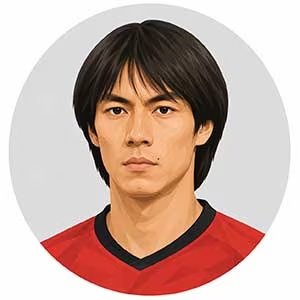
South Korea - SweeperHong, Myung-bo
ominally a sweeper or central defender, Hong operated as the interpretative centre of a defensive structure rather than simply its deepest stopper. His greatest assets were anticipation, positioning and the ability to begin attacks once possession had been recovered. He could step forward with the ball, pass through midfield and recognise danger early enough to reduce the need for emergency defending. That made him particularly valuable as the spare defender in systems that allowed him to read movements behind more aggressive markers. His career also demonstrated considerable tactical portability: he played in Korea and Japan, appeared as a defensive midfielder as well as a defender and adapted especially well to Guus Hiddink’s back three during the 2002 World Cup. Four World Cups produced 16 appearances, and in 2002 he captained South Korea to the semi-finals and received the Bronze Ball, an extraordinary individual distinction for a defender. His international career eventually reached 136 appearances and ten goals. At club level he won major honours with Pohang Steelers and later played extensively in Japan before finishing with LA Galaxy. His influence was therefore not built around spectacular defensive volume. Hong’s football was valuable because he could decide where the next defensive or constructive action should occur before being forced into it.
That anticipation also concealed vulnerabilities. Hong was not an exceptionally fast recovery defender, and situations that eliminated his reading advantage could expose him physically. An attacker receiving space to accelerate directly at him created a different problem from an attack he could observe developing in front of the defensive line. His preference for reading and intercepting also meant that an incorrect interpretation could become disproportionately expensive because he was often positioned as the player responsible for repairing everybody else’s mistakes. The opening goal against Turkey provides the extreme example of another risk: confidence in possession close to his own goal could become costly when pressure arrived faster than expected. Nor should his 2002 performances be projected unchanged across his entire career. By then he was already thirty-three and Hiddink initially questioned whether an older defender with limited pace could survive the physical intensity he wanted from the team. Hong ultimately demonstrated that his reading and positional intelligence could compensate, but compensation is not absence of limitation. His optimal environment gave him a panoramic view of play, nearby aggressive defenders and enough structural freedom to anticipate. Repeated isolation in large spaces, continuous recovery races or a defensive system demanding primarily physical duels reduced the comparative advantage on which his authority rested.
Psychologically, Hong’s strongest documented signal is responsibility expressed through intervention rather than emotional display. Hiddink’s account of the 2002 group describes a captain who could communicate information between players and staff while accepting that the coach, not the senior players, controlled selection and training. Yet Hong was not merely an obedient transmission mechanism. During the tournament he and other senior players could approach Hiddink about the condition of the squad, while Hong’s authority among teammates derived sufficiently from credibility that he did not need constant visible confrontation to establish it. His response to the Turkey error is useful precisely because no mythology is necessary: there was no immediate attempt to externalise responsibility, no documented attack on a teammate and no subsequent withdrawal from involvement. His penalty against Spain supplies a different form of evidence. As captain he accepted the final kick that could send South Korea into a World Cup semi-final, waited through the preceding penalties and converted without altering his restrained behavioural presentation afterwards. That should be scored as successful acute-pressure execution, not as proof that he felt no pressure. Later events also prevent turning restraint into universal compliance. As a coach and administrator Hong has been willing to defend his own judgement publicly and become involved in institutional disputes when responsibility and authority were contested. Those episodes belong to a different role and should not be imported mechanically into his playing ratings, but they caution against interpreting quiet leadership as submissiveness. Evidence for systematic referee confrontation, retaliation after provocation, aggressive responses to teammates’ mistakes or performance deterioration under hostile crowds is insufficient and should remain unknown. The defensible distinction is more precise: Hong sought control by making himself responsible for the next decision, not by controlling the emotional temperature around him. Error could damage the team without necessarily producing a second psychological error.


 All-Time AsiaAsia