We use Google Analytics to understand how visitors use this site. Analytics cookies are only activated with your consent. For details, read our Privacy Policy.
Profile lensThe same player, read from a different angle.
Athletic82
Acceleration
87
Pace
86
Agility
85
Strength
78
Balance
77
Jumping
80
Stamina
83
Fitness
78
Technical80
Dribbling
83
Short Passing
77
Long Passing
76
Finishing
84
Shot Accuracy
83
Shot Power
82
Shooting Technique
77
Heading
76
Tackling
40
Crossing
73
Free Kick
66
Penalties
72
First Touch
83
Mental77
Composure
76
Aggression
82
Consistency
76
Creativity
75
Leadership
76
Work Rate
83
Tactical78
Vision
77
Off the Ball
85
Defensive Positioning
43
Teamwork
76
Anticipation
83
Marking
33
Attacking80
Crossing
73
Finishing
84
Heading Accuracy
76
Shot Accuracy
83
Off the Ball
85
Technique77
Dribbling
83
Free Kick
66
Short Passing
77
Long Passing
76
First Touch
83
Shot Technique
77
Movement84
Acceleration
87
Pace
86
Agility
85
Balance
77
Physicality80
Shot Power
82
Jumping
80
Stamina
83
Strength
78
Fitness
78
Defending39
Marking
33
Tackling
40
Def. Positioning
43
Mentality & Game Reading78
Aggression
82
Composure
76
Penalties
72
Vision
77
Leadership
76
Work Rate
83
Teamwork
76
Anticipation
83
Consistency
76
Creativity
75
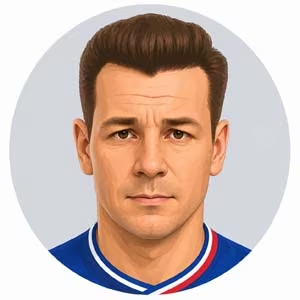
France - Right WingerWiltord, Sylvain
Born in Neuilly-sur-Marne, near Paris, in 1974, Wiltord was a quick, technically capable forward comfortable as a central striker, second striker or winger, valued for intelligent movement and clinical finishing rather than any single spectacular quality. He came through Rennes before a prolific spell at Bordeaux, where his 22 goals in 1998–99 won him the French Player of the Year award and the Ligue 1 title. His transfer to Arsenal in 2000, a club-record fee at the time, came weeks after his Euro 2000 heroics, and he spent four seasons under Arsène Wenger alongside a close friend from the national team, Thierry Henry, contributing to two Premier League titles and two FA Cups — including the decisive goal at Old Trafford in May 2002 that clinched the title in front of Arsenal's fiercest rivals — before staying through the club's unbeaten 2003–04 Invincibles season. He later won three consecutive Ligue 1 titles at Lyon, before a well-traveled final chapter took him through Rennes again, Marseille, Metz and Nantes. For France he won 92 caps and 26 goals, played at two World Cups and two European Championships, and reached the 2006 World Cup final, where he missed his penalty in the shootout defeat to Italy.
His limitations were tied to consistency rather than to any single technical gap. Wiltord's output could fluctuate between spells of genuine incisiveness and quieter stretches where his final ball or finishing let him down, and he was, by the account of French supporters themselves, a player who divided opinion rather than commanded universal affection — adored in some seasons and criticized sharply in others, never quite achieving the untouchable status some of his more consistently brilliant Arsenal teammates enjoyed. His versatility across multiple attacking positions, while valuable to his coaches, occasionally meant he lacked a single defined role to build a more singular reputation around.
Temperamentally the available record describes him as reasonably reserved and professional rather than a source of controversy, a player whose story is told largely through goals and transfers rather than through dressing-room anecdotes. His missed penalty in the 2006 World Cup final, in a shootout France ultimately lost, appears to have been absorbed without any lasting public campaign of self-recrimination, consistent with a career otherwise notably free of dramatic personal episodes. In 2015 he took part in a French reality television program that placed athletes in remote locations; shortly after his own participation ended, several other contestants were killed in a helicopter accident during filming, and Wiltord spoke publicly and with evident grief about the loss of people he considered friends. He moved into padel coaching after retiring from football at thirty-eight, a quieter second career consistent with a public profile that was never built on visibility for its own sake. Clinical in the moments that mattered most, inconsistent enough across the rest of his career to remain a genuinely debated figure among his own supporters, and personally affected by a real tragedy adjacent to his own life, Wiltord's career is defined by a small number of enormous moments rather than by sustained, uncontested brilliance.