We use Google Analytics to understand how visitors use this site. Analytics cookies are only activated with your consent. For details, read our Privacy Policy.
Profile lensThe same player, read from a different angle.
Athletic82
Acceleration
87
Pace
81
Agility
86
Strength
78
Balance
74
Jumping
84
Stamina
82
Fitness
87
Technical85
Dribbling
81
Short Passing
75
Long Passing
70
Finishing
94
Shot Accuracy
93
Shot Power
83
Shooting Technique
94
Heading
85
Tackling
38
Crossing
72
Free Kick
72
Penalties
82
First Touch
85
Mental82
Composure
87
Aggression
76
Consistency
87
Creativity
80
Leadership
76
Work Rate
74
Tactical86
Vision
76
Off the Ball
94
Defensive Positioning
41
Teamwork
82
Anticipation
92
Marking
33
Player Traits
Attacking88
Crossing
72
Finishing
94
Heading Accuracy
85
Shot Accuracy
93
Off the Ball
94
Technique80
Dribbling
81
Free Kick
72
Short Passing
75
Long Passing
70
First Touch
85
Shot Technique
94
Movement82
Acceleration
87
Pace
81
Agility
86
Balance
74
Physicality83
Shot Power
83
Jumping
84
Stamina
82
Strength
78
Fitness
87
Defending37
Marking
33
Tackling
38
Def. Positioning
41
Mentality & Game Reading81
Aggression
76
Composure
87
Penalties
82
Vision
76
Leadership
76
Work Rate
74
Teamwork
82
Anticipation
92
Consistency
87
Creativity
80
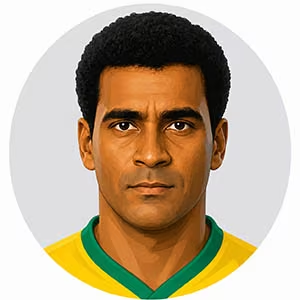
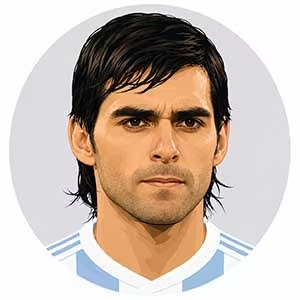
Brazil - StrikerWaldo
Fluminense elders still recount the booming, low-trajectory thump of a leather ball crashing against the crossbar in the late 1950s, a terrifying sonic warning to Brazilian goalkeepers that a physical force of nature from Niterói had stepped onto the pitch. Waldo Machado da Silva—known universally across South America and Spain simply as Waldo—was the ultimate explosive, high-output penalty-box juggernaut: a center-forward whose lethal blend of terrifying ball-striking velocity, aerial power, and lightning short-burst acceleration made him one of the most prolific, yet chronically underappreciated goalscorers in the history of global football.
Armed with an absolute cannon of a right foot, Waldo turned any shooting lane within thirty yards into an immediate crisis for the opposition. He combined a broad, muscular frame capable of pinning rugged center-halves with a deceptively sharp first-yard burst that allowed him to attack crosses across the near post or peel into the channels. As Fluminense’s undisputed scoring deity between 1953 and 1961, he shattered every record in club history, amassing an astonishing 319 goals in 403 matches—a legendary benchmark that remains the all-time scoring record for Tricolor Carioca to this day—winning the 1959 Campeonato Carioca and two Torneios Rio-São Paulo (1957, 1960). Crossing the Atlantic in 1961 to spearhead Valencia CF, he conquered Spanish football across nine glorious seasons, scoring 160 goals in 297 matches (ranking second on the club's all-time competitive scoring list) and lifting back-to-back Inter-Cities Fairs Cups (1961–62, 1962–63), the 1966–67 Copa del Generalísimo, and claiming the prestigious Pichichi Trophy in 1966–67 with 24 league goals. For Brazil, across five caps and two goals in 1960, his international opportunities were famously choked off by the staggering depth of the Pelé, Vavá, and Coutinho era, alongside the CBF's strict historical policy of ignoring overseas players for World Cup squads once he moved to Spain.
That extraordinary scoring machinery, however, was fundamentally geared toward direct final-third execution. Waldo was an unapologetic penalty-box finisher and channel-runner rather than a fluid, deep-lying playmaker who orchestrated buildup play through delicate one-twos in midfield; his game was direct, forceful, and demanded vertical service. When isolated in slow, horizontal possession matches where teammates failed to feed him early balls into the box or deliver service behind the defensive line, his tactical influence on the rhythm of the game could appear minimal. Furthermore, his left foot was functional rather than lethal, leaving him heavily reliant on creating angles to unleash his favored right-footed thunderbolt.
Psychologically, Waldo was an intensely focused, humble professional who approached football with the quiet seriousness of a blue-collar craftsman. He was completely detached from the theatrical bohemianism often associated with Brazilian forwards of his generation, avoiding nightclub nightlife and dedicating himself entirely to rigorous physical training, family life, and tactical obedience. On the pitch, his body language was a masterclass in coiled, predatory menace: lurking between center-backs with silent vigilance, demanding the ball with short, decisive gestures, and unleashing ferocious strikes without an ounce of hesitation or self-doubt. Inside the dressing rooms of the Maracanã, Mestalla, and Hércules, he was an adored, gentle giant whose spotless professional integrity, devastating finishing consistency, and unyielding humility made him an immortal folk hero across two continents.