We use Google Analytics to understand how visitors use this site. Analytics cookies are only activated with your consent. For details, read our Privacy Policy.
Profile lensThe same player, read from a different angle.
Athletic82
Acceleration
88
Pace
93
Agility
85
Strength
78
Balance
77
Jumping
74
Stamina
84
Fitness
76
Technical78
Dribbling
83
Short Passing
76
Long Passing
78
Finishing
74
Shot Accuracy
74
Shot Power
86
Shooting Technique
76
Heading
68
Tackling
65
Crossing
76
Free Kick
71
Penalties
71
First Touch
81
Mental73
Composure
76
Aggression
78
Consistency
74
Creativity
73
Leadership
70
Work Rate
72
Tactical71
Vision
74
Off the Ball
77
Defensive Positioning
64
Teamwork
72
Anticipation
73
Marking
64
Player Traits
Attacking74
Crossing
76
Finishing
74
Heading Accuracy
68
Shot Accuracy
74
Off the Ball
77
Technique78
Dribbling
83
Free Kick
71
Short Passing
76
Long Passing
78
First Touch
81
Shot Technique
76
Movement86
Acceleration
88
Pace
93
Agility
85
Balance
77
Physicality80
Shot Power
86
Jumping
74
Stamina
84
Strength
78
Fitness
76
Defending64
Marking
64
Tackling
65
Def. Positioning
64
Mentality & Game Reading73
Aggression
78
Composure
76
Penalties
71
Vision
74
Leadership
70
Work Rate
72
Teamwork
72
Anticipation
73
Consistency
74
Creativity
73
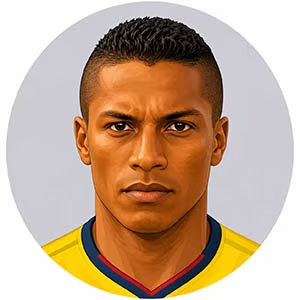
Ecuador - Right BackValencia, Antonio
Antonio Valencia spent the first half of his career as a winger good enough to torment Premier League full-backs and the second half as a full-back good enough that nobody remembered he had started anywhere else. The conversion is not unheard of in football, but it is rarely this complete: by his thirties, opposing wingers were the ones being torn apart by a man who used to be one of them.
Born in Lago Agrio, in Ecuador's Amazon region, in 1985, Valencia broke through at El Nacional before a brief stint at Villarreal preceded his move to Wigan Athletic in 2006, where his form as an explosive, direct right winger earned a transfer to Manchester United in 2009. Under Alex Ferguson he was initially a winger of exceptional pace and directness, his final ball sometimes inconsistent but his raw output — crosses delivered at speed, defenders isolated and beaten repeatedly — genuinely difficult to defend against. A serious leg break suffered against Rangers in 2010 interrupted his rise, and the player who returned was gradually redeployed at right-back, first out of necessity and then permanently, once it became clear the position suited his physical profile and defensive discipline better than anyone had anticipated. He made over 330 appearances for United across eleven seasons, won the Premier League, the FA Cup, the League Cup twice and the 2017 Europa League, and captained the club for two seasons under José Mourinho — an unusual honour for a South American in an institution that had rarely handed the armband outside a small circle of homegrown or long-established leaders. For Ecuador he won 128 caps, a national record, and played at the 2006 and 2014 World Cups.
His limitations shifted with his position and never fully disappeared in either. As a winger his end product was streaky, brilliant in matches where directness alone could unlock a defence and anonymous where it could not. As a full-back his attacking output declined sharply from his winger years, and though defensively sound, he was not a natural reader of the game in the way elite converted full-backs eventually become — his defending relied more on physical recovery and discipline than on anticipation, which occasionally exposed him against technically superior wide players who could manipulate him with movement rather than pace.
Temperamentally he was almost aggressively private, a quality that made him an unusual choice as captain of one of the most scrutinized clubs in world football. Valencia gave few interviews throughout his career, avoided the media obligations most players in his position accepted as routine, and led inside the dressing room through consistency and physical example rather than words — teammates described him as one of the quietest captains they had played under, someone who earned authority through reliability rather than presence. He rarely protested to referees and maintained a generally clean disciplinary record given the physical demands of right-back play in the Premier League, though his tackling could be uncompromising when the situation called for it. He accepted his positional conversion without any recorded resistance, a transition that ended his more glamorous attacking profile in exchange for a longer, more decorated career, and he never spoke publicly about missing the winger version of himself. Away from football his profile remained defined by that same reticence for most of his career, though his conduct after retirement, including sharply worded public statements on Ecuadorian politics during a period of civil unrest, drew considerably more attention and controversy than anything from his playing days had produced. Reserved, adaptable and quietly durable for over a decade at the top, Valencia built one of South American football's longest careers in English football on a foundation of doing exactly what was asked of him and saying almost nothing about it.


 All Time Manchester UnitedClub