We use Google Analytics to understand how visitors use this site. Analytics cookies are only activated with your consent. For details, read our Privacy Policy.
Profile lensThe same player, read from a different angle.
Athletic84
Acceleration
85
Pace
83
Agility
84
Strength
78
Balance
76
Jumping
87
Stamina
88
Fitness
87
Technical77
Dribbling
78
Short Passing
77
Long Passing
75
Finishing
66
Shot Accuracy
64
Shot Power
77
Shooting Technique
64
Heading
82
Tackling
72
Crossing
78
Free Kick
68
Penalties
66
First Touch
80
Mental78
Composure
78
Aggression
80
Consistency
81
Creativity
70
Leadership
75
Work Rate
78
Tactical74
Vision
76
Off the Ball
75
Defensive Positioning
69
Teamwork
78
Anticipation
76
Marking
69
Attacking73
Crossing
78
Finishing
66
Heading Accuracy
82
Shot Accuracy
64
Off the Ball
75
Technique74
Dribbling
78
Free Kick
68
Short Passing
77
Long Passing
75
First Touch
80
Shot Technique
64
Movement82
Acceleration
85
Pace
83
Agility
84
Balance
76
Physicality83
Shot Power
77
Jumping
87
Stamina
88
Strength
78
Fitness
87
Defending70
Marking
69
Tackling
72
Def. Positioning
69
Mentality & Game Reading76
Aggression
80
Composure
78
Penalties
66
Vision
76
Leadership
75
Work Rate
78
Teamwork
78
Anticipation
76
Consistency
81
Creativity
70
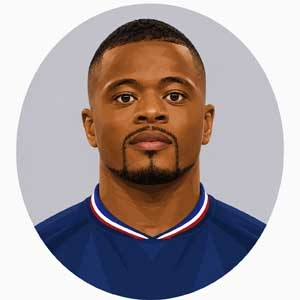
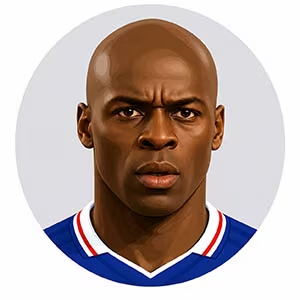
France - Left BackEvra, Patrice
Surviving an agonizing childhood in Les Ulis selling sandwiches in the cold and enduring a harrowing Manchester derby debut in January 2006 where Sir Alex Ferguson substituted him at half-time with the brutal instruction to sit down and learn what English football meant forged a Dakar-born defender into an indestructible gladiator. Patrice Latyr Evra was the definitive modern, high-friction left-back: a pocket powerhouse standing five-foot-nine who combined explosive short-burst acceleration, exceptional recovery tackling, dynamic overlapping width, and an astonishing vertical leap that allowed him to dominate aerial duels against wingers six inches taller.
Operating as an aggressive, two-way flank defender, Evra was an elite combination of defensive grit and offensive transition. He utilized rapid deceleration and a low center of gravity to stay on his feet against tricksters in one-on-one isolations, timing clean slide tackles before immediately surging sixty yards forward to deliver whipped crosses or combine with Cristiano Ronaldo and Ryan Giggs down the left channel. Rising through Italian lower leagues at Marsala and Monza before breaking through at Didier Deschamps’ AS Monaco—reaching the 2003–04 UEFA Champions League final and winning the 2003 Coupe de la Ligue—his global apex unfolded at Manchester United between 2006 and 2014. Across 379 appearances and ten goals at Old Trafford, he was an ever-present warrior in United's modern dynasty: lifting five Premier League titles, three League Cups, the 2008 FIFA Club World Cup, and the 2007–08 UEFA Champions League in Moscow, while reaching three further Champions League finals (2009, 2011, 2015). His later move to Juventus yielded two consecutive domestic doubles (2014–15, 2015–16) and another Champions League final appearance, before closing his career with Marseille and West Ham. For France, across 81 caps, he served as national team captain, featuring across two World Cups (2010, 2014) and three European Championships (2008, 2012, 2016), starting the Euro 2016 final in Paris.
His high-octane, front-foot style, however, carried inherent structural risks. Evra was an attack-minded full-back who loved pushing deep into the opposition third; if an opponent launched an immediate counter-attack into the channel vacated behind him and United's left-sided center-back was slow across to cover, dynamic wingers could exploit the space. Furthermore, in the latter stages of his career, a slight drop in recovery sprint speed made him more reliant on aggressive tactical positioning and anticipatory fouls to contain rapid, modern wingers in wide-open transitions.
Fiercely proud, vocal, and possessing an unyielding psychological resilience, Evra was the ultimate dressing-room general and emotional catalyst. He approached professional football with a profound sense of gratitude and ferocious loyalty, embracing high-pressure environments where weaker minds crumbled and defending his teammates with total, uncompromising passion. Even in his darkest career chapter—the infamous Knysna player strike at the 2010 World Cup in South Africa, where he bore the brunt of intense national backlash—he rebuilt his international standing through sheer mental toughness and unblemished leadership. On the pitch, his body language was a masterclass in kinetic defiance: chest out, barking tactical instructions, throwing himself into 50-50 duels without fear of injury, and celebrating defensive blocks with the same primal fury as match-winning goals. Inside the dressing rooms of Carrington, Vinovo, and Clairefontaine, his charismatic authority, infectious energy, and serial-winner mindset cemented an immortal legacy as one of the most decorated, resilient, and formidable left-backs of the 21st century.