We use Google Analytics to understand how visitors use this site. Analytics cookies are only activated with your consent. For details, read our Privacy Policy.
Profile lensThe same player, read from a different angle.
Athletic81
Acceleration
90
Pace
87
Agility
85
Strength
73
Balance
76
Jumping
72
Stamina
83
Fitness
80
Technical83
Dribbling
84
Short Passing
83
Long Passing
82
Finishing
86
Shot Accuracy
83
Shot Power
81
Shooting Technique
77
Heading
70
Tackling
44
Crossing
78
Free Kick
79
Penalties
86
First Touch
84
Mental81
Composure
83
Aggression
74
Consistency
77
Creativity
83
Leadership
83
Work Rate
79
Tactical80
Vision
83
Off the Ball
82
Defensive Positioning
48
Teamwork
82
Anticipation
79
Marking
44
Attacking80
Crossing
78
Finishing
86
Heading Accuracy
70
Shot Accuracy
83
Off the Ball
82
Technique82
Dribbling
84
Free Kick
79
Short Passing
83
Long Passing
82
First Touch
84
Shot Technique
77
Movement85
Acceleration
90
Pace
87
Agility
85
Balance
76
Physicality78
Shot Power
81
Jumping
72
Stamina
83
Strength
73
Fitness
80
Defending45
Marking
44
Tackling
44
Def. Positioning
48
Mentality & Game Reading81
Aggression
74
Composure
83
Penalties
86
Vision
83
Leadership
83
Work Rate
79
Teamwork
82
Anticipation
79
Consistency
77
Creativity
83
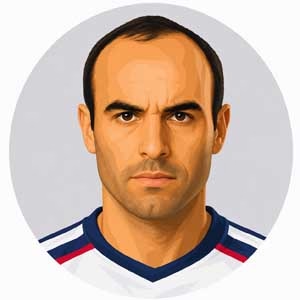
USA - ForwardDonovan, Landon
Donovan was an attacking midfielder, second striker and wide forward whose greatest weapon was the speed with which he converted perception into movement. He was quick without depending primarily on elaborate dribbling: transitions became dangerous because he identified open grass early, accelerated into it and released the ball before defenders could reorganise. His off-ball running was equally important, particularly when attacks required a second movement after the initial pass. Technically he was clean rather than ornamental, capable of finishing with either foot, delivering set pieces, combining at pace and playing the final pass. That versatility helped produce extraordinary numbers for both LA Galaxy and the United States; internationally he finished with 57 goals and 58 assists in 157 appearances, while his five World Cup goals remain among the clearest evidence that his production survived elite tournament pressure. Yet his European career was fragmented. He joined Bayer Leverkusen young, returned twice to MLS after struggling to establish himself there, had an unsuccessful short spell with Bayern Munich, but later adapted immediately during two loans at Everton. The contrast matters: failure to secure a permanent European career cannot simply be translated into inability to perform against stronger opposition when his international record and Everton performances contradict that conclusion.
His limitations appeared when football demanded sustained individual creation against compressed space or when the surrounding environment removed the conditions in which his decision-making became fastest. Donovan was dangerous carrying into space but less naturally equipped to dismantle a static low block through repeated one-against-one dribbling. He was neither physically imposing nor a specialist possession controller who could slow a match and dictate it from midfield. More importantly, his performance conditions were unusually sensitive to accumulated demands. By 2014 he acknowledged that he could no longer produce an excellent training performance twelve consecutive days and that his body increasingly required recovery. Earlier, after years of almost uninterrupted club and international obligations, he had stepped away from football for several months before returning in 2013. The private causes fall outside this profile’s editorial scope; the observable football consequence does not: continuous participation had become unsustainable enough for him voluntarily to remove himself during an important phase of World Cup qualification. This must remain separate from competitive fragility. Donovan could experience deterioration under prolonged occupational load while still producing exceptionally well when confronted with the concentrated pressure of an individual decisive match.
That separation is the central psychological fact of Donovan’s career: acute competitive pressure could activate him while sustained institutional pressure could exhaust or alienate him. His response to authority was neither obedient nor reflexively rebellious. After Jürgen Klinsmann excluded him from the 2014 World Cup squad, Donovan immediately told the coach he believed the decision was a major mistake; privately the rejection affected him intensely, but he did not turn it into refusal to participate in the national-team environment. Months later he still publicly maintained that he deserved selection while also acknowledging that throughout his career he had sometimes received selection advantages and that, on this occasion, the decision had gone against him. His confrontation with David Beckham reveals another mechanism. As Galaxy captain, Donovan became angry at what he perceived as inadequate commitment from the club’s highest-status player and criticised him publicly before confronting him privately; when challenged, Donovan admitted that the sequence was wrong and apologised for how he had handled it without retracting the substance of his complaint. That is status-insensitive accountability rather than simple aggression: hierarchy did not prevent criticism when he believed collective standards were being violated, but criticism could initially emerge through an imperfect channel. His response to his own mistakes could also be immediate rather than cumulative. In the 2012 MLS Cup final he missed an open chance, later converted a pressure penalty and, after the equaliser, physically retrieved the ball and rushed it back to halfway as Galaxy pursued victory. Evidence for persistent referee conflict, retaliatory fouling or provocation-driven aggression is insufficient and should remain unknown. Donovan’s contradiction is more useful: he was capable of extraordinary clarity when the scoreboard created urgency, while prolonged external obligation could reduce the very engagement from which that clarity emerged.