We use Google Analytics to understand how visitors use this site. Analytics cookies are only activated with your consent. For details, read our Privacy Policy.
Profile lensThe same player, read from a different angle.
Athletic83
Acceleration
87
Pace
86
Agility
83
Strength
77
Balance
74
Jumping
84
Stamina
91
Fitness
84
Technical78
Dribbling
78
Short Passing
76
Long Passing
80
Finishing
65
Shot Accuracy
68
Shot Power
83
Shooting Technique
70
Heading
80
Tackling
75
Crossing
77
Free Kick
66
Penalties
68
First Touch
78
Mental85
Composure
82
Aggression
86
Consistency
85
Creativity
72
Leadership
85
Work Rate
94
Tactical79
Vision
72
Off the Ball
77
Defensive Positioning
75
Teamwork
87
Anticipation
82
Marking
77
Player Traits
Attacking73
Crossing
77
Finishing
65
Heading Accuracy
80
Shot Accuracy
68
Off the Ball
77
Technique75
Dribbling
78
Free Kick
66
Short Passing
76
Long Passing
80
First Touch
78
Shot Technique
70
Movement83
Acceleration
87
Pace
86
Agility
83
Balance
74
Physicality84
Shot Power
83
Jumping
84
Stamina
91
Strength
77
Fitness
84
Defending76
Marking
77
Tackling
75
Def. Positioning
75
Mentality & Game Reading81
Aggression
86
Composure
82
Penalties
68
Vision
72
Leadership
85
Work Rate
94
Teamwork
87
Anticipation
82
Consistency
85
Creativity
72
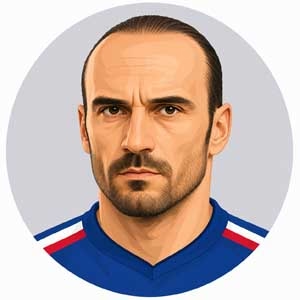
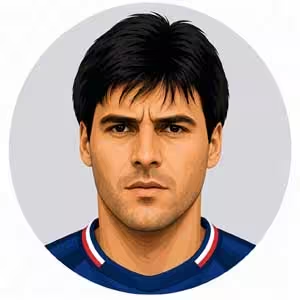
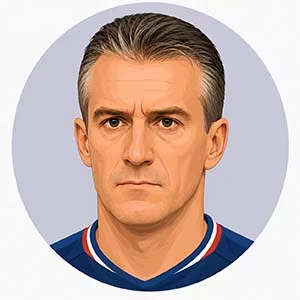
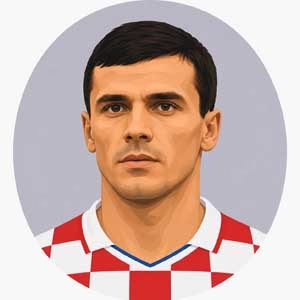
France - Left BackDi Meco, Éric
Before the 1993 Champions League final, Jean-Pierre Papin — by then at Milan, having left Marseille the year before — told a French magazine exactly how he planned to unsettle his former teammate: he knew Éric Di Meco well, he said, and he knew precisely how to make him lose his temper. Marseille won the match anyway, on a single Basile Boli header, and decades later Di Meco could still recall Papin's jibe word for word on live radio, along with the fact that Papin, in his telling, held a grudge against him for years afterward over how that final went. Provocation aimed at Di Meco was, evidently, common knowledge among people who had played beside him.
Born in Avignon in 1963, Di Meco was already a Marseille supporter as a boy before joining the club's academy and building a fourteen-year career there almost entirely as a left-back, after starting out in midfield. He was combative, physically committed and reliable defensively rather than technically expansive, a player teams built their structural solidity around during Marseille's run of four consecutive French titles. He was part of the side that won the club's only European Cup in 1993, a triumph later stained by a domestic match-fixing scandal that triggered Marseille's relegation the same year and sent Di Meco to Monaco, where he added a further league title before retiring in 1998. For France he won 23 caps, served as backup to a younger Bixente Lizarazu at Euro 1996, and retired from international duty immediately afterward. His playing career ended prematurely, cut short by a serious injury that closed out his time as a professional athlete earlier than his form alone would have.
His limitations were tied closely to the same combative instincts that made him valuable. Di Meco's temper was well known enough within the game that an opponent could plan, publicly and in advance, to exploit it, and while the details of any resulting disciplinary cost are less documented than the reputation itself, the fact that a rival felt confident naming the strategy on the record says something about how reliably it had worked before.
Temperamentally he has remained, well into a long second career, exactly as direct as his playing reputation suggested. Di Meco became one of French football's most prominent television pundits, known on radio and television for blunt, unfiltered opinions delivered without diplomatic softening — he has openly criticized managers, players and his own former club without hesitation, and on at least one occasion left a live broadcast abruptly via video link rather than continue a discussion he found unacceptable. His attachment to Marseille never wavered: he still lives in the city, raised his children there, and spent thirteen years after retiring as an elected deputy mayor, a civic commitment that extended his identification with the club and city well beyond football itself. He described the culture of relentless winning instilled at Marseille during his years there as something he believed shaped the entire generation of French internationals who passed through the club, crediting it explicitly for later success at the highest level. Combative, outspoken and incapable of the diplomatic hedge, Di Meco built both of his careers — as a player and as a commentator — on refusing to soften what he actually thought.