We use Google Analytics to understand how visitors use this site. Analytics cookies are only activated with your consent. For details, read our Privacy Policy.
Profile lensThe same player, read from a different angle.
Athletic81
Acceleration
87
Pace
84
Agility
85
Strength
76
Balance
83
Jumping
74
Stamina
80
Fitness
77
Technical88
Dribbling
91
Short Passing
87
Long Passing
85
Finishing
89
Shot Accuracy
84
Shot Power
85
Shooting Technique
85
Heading
68
Tackling
38
Crossing
84
Free Kick
93
Penalties
93
First Touch
90
Mental82
Composure
90
Aggression
78
Consistency
77
Creativity
90
Leadership
80
Work Rate
79
Tactical84
Vision
88
Off the Ball
89
Defensive Positioning
36
Teamwork
78
Anticipation
80
Marking
36
Player Traits
Attacking83
Crossing
84
Finishing
89
Heading Accuracy
68
Shot Accuracy
84
Off the Ball
89
Technique89
Dribbling
91
Free Kick
93
Short Passing
87
Long Passing
85
First Touch
90
Shot Technique
85
Movement85
Acceleration
87
Pace
84
Agility
85
Balance
83
Physicality78
Shot Power
85
Jumping
74
Stamina
80
Strength
76
Fitness
77
Defending37
Marking
36
Tackling
38
Def. Positioning
36
Mentality & Game Reading83
Aggression
78
Composure
90
Penalties
93
Vision
88
Leadership
80
Work Rate
79
Teamwork
78
Anticipation
80
Consistency
77
Creativity
90
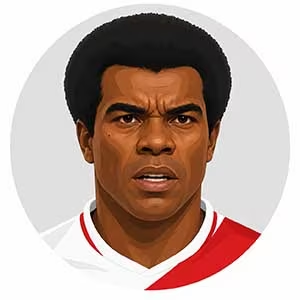
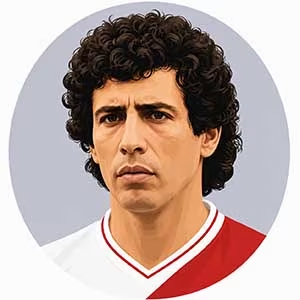
Peru - Attacking MidfielderCubillas, Teófilo
Scottish goalkeeper Alan Rough could only stand and watch on June 3, 1978, in Córdoba, as a Peruvian number ten stepped up to a dead ball outside the box and struck it with the outside three toes of his right boot, sending a vicious, swerving tracer bullet curling past the defensive wall straight into the top corner. Teófilo Juan Cubillas Arizaga, immortalized across South America as El Nene, stood as the undisputed creative crown jewel of Peru’s golden era throughout the 1970s. Stationed as an advanced playmaker (enganche) or roaming second striker, Cubillas possessed explosive short-burst acceleration over ten yards, sublime balance when dribbling through tight midfield channels, and thunderous, dead-eye shooting range off the laces. His domestic dominance with Alianza Lima delivered multiple league championships, while a European stint at FC Porto brought him the 1976–77 Taça de Portugal. On the international stage, across 81 caps and 26 goals for La Blanquirroja, he orchestrated the 1975 Copa América triumph and achieved the rare historic feat of scoring five or more goals in two distinct World Cups (1970 and 1978), amassing ten total World Cup finals goals.
Yet this pure attacking brilliance came with stark structural trade-offs. Cubillas was an offensive purist who contributed virtually nothing to defensive pressing, ball-recovery dogfights, or aerial duels, forcing his managers to field tireless midfield ball-winners to cover his lack of defensive running. When matched against aggressive, physical man-markers who suffocated his space between the lines and fouled him before he could turn, his influence could fade into long stretches of passivity. His subsequent years in the North American Soccer League with the Fort Lauderdale Strikers highlighted these physical limitations once his explosive initial burst began to decline.
Dignified, humble, and completely unburdened by ego, Cubillas carried the hopes of an entire nation with serene grace. He never engaged in provocative theatrics, cheap simulation, or on-pitch arguments; even when subjected to brutal, studs-up tackles across the rough landscape of South American qualifiers, he simply rose from the turf, adjusted his socks, and let his technical brilliance deliver retribution on the scoreboard. Inside the Peruvian dressing room, he was a quiet, universally beloved talisman who let veteran enforcers manage team confrontations while he led through pristine sporting conduct and clutch execution. Match officials admired his spotless fair play, while generations of goalkeepers feared his swerving long-range strikes, leaving an eternal legacy as the greatest and most clutch footballer in Peruvian history.