We use Google Analytics to understand how visitors use this site. Analytics cookies are only activated with your consent. For details, read our Privacy Policy.
Profile lensThe same player, read from a different angle.
Athletic79
Acceleration
83
Pace
82
Agility
81
Strength
76
Balance
77
Jumping
75
Stamina
86
Fitness
75
Technical81
Dribbling
84
Short Passing
77
Long Passing
83
Finishing
72
Shot Accuracy
71
Shot Power
85
Shooting Technique
78
Heading
73
Tackling
74
Crossing
80
Free Kick
78
Penalties
77
First Touch
84
Mental80
Composure
81
Aggression
84
Consistency
81
Creativity
76
Leadership
80
Work Rate
78
Tactical76
Vision
79
Off the Ball
75
Defensive Positioning
72
Teamwork
83
Anticipation
78
Marking
70
Player Traits
Attacking74
Crossing
80
Finishing
72
Heading Accuracy
73
Shot Accuracy
71
Off the Ball
75
Technique81
Dribbling
84
Free Kick
78
Short Passing
77
Long Passing
83
First Touch
84
Shot Technique
78
Movement81
Acceleration
83
Pace
82
Agility
81
Balance
77
Physicality79
Shot Power
85
Jumping
75
Stamina
86
Strength
76
Fitness
75
Defending72
Marking
70
Tackling
74
Def. Positioning
72
Mentality & Game Reading80
Aggression
84
Composure
81
Penalties
77
Vision
79
Leadership
80
Work Rate
78
Teamwork
83
Anticipation
78
Consistency
81
Creativity
76
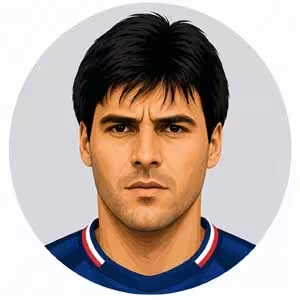
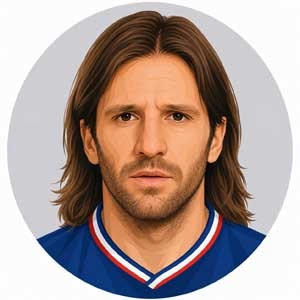
France - Left BackCandela, Vincent
Candela was nominally a left-back, but his game was closer to that of a two-way flank player whose technical education survived every tactical reassignment. Right-footed despite operating primarily on the left, he could receive inside, combine through midfield, overlap or underlap and attack the final third without becoming predictable from his starting position. Roma’s Hall of Fame classifies him both as left-back and left midfielder, while Fabio Capello later described the 2000–01 side explicitly through the attacking danger generated by Cafu on the right and Candela on the left from the wing-back positions. His close control, balance, crossing and willingness to use either foot made him unusually difficult to press towards one obvious direction. He also possessed enough tactical intelligence to survive the transition from Zdeněk Zeman’s highly automated four-man structure to Capello’s more controlled back three. Across eight years at Roma he played 289 competitive matches and scored 16 goals, becoming one of the structural pieces of the 2001 championship side. For France, however, his situation was very different: 40 senior caps but long periods behind Bixente Lizarazu, including only one appearance during the victorious 1998 World Cup.
His versatility should not be confused with universal defensive security. Candela was technically stronger moving forward than many defenders of his generation, but his instinct to participate could expose space behind him if the surrounding structure failed to compensate. He was not an aerially dominant defender and was less naturally suited to repeated isolated duels against powerful forwards than to defending from a flank with positional support nearby. His attacking influence also declined when the system demanded conservative occupation without opportunities to combine or advance. Zeman’s training provides another limitation from Candela’s own testimony: as a young player he resisted the extreme physical work, the running and the apparently repetitive exercises because he did not initially understand their purpose. Only retrospectively did he credit Zeman with teaching him sacrifice and discipline. That distinction matters. Candela was not incapable of discipline; he became highly functional inside extremely demanding systems. But compliance was stronger once he could integrate the demand into his own understanding of football. When physical sharpness declined later in his career, the same flank role naturally lost value because much of his effectiveness depended on repeated movement, technical execution at speed and the ability to recover after advancing.
Psychologically, Candela is best defined by expressive autonomy without strong status dependency. His international career supplies unusually clean evidence for the second half. He spent roughly eight years competing with Lizarazu and later said that, despite often being the substitute, he continued to feel important. He remembered the 1998 World Cup final from the bench without disguising a personal reaction: when France were winning comfortably he stopped thinking about whether he might enter, enjoyed the moment almost as a spectator, and after the final whistle consciously thought that he had earned the right to be there. That is neither self-erasure nor resentment. At Roma his relationship with authority was more combustible. Candela recalls frequent arguments with Zeman and initially with Capello; yet the Capello relationship subsequently became, in his words, “fantastic,” and he later ranked him extremely highly as a manager. The pattern therefore does not support generic rebellion. Candela could clash openly over methods and interpretation, then form a durable relationship once mutual understanding developed. He also retrospectively describes leaving Roma as an impulsive decision that he might have handled with greater lucidity, explicitly acknowledging a tendency to decide instinctively and dislike ambiguity. Evidence for persistent referee conflict, retaliatory aggression, teammate blame or hostile-crowd degradation is insufficient and should remain unknown. What is documented is more distinctive: Candela could accept reduced status remarkably well, but his engagement was strongest when tactical discipline still left room for personal interpretation; constraint provoked argument more readily than competition did.


 All Time RomaClub