We use Google Analytics to understand how visitors use this site. Analytics cookies are only activated with your consent. For details, read our Privacy Policy.
Profile lensThe same player, read from a different angle.
Athletic82
Acceleration
86
Pace
83
Agility
87
Strength
74
Balance
73
Jumping
95
Stamina
77
Fitness
80
Technical60
Dribbling
78
Short Passing
69
Long Passing
69
Shot Accuracy
75
Shot Power
77
Shooting Technique
75
Heading
72
Free Kick
68
Penalties
71
First Touch
78
Mental82
Composure
85
Consistency
77
Leadership
84
Goalkeeping87
Reflexes
93
Positioning
85
Handling
84
Kicking
87
Goalkeeping87
Reflexes
93
Positioning
85
Handling
84
Kicking
87
Attacking74
Heading Accuracy
72
Shot Accuracy
75
Technique73
Dribbling
78
Free Kick
68
Short Passing
69
Long Passing
69
First Touch
78
Shot Technique
75
Physicality81
Shot Power
77
Jumping
95
Stamina
77
Strength
74
Fitness
80
Movement82
Acceleration
86
Pace
83
Agility
87
Balance
73
Mentality & Game Reading79
Composure
85
Penalties
71
Leadership
84
Consistency
77
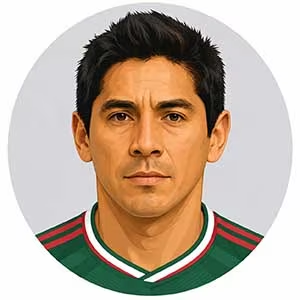
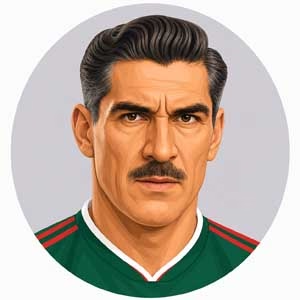
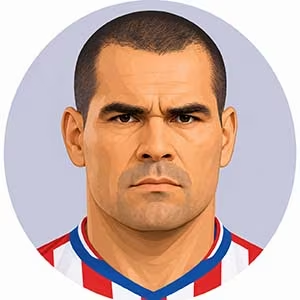
Mexico - GoalkeeperCampos, Jorge
Fluorescent, self-designed neon jerseys and a five-foot-seven frame made Jorge Francisco Campos Navarrete the most electrifying and unconventional dual-threat phenomenon in Latin American football history. Born in Acapulco and forged in the youth system of UNAM Pumas, El Brody defied every modern athletic parameter for a goalkeeper. He lacked the reach and high-ball physical dominance required against direct, physical aerial attacks, but compensated through an extraordinary vertical leap honed on the beach, spring-loaded lateral elasticity, and foot speed so exceptional that Pumas frequently deployed him as a starting center-forward (scoring 14 league goals in the 1989–90 season alone). In goal, his positioning was hyper-aggressive: he played twenty yards off his line, anticipating through-balls like a sweeper and parrying shots with acrobatic, volleyball-style dives. With Pumas, Cruz Azul, Atlante, and MLS side Chicago Fire, he was a box-office magnet, collecting two Mexican league championships and the 1998 MLS Cup/US Open Cup double. For the Mexican national team across 129 caps, he was the charismatic backbone of the 1993 Copa América runners-up, two Gold Cup triumphs (1993, 1996), and the 1999 FIFA Confederations Cup victory, starting between the posts at both the 1994 and 1998 World Cups. However, his high-risk style carried real tactical vulnerabilities: his tendency to punch rather than catch created chaos on second balls, and his height left him exposed to looping headers and top-corner strikes from distance.
Unapologetically joyful, completely immune to self-doubt, and addicted to the spectacle of the game, Campos approached international football as an extension of coastal street play. He operated without a trace of conventional goalkeeping angst; conceding a goal never shattered his equilibrium, and he would attempt risky dribbles outside his penalty box against world-class strikers with total nonchalance. This total absence of fear was his greatest asset, but it also exasperated conservative coaches who viewed his box excursions and frequent mid-game position switches from goalkeeper to striker as excessive showmanship. In the dressing room, he was the undisputed life of the party—universally adored for his generosity, surf-culture warmth, and practical jokes, acting as the primary social glue that kept El Tri relaxed in high-pressure tournaments. In the cauldron of international football, from Azteca derbies to World Cup knockout ties against Germany and Bulgaria, his pulse never quickened, pulling off reflex stops while sporting a broad, relaxed smile. Referees found him impossible to discipline because of his boundless charm and fair play, while opponents were perpetually unsettled by his sheer unpredictability, leaving a singular legacy as the last truly great, eccentric goalkeeper-striker the global game has ever known.