
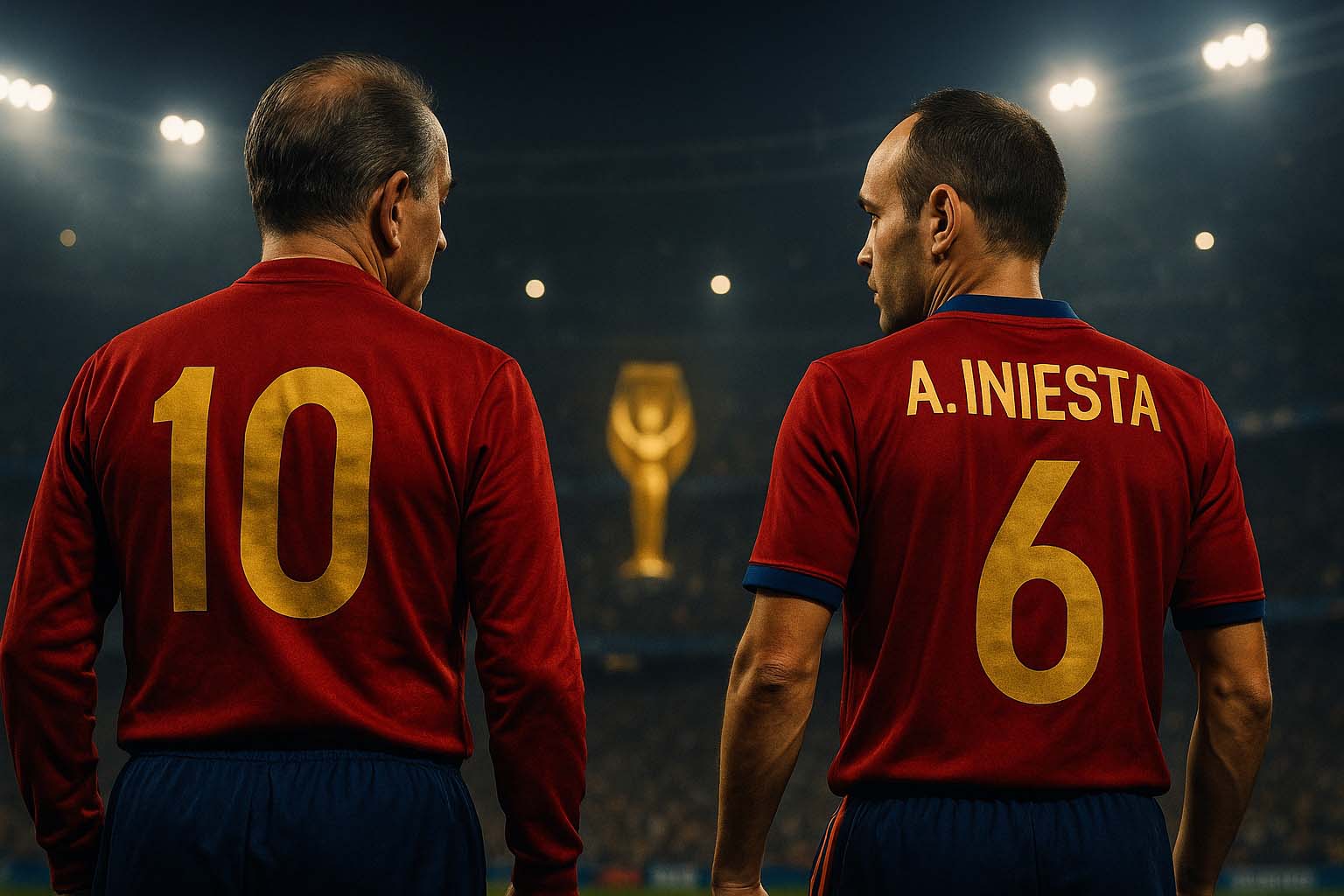
Busquets, Xabi Alonso, Xavi, Iniesta, David Silva and Fabregas: in 2012, Spain won a European Championship fielding six midfielders, some of whom seemed almost like reflections of one another. Busquets and Xabi Alonso were two old-school holding midfielders who, in their respective club teams, occupied similar spaces and performed similar functions. Xavi resembled, mutatis mutandis, his twin Iniesta, who in turn shared something with Fabregas and even David Silva.
How could a team win such an important tournament, completing a treble unlikely ever to be matched, by seemingly sabotaging so many deep-rooted football convictions?
How did Spain, condemned for decades to play the role of the talented sparring partner with high expectations and loud failures, become the best footballing school in the world, at least if we shine the spotlight on the midfield and realize how many playmakers, even unconventional ones, Spanish football has produced?
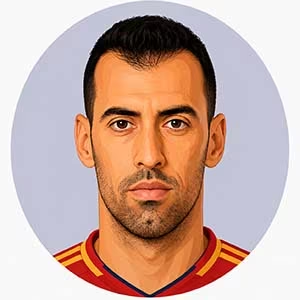 DM
DM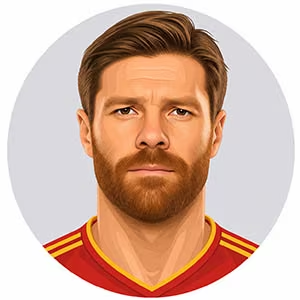 CM
CM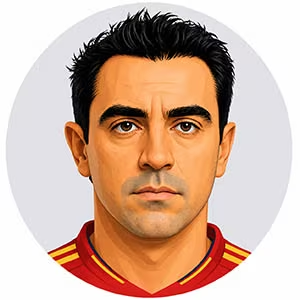 CM
CM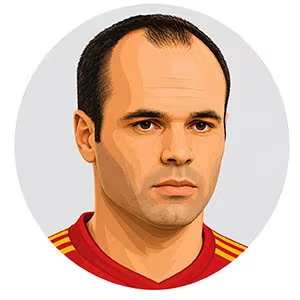 AM
AM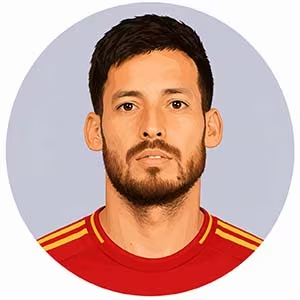 AM
AM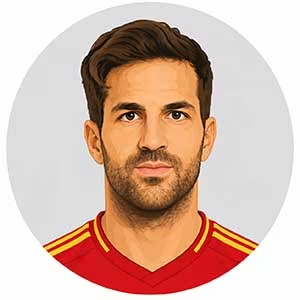 CM
CMA country of many footballs, not one football.
European football has seen various national schools develop their identities in different ways and at different times. Italy, England and Germany each built recognizable traditions that survived decades of tactical evolution. Spain was different. Like France, but for different reasons, it struggled for a long time to find one shared footballing identity.
Perhaps no other football country suffered so much from its own regionalism. In Italy, football has often been a northern phenomenon, especially philosophically and structurally, with the key exceptions of Rome and Naples. In Spain, the situation is more complex: fierce regional identity created locally rooted football cultures, each with its own vocabulary and emotional temperature.
Madrid embraced grandeur, the pursuit of results as the final outcome of individual brilliance, and built an unrivalled trophy cabinet on those convictions. In the Basque Country one can always breathe the Atlantic air: the cultural influence of British football was never merely decorative. The atmosphere in Basque stadiums, the almost Homeric passion around their heroes, often evokes Scotland and England more than the rest of Spain.
Andalusia translated its explosiveness into a football that celebrates both quality and the courage to go toe-to-toe with the best. Sevilla, in this sense, has often seemed like a hybrid: technical, raw, popular, proud. And Catalonia? Looking even at the Barcelona of the 1950s, blessed by the delightful genius of Kubala and the tireless runs of Luis Suarez Miramontes, one can already sense a football that turned aesthetic vocation into a religion.
When Catalan beauty learned how to win.
The crucial turn came after the successful orange transplant in Catalonia. The roots of what we now instantly recognize as Spanish football lie in the long love affair between the football of Rinus Michels and Johan Cruijff and that of the Spaniards.
This was not simply influence. It was mutual hybridization, even if the ideological backbone was essentially of Ajax origin. Barcelona, after the 1988-89 season, changed pace completely. What is more astonishing is how the entire Spanish football system eventually managed to do the same.
Cruijff's great merit was putting individual technique, long abundant in Spain's central areas, at the service of the collective. He understood the strengths of Spanish football and corrected its shortcomings: he took passers, organizers, small-space thinkers and turned them into the skeleton of an idea.
The midfield was always there. The system arrived later.
Spain had always produced legions of players capable of ruling the middle of the pitch: from Luis Suarez Miramontes to Michel, from Bakero to the wave of excellent players who made La Liga the promised land for many of the world's best playmakers. This abundance, however, did not always translate into results. It had not yet become a trademark, a signature, a flavor running through the whole cake.
Each region remained comfortable in its own traditions. Internal divisions, the difficulty of forming a cohesive group and the lack of a shared footballing vision made things worse. The summary is simple: many talents, technically superior to nearly all of Europe, but poor ability to translate that superiority into convincing results.
All this changed with Michels and especially Cruijff. Unfazed by possible contradictions, like all geniuses, Johan never backtracked, not even when he suffered heavy defeats against teams playing radically different football. He continued a legacy destined to outlast its founder, a legacy still alive today and one that encompasses all of Spain.
Even Madrid, while maintaining a clearly distinct identity from Catalonia, has produced or imported many high-caliber midfielders. Overall, Spanish youth academies poured their heart into perfecting the zone where the heart of the game lies, sometimes at the expense of specialization or excellence in other departments.
The results have been visible for some time. Spain created the most successful cycle in national-team football history, based almost entirely on the technical superiority of an unrepeatable midfield. And after a few slower years, without compromising its non-negotiable principles, Spain launched a new generation of sublimely technical players, almost all capable of playing as, or functioning like, playmakers.
"Brain first," said Thierry Henry in an interview, when asked what set Spanish football apart. The brain, said Titi, comes before anything else.
A bridge between South America and the Netherlands.
The renewed identity of Spanish football is a bridge: the strengths of South American football, trimmed of what Europeans often consider excess, and channeled through a Dutch-derived structure. Talent, intelligence, technique, control. A football sophisticated enough to make small players giants, and patient enough to turn the midfield into the whole world.