We use Google Analytics to understand how visitors use this site. Analytics cookies are only activated with your consent. For details, read our Privacy Policy.
Profile lensThe same player, read from a different angle.
Athletic79
Acceleration
76
Pace
80
Agility
72
Strength
85
Balance
78
Jumping
83
Stamina
80
Fitness
77
Technical77
Dribbling
75
Short Passing
78
Long Passing
74
Finishing
62
Shot Accuracy
62
Shot Power
76
Shooting Technique
63
Heading
78
Tackling
83
Crossing
64
Free Kick
58
Penalties
57
First Touch
77
Mental76
Composure
76
Aggression
85
Consistency
74
Creativity
66
Leadership
79
Work Rate
80
Tactical80
Vision
72
Off the Ball
62
Defensive Positioning
84
Teamwork
78
Anticipation
85
Marking
84
Player Traits
Attacking66
Crossing
64
Finishing
62
Heading Accuracy
78
Shot Accuracy
62
Off the Ball
62
Technique71
Dribbling
75
Free Kick
58
Short Passing
78
Long Passing
74
First Touch
77
Shot Technique
63
Movement77
Acceleration
76
Pace
80
Agility
72
Balance
78
Physicality80
Shot Power
76
Jumping
83
Stamina
80
Strength
85
Fitness
77
Defending84
Marking
84
Tackling
83
Def. Positioning
84
Mentality & Game Reading75
Aggression
85
Composure
76
Penalties
57
Vision
72
Leadership
79
Work Rate
80
Teamwork
78
Anticipation
85
Consistency
74
Creativity
66
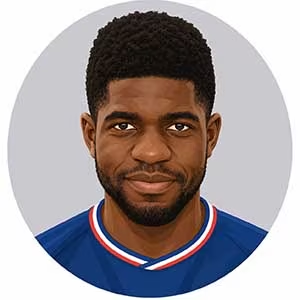
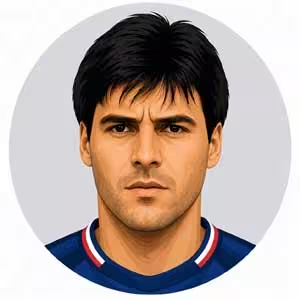
France - Centre-backUmtiti, Samuel
In Saint Petersburg on 10 July 2018, France and Belgium were level in a World Cup semi-final when Samuel Umtiti attacked Antoine Griezmann’s corner at the near post. Marouane Fellaini stood between him and the goal and possessed an obvious height advantage, but Umtiti moved first, reached the delivery ahead of him and redirected the ball beyond Thibaut Courtois. France won 1–0. The action reflected much of his defensive football in reverse: identify the trajectory early, establish position before the larger opponent can use his body and attack the ball rather than wait for the duel to arrive. Four days later Umtiti played the entire final as France became world champions. He had done so while managing a left knee that had already caused significant problems during the preceding Barcelona season. The tournament therefore became simultaneously the highest achievement of his career and the point around which every subsequent discussion of physical risk would revolve.
At his peak Umtiti was a left-footed centre-back whose combination of strength, acceleration and technical security allowed him to defend proactively without treating possession as a separate phase. He could step ahead of a striker to intercept, follow attackers into midfield and recover quickly enough to protect the space created by aggressive positioning. Despite standing around 1.82 metres, he competed effectively in the air through timing and powerful elevation. On the ball he could receive under pressure, carry beyond the first line and pass progressively with his left foot, making him particularly useful to Barcelona’s construction from the back. Lyon developed him across both central and occasional left-sided defensive roles before Barcelona signed him in 2016. His adaptation was rapid, and by 2017–18 he had become a first-choice defender for both club and country. France’s 2018 structure required a slightly different interpretation: less continuous possession dominance, greater tolerance for defending deeper and more emphasis on winning direct duels. Umtiti demonstrated that his effectiveness was not dependent on one tactical environment.
The limitation that subsequently overwhelmed everything else was physical availability. His left knee had already become problematic before the World Cup and deteriorated sufficiently afterwards that Barcelona repeatedly lost access to the defender who had established himself during his first two seasons. Umtiti pursued conservative treatment rather than immediately undergoing surgery, and the following years became a cycle of rehabilitation, attempted returns and further physical interruptions. It would be medically irresponsible to claim that playing the World Cup directly caused the later collapse: the knee problem predated the tournament, and its subsequent evolution involved treatment choices and recurrent complications that cannot be reduced to one event. What is observable is that the athletic margin supporting his front-foot defending declined sharply. Without reliable acceleration and lateral mobility, aggressive stepping became harder to repair when unsuccessful, while repeated interruptions damaged match rhythm. His technical quality remained, but centre-back performance could no longer be separated from whether the body allowed the positioning to be executed at the required speed.
Psychologically, Umtiti is best defined by **present-priority risk acceptance followed by prolonged identity reconstruction**. He later acknowledged that he had been managing physical problems around the 2018 World Cup and that becoming world champion had been an overriding objective. The behaviour therefore supports a willingness to accept uncertain future physical cost rather than voluntarily surrender an immediate, potentially unique competitive opportunity. That choice should not be confused with inability to understand risk: subsequent disagreement around treatment suggests Umtiti remained strongly involved in decisions concerning his own body and preferred a conservative path when surgery was discussed. The more difficult psychological phase came afterwards. At Barcelona he moved from first-choice world champion to prolonged marginalisation, was booed by sections of the Camp Nou crowd and repeatedly faced speculation that the club wanted him to leave. Yet his response did not become public retaliation against supporters or teammates. He continued rehabilitation and later accepted a move to Lecce, a dramatic reduction in competitive status, in order to play regularly again. There he rebuilt enough continuity to complete a substantial Serie A season. Evidence for referee obsession, retaliatory aggression, teammate blame or authority conflict is insufficient for defining scores. The contradiction is more valuable: **Umtiti once privileged the immediate opportunity to compete despite physical uncertainty; when the consequences later removed status and continuity, he eventually accepted a much smaller stage rather than requiring restoration of his former prestige before attempting to become a footballer again**.