We use Google Analytics to understand how visitors use this site. Analytics cookies are only activated with your consent. For details, read our Privacy Policy.
Profile lensThe same player, read from a different angle.
Athletic74
Acceleration
67
Pace
67
Agility
71
Strength
91
Balance
85
Jumping
74
Stamina
63
Fitness
74
Technical43
Dribbling
51
Short Passing
52
Long Passing
61
Shot Accuracy
44
Shot Power
84
Shooting Technique
44
Heading
45
Free Kick
44
Penalties
44
First Touch
52
Mental81
Composure
84
Consistency
79
Leadership
70
Goalkeeping91
Reflexes
93
Positioning
91
Handling
90
Kicking
89
Goalkeeping91
Reflexes
93
Positioning
91
Handling
90
Kicking
89
Attacking45
Heading Accuracy
45
Shot Accuracy
44
Technique51
Dribbling
51
Free Kick
44
Short Passing
52
Long Passing
61
First Touch
52
Shot Technique
44
Physicality77
Shot Power
84
Jumping
74
Stamina
63
Strength
91
Fitness
74
Movement73
Acceleration
67
Pace
67
Agility
71
Balance
85
Mentality & Game Reading69
Composure
84
Penalties
44
Leadership
70
Consistency
79
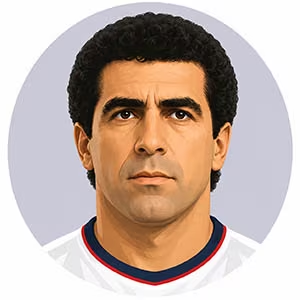
Poland - GoalkeeperTomaszewski, Jan
Brian Clough famously dismissed him on live British television as a "clown in gloves" just hours before the opening whistle, yet on October 17, 1973, at Wembley Stadium, a towering Polish shot-stopper delivered the most defiantly heroic goalkeeping display in international history. Jan Tomaszewski was the eccentric, sprawling rock who stopped England’s 36-shot siege with a fractured hand, securing the 1–1 draw that qualified Poland for the 1974 World Cup and eliminated the hosts. Standing six-foot-four with an imposing frame and unorthodox, sprawling reflexes, Tomaszewski pioneered a chaotic, body-blocking style: smothering low drives with his shins, using his chest to absorb point-blank blasts, and establishing himself as the greatest penalty-saver of his era. At the 1974 World Cup in West Germany, he backstopped Kazimierz Górski’s sensational team to the bronze medal, making history as the first goalkeeper to save two penalties in a single tournament (denying Sweden’s Staffan Tapper and West Germany’s Uli Hoeneß). Across 63 caps for Poland, he added an Olympic Silver Medal in Montreal 1976 and featured at the 1978 World Cup.
Tomaszewski’s unorthodox, high-wire style naturally walked a permanent edge with chaos. His handling was notoriously unorthodox and messy; he rarely caught balls cleanly, preferring to palm, punch, or kick rebounds into open space, which created frantic goalmouth scrambles if his defenders failed to clear the second ball. Furthermore, his footwork in possession was clumsy and rudimentary, and his aggressive charges out of the six-yard box occasionally resulted in awkward misjudgments.
Theatrical, fearless, and fueled by a massive, eccentric self-belief, Tomaszewski actively fed on doubt and hostile stadium energy. The louder the whistling and the more chaotic the penalty box became, the wider he spread his arms, using psychological bravado to unnerve penalty-takers and forwards alike. On the pitch, his presence was explosive and unconventional: celebrating dramatic double-saves with wild arm pumps and shouting animated instructions to his back four. Inside the ŁKS Łódź and Polish national team dressing rooms, he was an indispensable, colorful character whose Wembley heroics made him an eternal folk legend, cementing an immortal legacy as the ultimate unorthodox, clutch shot-stopper of 1970s world football.