We use Google Analytics to understand how visitors use this site. Analytics cookies are only activated with your consent. For details, read our Privacy Policy.
Profile lensThe same player, read from a different angle.
Athletic83
Acceleration
96
Pace
95
Agility
90
Strength
67
Balance
74
Jumping
82
Stamina
82
Fitness
78
Technical83
Dribbling
83
Short Passing
74
Long Passing
72
Finishing
90
Shot Accuracy
87
Shot Power
77
Shooting Technique
79
Heading
83
Tackling
30
Crossing
67
Free Kick
62
Penalties
77
First Touch
84
Mental76
Composure
81
Aggression
74
Consistency
74
Creativity
81
Leadership
74
Work Rate
73
Tactical84
Vision
74
Off the Ball
91
Defensive Positioning
30
Teamwork
80
Anticipation
90
Marking
33
Player Traits
Attacking84
Crossing
67
Finishing
90
Heading Accuracy
83
Shot Accuracy
87
Off the Ball
91
Technique76
Dribbling
83
Free Kick
62
Short Passing
74
Long Passing
72
First Touch
84
Shot Technique
79
Movement89
Acceleration
96
Pace
95
Agility
90
Balance
74
Physicality77
Shot Power
77
Jumping
82
Stamina
82
Strength
67
Fitness
78
Defending31
Marking
33
Tackling
30
Def. Positioning
30
Mentality & Game Reading78
Aggression
74
Composure
81
Penalties
77
Vision
74
Leadership
74
Work Rate
73
Teamwork
80
Anticipation
90
Consistency
74
Creativity
81
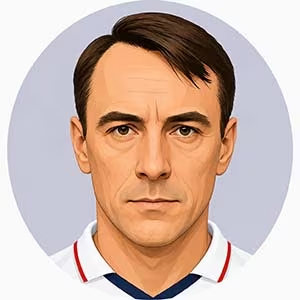
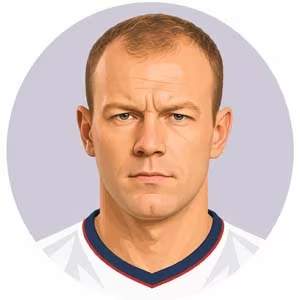
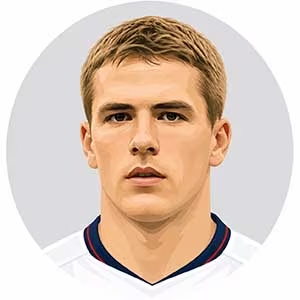
England - StrikerOwen, Michael
Michael Owen was, for roughly four years starting at eighteen, arguably the most electrifying finisher in world football, and then spent the following decade being discussed primarily in terms of what injuries had taken from him — a trajectory so front-loaded that his career essentially split into two entirely different stories joined at the middle by a single serious hamstring problem.
Born in Chester in 1979, Owen made his Liverpool debut at seventeen and became a phenomenon almost immediately, built around a combination of explosive acceleration, clinical composure in one-on-one situations with goalkeepers, and a predator's instinct for the exact moment a defensive line would break. He was not physically imposing and relied almost entirely on speed and anticipation rather than strength or aerial ability, a profile that made him devastating against high defensive lines and considerably less effective once his pace began to decline. His breakthrough goal against Argentina at the 1998 World Cup, a driving run from the halfway line finished with characteristic composure, made him a national sensation at eighteen, and he followed it by winning the 2001 Ballon d'Or, still the most recent English winner of the award, in a season where he scored the winning goals in the FA Cup and UEFA Cup finals for Liverpool. He scored 158 goals in 297 appearances for Liverpool, moved to Real Madrid in 2004 for a season of largely substitute appearances, then to Newcastle United, where a series of severe injuries, including a ruptured anterior cruciate ligament suffered playing for England at the 2006 World Cup, fundamentally altered the remainder of his career. He later played for Manchester United and Stoke City in reduced, more peripheral roles. For England he scored 40 goals in 89 caps, held the national scoring record for years, and played at three World Cups, though the version of him that appeared at 2006 was already physically compromised relative to his peak.
His limitations, in the specific and unusual sense that defines his career, were almost entirely medical rather than technical or temperamental. Owen's game depended completely on a level of explosive speed that serious recurring injuries, particularly to his hamstrings and knees, could not sustain past his mid-twenties, and once that speed diminished, so did almost everything that had made him exceptional — he had built comparatively little of his game around technique, physicality or aerial ability that might have compensated for the loss. His decision to continue playing for England at the 2006 World Cup while carrying an existing knee problem, resulting in the ACL rupture that many consider the single most damaging injury of his career, drew criticism in retrospect for a federation and player both perhaps too eager to have him available.
Temperamentally he was notably controlled, private and unusually businesslike for a player who became a national icon before he had turned nineteen. Owen rarely displayed dramatic emotion on the pitch, celebrating goals with brief, restrained gestures rather than exuberant displays, and gave interviews that were consistently measured and cautious rather than revealing, a media discipline that some read as professionalism and others as detachment. He accepted his declining role at later clubs with more equanimity than the scale of his fall from the sport's peak might have predicted, rarely engaging in public complaint about reduced playing time even when his contribution had become clearly peripheral. He maintained a significant, well-documented interest in horse racing and breeding throughout his career and increasingly after it, a genuine second passion that appeared to provide him an identity independent of football in a way relatively few of his contemporaries cultivated. He was not associated with disciplinary trouble, public conflict with managers, or the kind of institutional friction that defined some contemporaries navigating similarly steep declines, and his transition into broadcasting after retirement continued the same measured, unemotional public persona that had characterized his playing days. Composed, private and defined by a career whose trajectory was set almost entirely by physical circumstance rather than temperament, Owen's story remains one of English football's clearest illustrations of how much an athlete's identity can depend on a single physical attribute, and how completely its loss can reshape everything that follows.


 All Time LiverpoolClub