We use Google Analytics to understand how visitors use this site. Analytics cookies are only activated with your consent. For details, read our Privacy Policy.
Profile lensThe same player, read from a different angle.
Athletic75
Acceleration
65
Pace
71
Agility
64
Strength
87
Balance
66
Jumping
82
Stamina
80
Fitness
81
Technical76
Dribbling
67
Short Passing
75
Long Passing
74
Finishing
64
Shot Accuracy
62
Shot Power
76
Shooting Technique
64
Heading
82
Tackling
90
Crossing
69
Free Kick
62
Penalties
60
First Touch
72
Mental82
Composure
83
Aggression
85
Consistency
83
Creativity
64
Leadership
84
Work Rate
82
Tactical81
Vision
70
Off the Ball
64
Defensive Positioning
87
Teamwork
82
Anticipation
84
Marking
85
Attacking68
Crossing
69
Finishing
64
Heading Accuracy
82
Shot Accuracy
62
Off the Ball
64
Technique69
Dribbling
67
Free Kick
62
Short Passing
75
Long Passing
74
First Touch
72
Shot Technique
64
Movement67
Acceleration
65
Pace
71
Agility
64
Balance
66
Physicality81
Shot Power
76
Jumping
82
Stamina
80
Strength
87
Fitness
81
Defending87
Marking
85
Tackling
90
Def. Positioning
87
Mentality & Game Reading78
Aggression
85
Composure
83
Penalties
60
Vision
70
Leadership
84
Work Rate
82
Teamwork
82
Anticipation
84
Consistency
83
Creativity
64
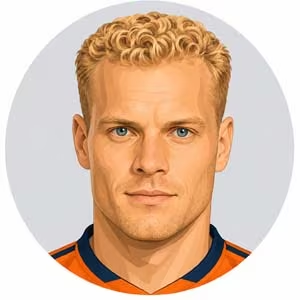
Germany - Centre-backMertesacker, Per
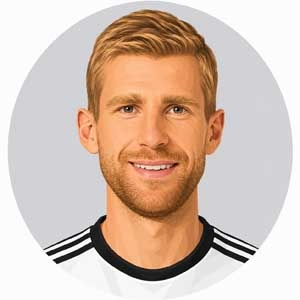
Per Mertesacker built an eighteen-year career on a single, unglamorous premise: that positioning and anticipation could substitute entirely for the acceleration he did not have. At 1.98m he was commanding in the air and physically imposing, but his defining quality was reading danger before it developed, cutting off passing lanes and covering space through early decision-making rather than recovery speed — a defender who won duels by not needing to run into them. He emerged at Hannover 96, moved to Werder Bremen in 2006, where he won the DFB-Pokal, and joined Arsenal in 2011, becoming club captain and playing over 200 matches across seven seasons, winning three FA Cups in his final years at the club. For Germany he collected 104 caps, captained the side at the 2014 World Cup, and lifted the trophy in Rio in what amounted to a farewell tournament for the country's golden generation.
His limitation was singular, well known to every opponent in Europe, and never solved. Mertesacker's lack of pace was a constant, exploitable weakness against quick forwards running in behind, and it became a running joke in English football specifically, with pundits and rival fans mocking his speed publicly for years — mockery he absorbed without significant public retaliation. He depended entirely on positioning discipline and on a well-organized structure around him; in matches that broke down into transition or when his defensive line was disorganized, the single asset that made him effective disappeared, and there was no physical recovery mechanism to fall back on. Coaches who used him in a high defensive line without adequate cover exposed him directly.
Temperamentally he was calm, self-deprecating about his own limitations, and unusually reflective for a professional footballer, qualities that became fully visible only after his retirement. Mertesacker led by organization and communication rather than confrontation, directing his defensive line verbally and consistently rather than through intimidation, and he was widely respected inside both the Arsenal and Germany dressing rooms as a stabilizing, articulate presence — Arsène Wenger specifically credited his calm leadership with settling a defence that had previously lacked one. He rarely lost his composure with referees or opponents, maintained a clean disciplinary record across nearly two decades of top-level football, and accepted criticism of his physical limitations with a self-awareness rare among elite athletes, frequently joking about his own lack of speed in interviews rather than defending against it. After retiring in 2018, he spoke candidly and publicly about the sustained psychological weight professional football had placed on him throughout his career, an admission that generated significant discussion in German football and was widely credited with opening space for other players to discuss similar pressures. Away from the pitch he pursued further education in sports management and remained closely involved with Arsenal's academy, applying the same reflective, organizational instincts to developing young players. Slow, self-aware and quietly commanding, Mertesacker built one of the most positionally intelligent careers in modern defending on the simple refusal to let one obvious limitation define him.