We use Google Analytics to understand how visitors use this site. Analytics cookies are only activated with your consent. For details, read our Privacy Policy.
Profile lensThe same player, read from a different angle.
Athletic77
Acceleration
73
Pace
68
Agility
74
Strength
81
Balance
83
Jumping
82
Stamina
66
Fitness
85
Technical47
Dribbling
50
Short Passing
60
Long Passing
64
Shot Accuracy
44
Shot Power
82
Shooting Technique
44
Heading
60
Free Kick
47
Penalties
47
First Touch
63
Mental78
Composure
78
Consistency
80
Leadership
70
Goalkeeping87
Reflexes
89
Positioning
89
Handling
87
Kicking
83
Goalkeeping87
Reflexes
89
Positioning
89
Handling
87
Kicking
83
Attacking52
Heading Accuracy
60
Shot Accuracy
44
Technique55
Dribbling
50
Free Kick
47
Short Passing
60
Long Passing
64
First Touch
63
Shot Technique
44
Physicality79
Shot Power
82
Jumping
82
Stamina
66
Strength
81
Fitness
85
Movement75
Acceleration
73
Pace
68
Agility
74
Balance
83
Mentality & Game Reading69
Composure
78
Penalties
47
Leadership
70
Consistency
80
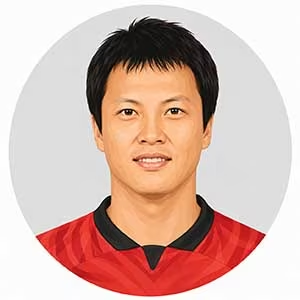
South Korea - GoalkeeperLee, Woon-jae
In Gwangju on 22 June 2002, South Korea and Spain reached a World Cup quarter-final penalty shoot-out after 120 scoreless minutes. Lee Woon-jae had spent the match dealing with a Spanish attack that repeatedly moved the ball into crossing and finishing positions, yet the decisive moment demanded a different kind of goalkeeping. When Joaquín stepped forward for Spain’s fourth penalty, Lee waited, moved to his right and saved. Hong Myung-bo then converted, sending South Korea into the semi-finals. Lee later explained that the situation had not felt chaotic to him. He had participated in seven shoot-outs since 1998 without losing one and entered the sequence expecting that, if he remained patient, an opponent would eventually give him the opportunity he needed. Years later he described his method even more explicitly: the goalkeeper should not allow the mind to move before the kick, should wait rather than predetermine the action and should resist being psychologically pulled by the taker. That distinction matters. His strength in shoot-outs was not emotional emptiness but deliberate inhibition of premature reaction.
Lee was a compact, powerful goalkeeper whose game depended more on positioning, reactions and reading than on exceptional reach. At roughly 1.82 metres he was not physically enormous for the position, so he compensated through set position, lower-body strength and quick response around the goal line. His best work came in situations where the attacker had apparently gained an advantage but still had to beat him at close or medium range. He could remain upright late, narrow the target and force the opponent to commit first, qualities that naturally transferred into penalties. South Korea’s 2002 run established him internationally, but his career was far larger than that tournament: he eventually reached 132 senior caps, represented the country across four World Cup squads and spent the core of his club career with Suwon Samsung Bluewings. With Suwon he won four league titles and major domestic and continental honours, then in 2008 became the first goalkeeper ever voted K-League MVP, starting 39 matches and conceding only 29 goals during the season. His distribution was functional rather than transformative; his identity rested primarily on denying shots, controlling immediate danger and remaining usable when the match narrowed into isolated decisive actions.
The limitations were equally specific. Lee’s lack of elite height reduced the margin available on high deliveries and shots placed beyond his natural reach; he could compensate through anticipation but could not manufacture additional wingspan. His style was also less suited to teams demanding a goalkeeper to become a primary progression mechanism far outside the penalty area. He was not a natural sweeper-playmaker whose distribution could reorganise possession by itself. More importantly, the calm visible in decisive match situations must not be projected into every behavioural domain. During the 2007 Asian Cup he was involved in a serious breach of team discipline, leaving the hotel during the tournament and receiving a one-year national-team suspension, a three-year ban from KFA-organised competitions and community service; Korean reporting identified him as the principal instigator among the four players punished. The incident belongs to discipline and judgement, not goalkeeping performance under acute pressure. Conflating the two would produce exactly the wrong profile. His subsequent football also resists any simple collapse narrative: after the suspension he returned to Suwon and produced the 2008 season that made him the league’s first goalkeeper MVP.
Psychologically, Lee is best defined by **procedural composure rather than global self-control**. He described shoot-outs as exercises in waiting, mind control and refusing to let the opponent dictate the goalkeeper’s first movement. That is unusually direct evidence of an internal competitive process: pressure was managed by simplifying the task into a rule—hold position, do not commit psychologically before the action, allow the kicker to reveal information. His response to public failure and punishment adds a second layer. When the 2007 disciplinary incident became public, Lee appeared with teammates, admitted wrongdoing and said there was no excuse; the apology was explicit rather than deflective. A year later, after winning the MVP award, he publicly connected the honour to having reflected on what had happened. This does not erase the original breach, nor does apology prove low impulsivity. It demonstrates post-error ownership and behavioural recovery. His retirement provides another revealing contradiction: Lee said he had cried privately for a week after deciding to stop playing but deliberately resisted crying publicly because he did not want the decision to appear regretted. Emotion therefore was not absent; expression was controlled according to context. Evidence is insufficient to assign distinctive referee hostility, retaliatory fouling or teammate-directed blame. The stronger signal is narrower: **in immediate competitive moments Lee could impose a mental procedure on himself, while outside that narrow domain his judgement was not uniformly controlled**. That separation is what makes the profile useful.


 All-Time AsiaAsia