We use Google Analytics to understand how visitors use this site. Analytics cookies are only activated with your consent. For details, read our Privacy Policy.
Profile lensThe same player, read from a different angle.
Athletic79
Acceleration
81
Pace
75
Agility
86
Strength
79
Balance
79
Jumping
86
Stamina
68
Fitness
77
Technical60
Dribbling
77
Short Passing
69
Long Passing
72
Shot Accuracy
62
Shot Power
83
Shooting Technique
60
Heading
55
Free Kick
81
Penalties
86
First Touch
75
Mental80
Composure
86
Consistency
73
Leadership
70
Goalkeeping88
Reflexes
92
Positioning
85
Handling
85
Kicking
90
Goalkeeping88
Reflexes
92
Positioning
85
Handling
85
Kicking
90
Attacking59
Heading Accuracy
55
Shot Accuracy
62
Technique72
Dribbling
77
Free Kick
81
Short Passing
69
Long Passing
72
First Touch
75
Shot Technique
60
Physicality79
Shot Power
83
Jumping
86
Stamina
68
Strength
79
Fitness
77
Movement80
Acceleration
81
Pace
75
Agility
86
Balance
79
Mentality & Game Reading79
Composure
86
Penalties
86
Leadership
70
Consistency
73
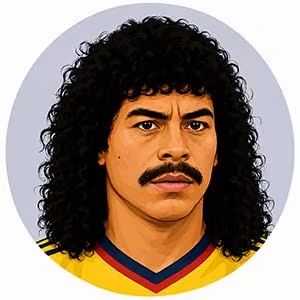
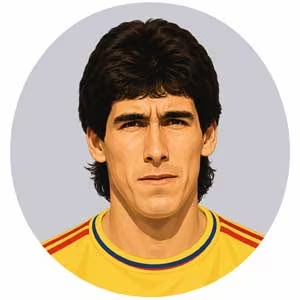
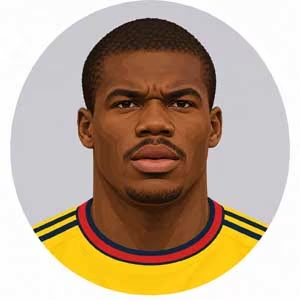
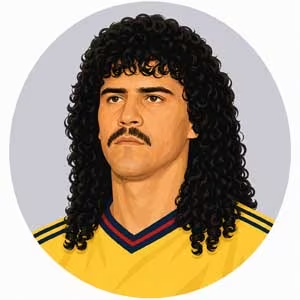
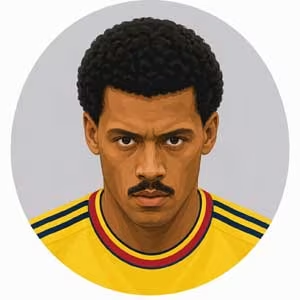
Colombia - GoalkeeperHiguita, René
Between the penalty box and the halfway line, no player ever blurred the boundaries between audacious tactical evolution and unhinged theatrical risk quite like José René Higuita Zapata. Developed at Millonarios before becoming the flamboyant totem of Francisco Maturana’s Atlético Nacional and the Colombian national team, El Loco turned the goalkeeping role into an extreme high-wire act. Standing five-foot-nine with spring-loaded calves and feline reflexes on his line, Higuita’s true tactical revolution was acting as an authentic outfield libero: straying thirty to forty yards from his goal to sweep behind a zonal back four, initiating passing sequences, executing short give-and-goes with center-backs, and scoring 43 career goals through pinpoint direct free-kicks and spot-kicks. He was the emotional heartbeat behind Atlético Nacional’s historic 1989 Copa Libertadores triumph—saving four penalties and scoring one himself in the final shootout against Olimpia—and immortalized his athletic audacity with the legendary "Scorpion Kick" against England at Wembley in 1995. However, this refusal to respect structural limits came at a massive cost: his lack of traditional reach left him vulnerable to aerial crosses and long-range lobs, while his reckless desire to dribble past opposing forwards led to catastrophic tournament blunders, most infamously when Roger Milla stripped him of possession 35 yards from goal to eliminate Colombia from the 1990 World Cup.
Driven by an irrepressible, street-level anti-establishment spirit, Higuita viewed football not as an exercise in risk mitigation, but as pure, defiant theater. He possessed an absolute psychological immunity to shame or external criticism; committing a disastrous giveaway that cost his team a match never altered his behavior for the following ninety minutes. This complete lack of inhibition made him a beloved folk hero across South America, but it also made him an unpredictable nightmare for conservative tacticians and a polarizing figure off the pitch, where his controversial association with Pablo Escobar and a subsequent 1993 imprisonment for mediating a kidnapping ransom cost him a place at USA '94. Inside the dressing room, he was a warm, intensely charismatic, and protective teammate whose magnetic personality lifted the spirits of younger players, though his erratic discipline frequently frustrated team administrators. When opposing strikers attempted to rattle him with physical contact on set pieces, Higuita responded with audacious technical stunts, audacious backheels, and direct verbal defiance. Referees found him impossible to contain within traditional protocols, while football history remembers him as a flawed, revolutionary icon who sacrificed defensive safety at the altar of pure, unapologetic spectacle.